



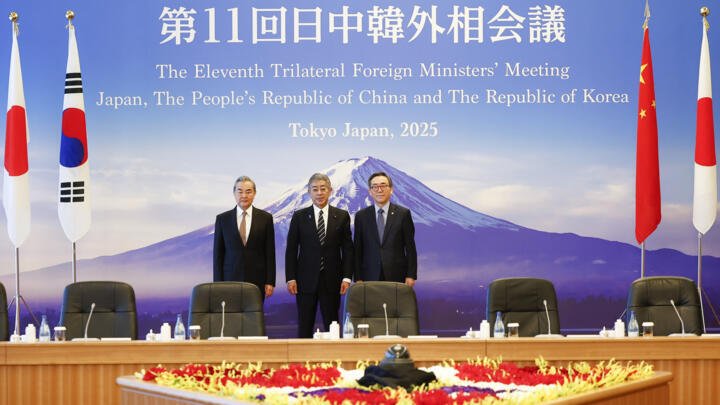
- Power Shift in Asia: South Korea China Japan dispute exposes cracks inside U.S. Indo-Pacific alliances
- Lee Jae-myung signals diplomatic neutrality despite pressure from Tokyo and Washington
- China’s influence grows as regional powers hedge between economics and security
- Taiwan flashpoint looms as Seoul prioritizes North Korea threat over confrontation with Beijing
South Korean President Lee Jae-myung’s decision to openly distance Seoul from the China–Japan rivalry has stunned policymakers across the region. Speaking to Japanese broadcaster NHK just 24 hours before meeting Prime Minister Sanae Takaichi, Lee said simply that “a dispute between China and Japan is not desirable for regional peace,” and that South Korea would “not meddle.”
Delivered on Japanese airwaves, on Japanese soil, ahead of a closely watched summit—this was no offhand diplomatic remark. It was a signal.
South Korean President Lee Jae-myung Seeks Chinese Mediation for Peace
For decades, the United States has treated Japan and South Korea as twin pillars of its Indo-Pacific architecture—mutually reinforcing, strategically aligned, and reliably positioned to balance China’s rise. Tokyo and Seoul together host close to 85,000 American troops, support U.S. naval operations in the Western Pacific, and anchor the forward presence that Washington sees as essential to protecting Taiwan and deterring Beijing.
Lee Jae-myung Xi Jinping Summit 2026: South Korea China Visit, Trade Deals, North Korea & Taiwan Tensions
But Lee’s words point to a changing reality: Asia’s middle powers are no longer willing to behave like passive participants in a U.S.-led containment game.
A Public Divergence Among U.S. Allies
To policymakers in Tokyo, Lee’s remark amounts to a diplomatic shock. Japan views China not merely as a competitor, but as a strategic adversary. Its 2024 National Security Strategy identifies Beijing as “the greatest strategic challenge” to Japanese sovereignty and regional order.
CHINA-JAPAN RELATIONS THREATEN JAPAN’S TOURISM FOR A LONG TIME
Japan is spending aggressively to reinforce that judgment:
- $43 billion in defense spending last year,
- a pledge to reach 2% of GDP by 2027,
- new long-range strike capabilities,
- and deepening interoperability with the U.S., Australia, and India.
By contrast, South Korea’s relationship with China remains intertwined and pragmatic. China still absorbs around 23% of Korean exports, roughly twice the American share. Beijing remains a crucial player in managing Pyongyang, whose nuclear arsenal remains Seoul’s top existential threat.
That economic dependence and security calculus explain why South Korea, even under conservative governments, has typically avoided rhetorical confrontation with Beijing. But Lee’s progressive foreign policy instincts, paired with his growing domestic mandate, have now pushed Seoul into overt diplomatic hedging.
Beijing Visit Sets the Stage
Lee’s recent visit to China—where he met President Xi Jinping and spoke explicitly about:
- North Korea diplomacy,
- trade stabilization,
- and a regional “peace architecture”—
is seen in Seoul as smart statecraft. But in Tokyo, it looked like a defection—an American ally stepping closer to China just as Beijing and Tokyo clash over everything from maritime patrols to technology controls.
The optics were striking. At a moment when Japan is expanding joint patrols around the Senkaku/Diaoyu Islands, pushing back against Chinese gray-zone tactics, and aligning its force posture with a Taiwan contingency, South Korea’s president appeared to be charting his own path.
Taiwan: The Strategic Pressure Point
The Taiwan issue is where Seoul’s neutrality becomes consequential.
Tokyo’s logic is clear:
If Taiwan falls, Japan is next.
Japanese ports, sea lanes, and aerospace corridors sit within minutes of Taiwan Strait battle space. Japanese war planners have built entire procurement cycles around this premise.
Washington shares the urgency.
In both the Biden and Trump eras, the United States has accelerated military basing, interoperability, and joint exercises designed to deter—if necessary, defeat—Chinese aggression.
South Korea, however, sees Taiwan differently. With North Korea just kilometers from Seoul, and a standing threat of artillery, nuclear brinkmanship, and missile barrages, South Korea’s first, second, and third priority is the Korean Peninsula. A Taiwan conflict could leave it dangerously exposed.
For Lee, neutrality is not weakness—it is strategic self-preservation.
A Regional Pattern: Hedging Over Alignment
Lee’s stance is emblematic of a broader trend: Asian states want options.
Across the region:
- The Philippines tilts back toward the U.S.—but signs energy deals with China.
- Vietnam joins U.S. semiconductor supply chains—while buying Russian arms.
- Indonesia refuses to choose sides altogether.
- India deepens the Quad—but does record trade with China.
South Korea’s shift fits the pattern.
A decade ago, Washington assumed its network of alliances would tighten as China advanced. Today, the opposite is happening: allies are hedging, calibrating, and carefully avoiding binary choices.
The U.S.–Japan Dilemma
What worries Washington and Tokyo is not one sentence from Lee—it is what that sentence reveals.
If South Korea refuses to align outright:
- Will it back Japan in a maritime showdown with China?
- Would it offer logistics or intelligence in a Taiwan crisis?
- Could a China–U.S. escalation fracture America’s Indo-Pacific coalition?
- Would North Korea exploit the distraction?
The uneasy truth is that the U.S. alliance system is strong militarily but fragile politically. It depends on convergence of interests, not treaty language. And interests are clearly drifting.
A Turning Point in Plain Sight
Lee Jae-myung said only a few sentences—but their implications are profound.
In a region defined by superpower rivalry, South Korea is signaling that it will not be a pawn, it will be a swing state—leveraging China’s economic clout, America’s military umbrella, and its own diplomatic agency.
For Tokyo, the message is sobering.
For Washington, it is a warning: alliances require alignment, not assumptions.
For Beijing, it is validation that quiet pressure pays dividends.
And for Asia as a whole, Lee’s comment reflects a new geopolitical reality—one where middle powers hold the balance, great powers must compete to court them, and neutrality may become the most powerful position of all.