



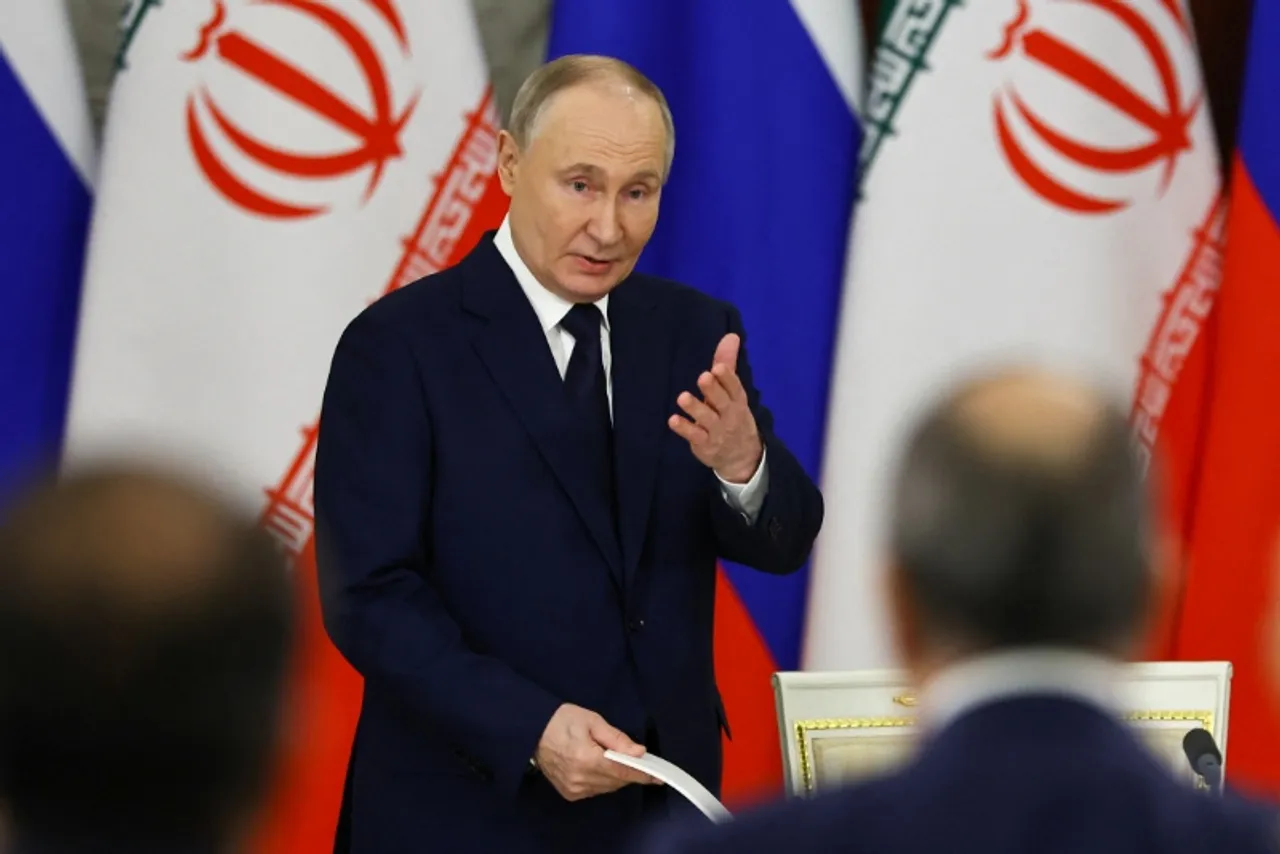
Russian President Vladimir Putin and the Kremlin have issued a clear diplomatic warning in the escalating standoff between the United States and Iran, saying there is still room for negotiation and cautioning that any U.S. use of force would have “dangerous consequences” and risk plunging the Middle East into widespread instability.
Kremlin spokesperson Dmitry Peskov, responding to U.S. President Donald Trump’s recent ultimatum for Iran to agree to a nuclear deal or face possible U.S. military action, emphasized that negotiations had not yet been exhausted and that restraint was imperative. “We continue to call on all parties to exercise restraint and renounce any use of force,” he told reporters, warning that military action against Tehran would destabilise the entire region’s security architecture.
U.S-Iran nuclear Talks: As Trump Calls for Nuclear Talks, the Middle East Holds Its Breath
Putin, speaking privately with UAE President Mohammed bin Zayed Al Nahyan in Moscow, signalled Moscow’s deep concern over the escalating tensions and indicated a desire to discuss Iran’s situation more broadly with key Arab partners.
Putin’s Statement in Context
Russia’s recent diplomatic posture ties into its longstanding strategy of positioning itself as a global powerbroker, particularly in the Middle East. Moscow and Tehran signed a 20-year strategic partnership treaty in January 2025, deepening political, military, and economic ties — though without a formal mutual defense clause.
Russia urges US-Iran talks, warns against chaos in Middle East
By advocating negotiation and warning against force, the Kremlin aims to balance its alliance with Iran against the risks of a broader regional war that could undermine its interests. Russia is wary that U.S. military action could bolster instability, fuel new refugee flows, increase energy market volatility, and draw in external powers, complicating Moscow’s own geopolitical calculations amid its protracted conflict in Ukraine.
Putin’s diplomatic messaging also reflects concerns among regional states wary of conflict spillover and economic disruption. The UAE and Saudi Arabia have both publicly stated they would not allow military operations against Iran to be launched from their soil or airspace — a critical factor that hampers U.S. strategic options.
U.S. Iran Strike Plans Face Stalemate as Gulf Nations Close Airspace
U.S. Preparedness and Military Positioning
President Trump has kept the military option on the table, warning that rejection of negotiations could lead to U.S. action “far worse” than previous strikes, underscoring a significant U.S. military buildup in the Gulf. A U.S. naval armada led by the USS Abraham Lincoln aircraft carrier strike group has been repositioned toward the region as part of a strategy to deter Iranian escalation and prepare for contingencies.
Washington’s military posture includes:
Carrier strike groups and guided-missile destroyers in nearby waters.
Multiple airbases across the Gulf — though access has been constrained by Gulf states’ refusal of their airspace for strikes on Iran.
Forward-deployed assets prepared for rapid strikes on Iranian nuclear or military targets if diplomatic channels collapse.
Despite the buildup, U.S. officials continue to stress they hope to avoid conflict. Secretary of State and Pentagon leadership have described the posture as deterrent and preparatory, reaffirming that force would be a last resort following failed diplomacy.
Iran’s Military Readiness and Response
In Tehran, hardliners and top officials have repeatedly rejected negotiations under threat, declaring that diplomacy cannot proceed in an “atmosphere of threats.” Iranian Foreign Minister Seyed Abbas Araghchi stated that Washington must abandon coercive tactics for dialogue to be meaningful.
Iran has indicated its armed forces are ready to respond “immediately and powerfully” to any attack, emphasizing preparedness across land, air, and sea domains. Top commanders have publicly warned neighbouring states against permitting their territory or airspace to be used against Iran or risk being treated as hostile.
Tehran’s Defense establishment has reportedly:
Strengthened air defense systems around strategic sites.
Bolstered missile forces capable of striking U.S. bases and Gulf infrastructure.
Warned that closure of key chokepoints like the Strait of Hormuz would be possible if the conflict escalates — a threat with major implications for global energy markets.
Regional Dynamics and Airspace Refusals
Key Gulf states including Saudi Arabia and the UAE have clearly signalled they will not allow U.S. military operations against Iran from their territory or airspace, complicating U.S. operational planning and compelling Washington to rely on longer, riskier flight paths and naval-based platforms.
These positions reflect a broader regional desire to avoid direct engagement with Tehran while prioritizing economic stability and avoiding escalation that could disrupt oil exports, inflame sectarian tensions, and fuel extremist recruitment.
Putin’s recent comments underscore Moscow’s bid to steer the crisis toward diplomacy and away from war, warning that any use of force could trigger a chaotic regional conflagration. With the U.S. military posture bolstered, Iranian forces prepared for confrontation, and key Gulf states seeking to limit escalation by restricting operational access, the region stands at a critical juncture where diplomacy, deterrence, and strategic calculations will determine whether conflict is averted or intensified.