


- Iran War escalates as Russia publicly backs Tehran, signaling political support amid U.S. pressure.
- Conflict spreads beyond the Gulf with missile strikes toward Diego Garcia and energy infrastructure attacks.
- Regional War threatens global energy markets due to attacks on Kharg Island and South Pars.
- Iran War faces sustainability questions as Tehran balances expansion with economic and military constraints.
The Iran war is entering a perilous new phase, shaped less by tactical battlefield developments than by the intricate calculus of global power. Russian President Vladimir Putin’s recent public affirmation of support for Tehran has injected political momentum into Iran’s war effort at a time when U.S. pressure is intensifying across multiple theaters.
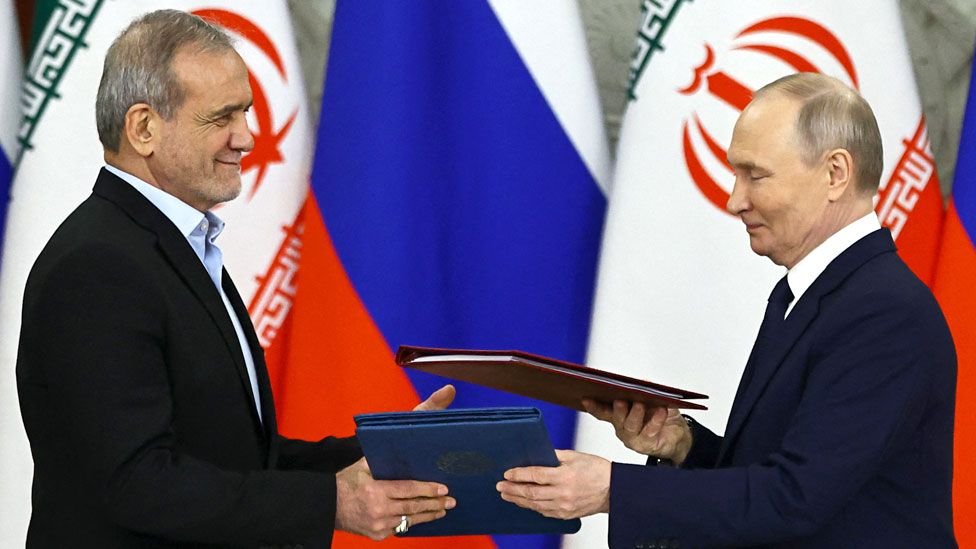
Delivered during Nowruz greetings to Iran’s Supreme Leader and President, Putin’s message framed Russia as a “loyal friend and reliable partner,” urging resilience as Tehran navigates “harsh trials.” The symbolism is unmistakable: Moscow is signaling that Iran is not isolated. Yet beneath the rhetoric lies a deliberately ambiguous strategic posture, one that may prove decisive in shaping Iran’s operational calculus.
Iran War: Strategic Signaling Without Strategic Commitment
Putin’s intervention comes as Iran confronts its most acute external threat since the 1979 Iranian Revolution. While Moscow offers political cover, the substance of that support remains limited. The Russia-Iran partnership lacks a mutual defense clause, and Russian officials have consistently expressed concern over Tehran’s nuclear ambitions, warning that a nuclear-armed Iran could trigger a regional arms race.
Moscow’s approach reflects a calibrated balancing act: it aims to maximize geopolitical influence, leverage Iran as a counterweight to Washington, and benefit from rising global oil prices, all while avoiding direct confrontation with the United States. Reports of proposed intelligence exchanges between Moscow and Washington—denied by the Kremlin—underscore the strategic tightrope Russia is walking.
Kharg Island: Washington’s Strategic Gamble
At the heart of U.S. planning is Kharg Island, Iran’s principal oil export hub, responsible for nearly 90% of its crude shipments. Earlier U.S. airstrikes targeted Iranian military sites on the island while deliberately sparing oil infrastructure. Current assessments suggest Washington is weighing more coercive measures—including a potential blockade or occupation—to compel Tehran to reopen the Strait of Hormuz.
Putin tells Tehran: Russia stands by Iran
Such a move would escalate the conflict from a tactical confrontation to an economic siege, threatening not only Iran’s fiscal capacity but also global energy stability. President Donald Trump has signaled a willingness to take unpredictable action, heightening uncertainty across the region. For Tehran, control of Kharg Island is existential: losing it could cripple its economy and compromise the war effort.
Iran Expands the Battlespace
Rather than consolidating defensively, Tehran has extended its operational footprint. Iranian forces launched ballistic missiles toward the joint U.S.-UK base at Diego Garcia, demonstrating reach and intent even if operational effectiveness was limited.
Kharg Island Occupation Could Trigger Endless War in the Strait of Hormuz
The war is no longer confined to the Persian Gulf or the Levant. Iran has simultaneously targeted regional energy infrastructure, including the South Pars gas field—one of the world’s largest—damaging approximately 12% of its production and prompting retaliatory strikes across Gulf states. The combined effect is a cascading energy crisis: oil prices have surged, shipping lanes remain under threat, and the Strait of Hormuz has emerged as a critical flashpoint.
Russia’s Calculated Interest
Moscow’s alignment with Tehran is both strategic and economic. Disruptions to Iranian exports have contributed to higher oil prices, generating windfall revenue for Russia amid sustained Western sanctions. At the same time, Russia’s measured engagement ensures influence without full entanglement, maintaining leverage in a rapidly evolving Middle East.
This nuanced support reflects Moscow’s broader strategy: provide sufficient backing to challenge U.S. regional dominance while avoiding direct confrontation, a posture that positions Russia as a strategic arbiter rather than a combatant.
Can Iran Sustain the Conflict?
The central question confronting policymakers is whether Iran can sustain an escalating, geographically diffuse conflict. Tehran has demonstrated operational resilience: a decentralized military structure, reliance on missile and drone capabilities, and a network of regional allies enable continued offensive operations. Its ability to threaten critical chokepoints, particularly the Strait of Hormuz, gives it disproportionate leverage over global energy markets.
Yet vulnerabilities are mounting. Repeated strikes on Kharg Island and South Pars are eroding economic capacity, while overextension in distant theaters—such as the Indian Ocean—risks provoking broader coalition responses. External support remains constrained; Russia provides political reassurance but limited material aid, and China has remained cautious.
A War at a Strategic Crossroads
Putin’s statement reinforces Tehran’s perception of strategic depth but cannot substitute for operational sustainability. As the United States considers further measures against Iran’s oil infrastructure and Iran continues to expand its operational reach, the conflict approaches a critical inflection point.
If Kharg Island becomes the next battleground, the consequences could extend far beyond the Middle East, disrupting global energy markets and reshaping strategic calculations for Washington, Moscow, and Beijing alike.
The million-dollar question remains: can Iran sustain this war? The answer will define not only Tehran’s fate but also the trajectory of a conflict with potentially global ramifications.