



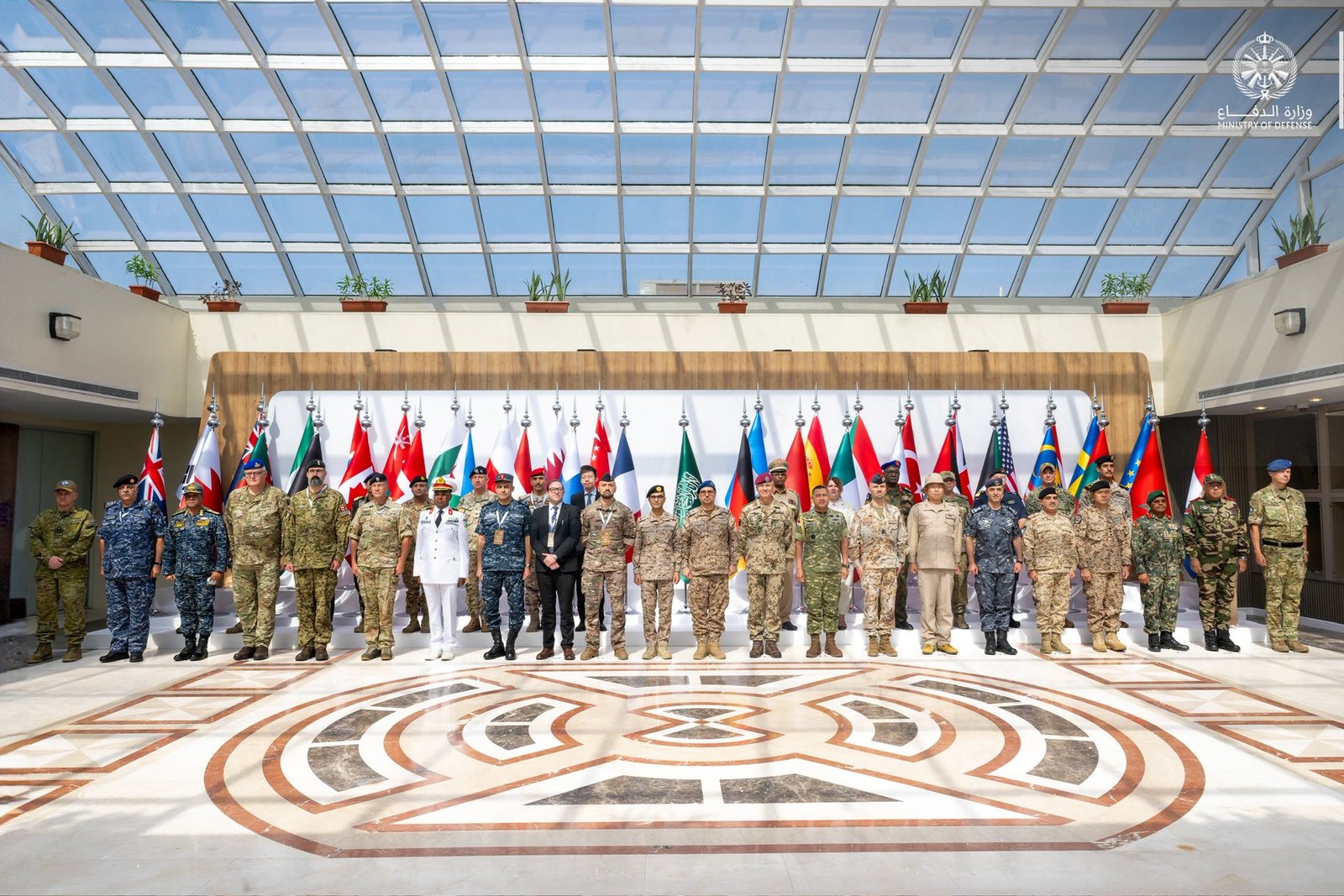
JEDDAH, August 15, 2026 — Saudi Arabia is moving to establish a new multinational maritime security architecture linking the Red Sea, Gulf of Aden and other strategic waterways, with representatives of 39 countries taking part in the coalition’s latest planning meeting and 13 countries formally completing their accession procedures.
The development marks a significant expansion of Riyadh’s efforts to build collective security mechanisms at a time when attacks on commercial shipping have transformed maritime security from a regional concern into a global geopolitical issue.
The Multinational Maritime Defense Coalition (MMDC) held its third planning meeting at the Western Fleet Command in Jeddah on August 13. Saudi authorities said 15 countries have signed the coalition’s joint statement, while 13 have completed their national procedures, signed the coalition charter and formally joined. The remaining participating countries are continuing their domestic approval procedures.
The coalition’s emergence comes directly against the backdrop of the Houthi attacks on commercial shipping in the Red Sea, which since late 2023 have repeatedly threatened one of the world’s most important maritime corridors.
But its significance now extends well beyond the Houthi threat.
The coalition is being developed as a collective mechanism to protect freedom of navigation, maritime straits, commercial shipping, energy routes and international trade, while sending a broader warning to any state or non-state actor seeking to use maritime disruption as an instrument of geopolitical pressure.
Makkah Defence Pact Signals Strategic Realignment in a Fragmenting Middle East
For Saudi Arabia, the initiative represents a shift from responding to individual maritime threats toward creating a permanent multinational structure capable of coordinating intelligence, command, surveillance and defensive operations.
Coalition Built on the Heels of the Makkah Defence Pact
The maritime coalition is also taking shape only days after Saudi Arabia, Türkiye and Pakistan signed the Makkah Joint Defence Agreement, creating a new trilateral security framework in the Muslim world.
Saudi Crown Prince and Prime Minister Mohammed bin Salman, Turkish President Recep Tayyip Erdogan and Pakistani Prime Minister Shehbaz Sharif signed the agreement in Makkah on August 7.
The pact provides for collective defence and establishes the principle that an armed attack against one member will be treated as an attack against all three, while also providing for deeper political, military and defence-industrial cooperation.
READ NEXT: A New Maritime Crisis Unfolds as Red Sea Blockade Deepens Global Trade Risks
Türkiye has subsequently said the three countries will establish political and military mechanisms to coordinate their security policies, including cooperation across land, sea, air and cyber domains. The agreement also envisages joint exercises, cooperation in unmanned systems, electronic warfare and artificial intelligence, and greater defence-industrial collaboration.
The timing of the maritime coalition is therefore strategically important.
Sources familiar with the developing security arrangements told The Islamabad Telegraph that some of the countries participating in the maritime coalition could join the Makkah Joint Defence Agreement in the near future. The sources said discussions about expanding the pact are part of a wider effort to create overlapping regional security mechanisms rather than a single military bloc.
The sources cautioned that no final timetable has been announced for additional accessions.
Türkiye has already indicated that the Makkah framework is open to expansion, while Egypt has been publicly discussed as one possible future participant.
The potential convergence of the two structures could give Saudi Arabia a considerably broader network of defence partnerships — one focused on collective defence among core members and another focused on maritime security involving a much larger group of states.
Saudi-led Maritime Coalition: Why the Red Sea Matters
The coalition is being formed against a maritime crisis whose economic consequences have reached far beyond the Middle East.
READ MORE: https://theislamabadtelegraph.com/global-maritime-chokepoint-crisis/
The Red Sea and Gulf of Aden provide the maritime connection between the Indian Ocean and the Mediterranean through the Bab el-Mandeb Strait and the Suez Canal. Any prolonged disruption forces commercial vessels to consider substantially longer routes around Africa.
The crisis intensified after the Houthis began attacking commercial shipping following the outbreak of the Gaza war. The International Maritime Organization has recorded 60 confirmed incidents since January 10, 2024, in addition to 17 incidents between November 2023 and January 9, 2024.
The IMO has repeatedly condemned the attacks and warned that they threaten freedom of navigation, seafarer safety and global trade. Its maritime safety committee said around 50 dangerous and destabilizing attacks had occurred since the November 2023 seizure of the Galaxy Leader.
The economic stakes are enormous.
UNCTAD has previously estimated that roughly 15 percent of global maritime trade by volume normally passes through the Suez Canal. When Red Sea attacks forced ships away from the route, vessels had to take the longer journey around the Cape of Good Hope, adding days to voyages and increasing fuel, insurance and freight costs.
The strategic vulnerability became even clearer in 2026 when disruptions in the Strait of Hormuz created another shock to global shipping and energy markets. UNCTAD warned in April that global merchandise trade growth could slow sharply in 2026 amid the wider disruption, while energy-market shocks were increasing inflationary pressures.
The lesson for regional governments was unmistakable: control of maritime chokepoints can translate into enormous geopolitical leverage.
From Red Sea Defence to Wider Maritime Security
The Saudi-led coalition is consequently broader than a conventional naval response to the Houthis.
The third planning meeting focused on transforming the coalition into an institutional and operational organization. Saudi Arabia will provide the coalition commander, while Pakistan is set to provide the deputy commander during the first term.
A headquarters has been designated and the coalition’s organizational, planning and reference frameworks are being finalized.
Member countries are also preparing to send officers and personnel into the coalition’s joint structures, including a Joint Command, Joint Operations and Coordination Center and Joint Maritime Intelligence Center. (Arab News)
That architecture is important because modern maritime security is no longer limited to warships escorting commercial vessels.
Threat detection increasingly depends on satellite surveillance, maritime domain awareness, intelligence-sharing, unmanned systems, electronic warfare, coastal radar and real-time information exchange.
The coalition’s intelligence center could therefore become as important as its naval assets.
A Message to Maritime Threat Actors
The political message is equally significant.
The coalition is being established at a moment when commercial shipping has become increasingly vulnerable to missiles, drones, mines, piracy, sabotage and attacks by armed groups operating from coastal territory.
Its formation effectively communicates that the Red Sea and surrounding waterways will not be treated as security vacuums.
Although the immediate catalyst is the Houthi campaign, the coalition’s stated objective is broader: protecting international navigation and trade routes.
That distinction matters.
It means the emerging framework can potentially respond to a range of maritime threats without being formally defined as an anti-Houthi military alliance.
Saudi Arabia and its partners can therefore present the coalition as a defensive maritime security partnership, consistent with international law and the principle of freedom of navigation.
That approach also gives countries with different foreign-policy relationships a greater opportunity to participate without being forced into a broader geopolitical confrontation.
Saudi Arabia’s Emerging Security Architecture
The maritime coalition and the Makkah defence pact should therefore be viewed as two connected but distinct layers of a rapidly developing regional security architecture.
The Makkah agreement provides a smaller core of strategic defence cooperation among Saudi Arabia, Türkiye and Pakistan.
The maritime coalition provides a much wider platform for countries seeking to protect shipping and international trade.
If countries participating in the maritime coalition subsequently enter the Makkah framework, the two arrangements could begin to overlap, creating a broader network of military cooperation centered on Saudi Arabia.
That would represent a significant development in the Middle East and wider Muslim world, particularly at a time when regional states are increasingly seeking greater responsibility for their own security.
It would also reflect a broader trend: regional powers are no longer willing to depend exclusively on external naval powers to protect the commercial arteries on which their economies depend.
The Next Test: Operational Readiness
The coalition now faces its most important test — turning political participation into operational capability.
The presence of 39 countries at the planning stage is significant, but the effectiveness of the organization will ultimately depend on how many countries provide ships, aircraft, intelligence assets, personnel, surveillance capabilities and logistical support.
The formal accession of 13 countries is an important first step.
The integration of their officers into joint command and intelligence structures will be the next.
For Saudi Arabia, the strategic objective is clear: establish a multinational maritime security mechanism capable of keeping vital waterways open even when regional conflicts threaten to spill into international shipping lanes.
For Pakistan, its designation as deputy commander during the coalition’s first term gives Islamabad a potentially influential role in a new security structure spanning the Red Sea and adjacent maritime corridors.
For Türkiye, participation connects its growing defence cooperation with Saudi Arabia and Pakistan to a wider regional maritime-security framework.
And for the countries considering membership, the attraction is straightforward: collective protection of sea lanes that underpin energy supplies, food imports, manufacturing and global commerce.
The coalition is therefore more than another naval grouping.
It is an emerging attempt to build a regional maritime security architecture after years in which attacks on shipping demonstrated how quickly a local conflict can become a global economic problem.
The Houthi attacks exposed the vulnerability.
The Makkah defence pact created a new core of strategic cooperation.
The 39-country maritime coalition is now building the wider security network.
If additional states eventually join the Makkah agreement, as sources familiar with the discussions suggest could happen, Saudi Arabia may find itself at the center of one of the most consequential new defence architectures to emerge across the Middle East and the wider Muslim world in years.