


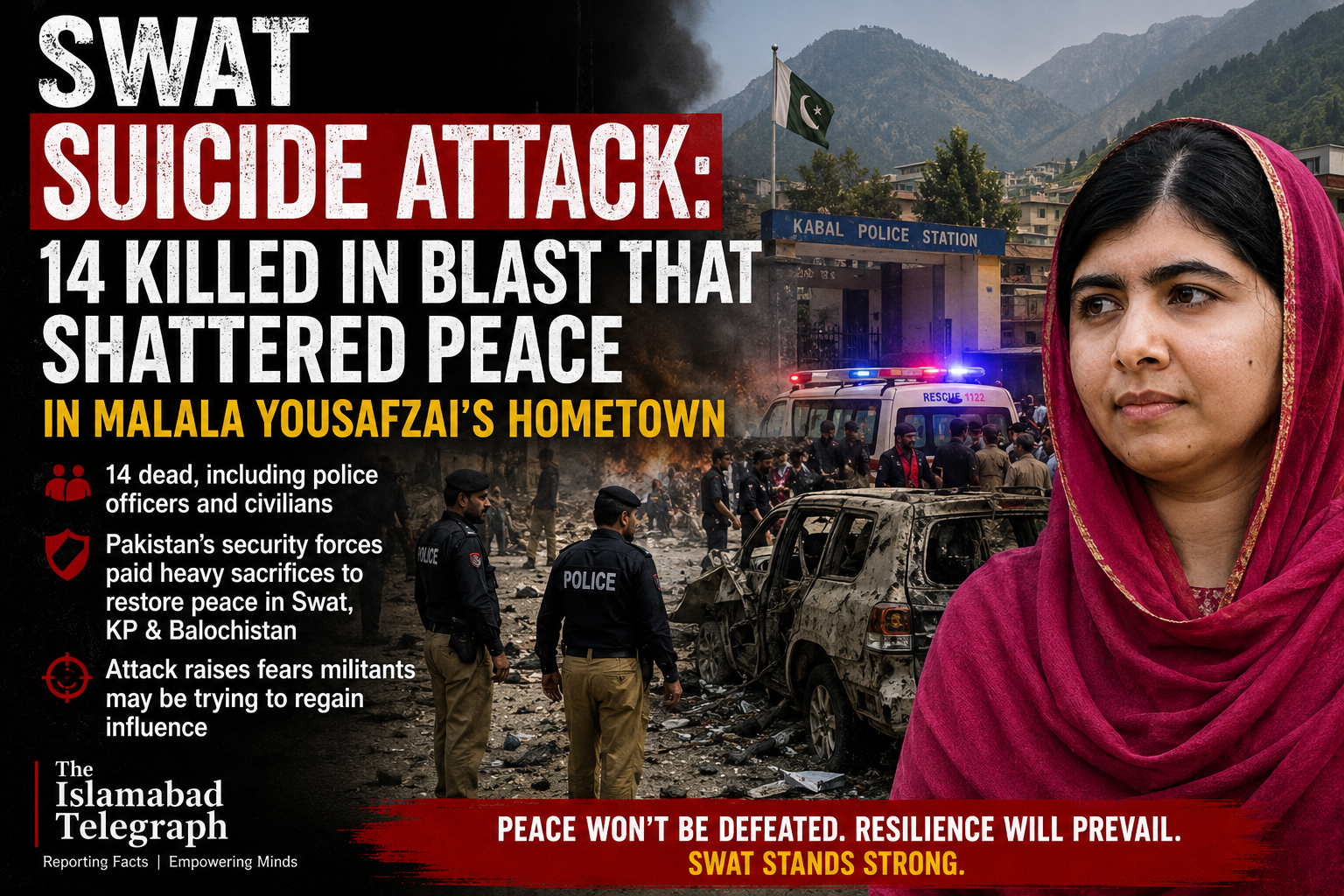
- Swat suicide attack kills 14, targeting peace rally near Kabal police station
- Pakistan’s security forces restored peace after years of sacrifices across Swat, KP and Balochistan
- Latest attack raises fears militants may be attempting to regain influence
Swat, Pakistan — The Swat suicide attack on Sunday has sent shockwaves across Pakistan and beyond, shattering the fragile calm in a valley long regarded as a symbol of resilience against extremism. The Swat suicide attack, one of the deadliest in recent years, underscores renewed concerns that militant groups may be attempting to regain their foothold in the region.
At least 14 people, including police officers and civilians, were killed and 15 others injured when a suspected bomber detonated explosives outside Kabal police station shortly after a peace rally concluded. The Swat suicide attack targeted participants of the Swat People’s Peace Uprising, a grassroots movement led by local residents demanding lasting stability.
The valley holds profound global significance as the hometown of Malala Yousafzai, the Nobel Peace Prize laureate who survived a Taliban assassination attempt as a teenager and became a universal symbol of courage against militancy. The Swat suicide attack has revived painful memories of a time when the region was under militant control, and voices advocating education and peace were violently silenced.
READ NEXT: US General Dropped Bombshell! US Can Not Protect Israel From Iran’s Missiles
Officials confirmed that the explosion occurred as people were dispersing from the rally, suggesting a deliberate attempt to target both civilians and law enforcement personnel. “Fourteen people, including police personnel and civilians, have been confirmed dead, while 15 injured are under treatment,” said Bilal Ahmed Faizi, spokesperson for KP Rescue 1122.
Ayesha Nasir, Assistant Commissioner of Kabal, stated that although the rally was organized by civilians, the likely target of the Swat suicide attack was the police presence at the station. Investigators later recovered the head of the suspected bomber, confirming the nature of the Swat suicide attack.
The latest Swat suicide attack comes despite years of sustained counterterrorism operations by Pakistan’s security forces, which have paid immense sacrifices to restore peace across the country. From Swat to Khyber Pakhtunkhwa’s tribal districts and the volatile province of Balochistan, thousands of soldiers and law enforcement personnel have laid down their lives to dismantle militant networks and secure civilian populations.
READ MORE: Suicide bomber strikes antimilitant rally in northwestern Pakistan, killing at least 14
These efforts transformed Swat from a conflict zone into a relatively stable region, reopening schools, reviving tourism, and restoring economic activity. The Swat suicide attack, however, highlights the persistent threat posed by extremist elements seeking to exploit vulnerabilities and reassert influence.
Swat was once the epicenter of the Tehreek-e-Taliban Pakistan (TTP) insurgency, where militants imposed a brutal regime before being driven out by decisive military operations. The valley’s recovery has often been cited internationally as a case study in successful counterinsurgency and stabilization. The Swat suicide attack now challenges that narrative, raising fears that militant remnants or new factions may be regrouping.
Security forces responded swiftly to the Swat suicide attack, cordoning off the area and launching an investigation. Ambulances transported the wounded to hospitals in Saidu Sharif and Mingora, while forensic teams began collecting evidence. No group has claimed responsibility so far, but suspicion is likely to fall on TTP-linked networks that have intensified attacks in Khyber Pakhtunkhwa in recent months.
Khyber Pakhtunkhwa Chief Minister Muhammad Sohail Afridi condemned the Swat suicide attack and directed authorities to submit a detailed report. “I extend heartfelt condolences to the families of the police personnel and civilians martyred in the explosion,” he said, adding that the government would ensure the best possible treatment for the injured.
For international observers, the Swat suicide attack is a stark reminder that while Pakistan has made significant gains in counterterrorism, the threat has not been fully eliminated. Analysts note that militant groups often attempt to stage high-profile attacks to signal their continued relevance and undermine public confidence.
Despite the tragedy, Pakistan’s security forces continue to be widely recognized for their role in restoring stability under extraordinarily challenging conditions. Their operations across Swat, Khyber Pakhtunkhwa, and Balochistan have not only dismantled organized militant strongholds but also enabled millions of civilians to return to normal life.
The resilience of local communities has also been crucial. The very existence of the peace rally targeted in the Swat suicide attack reflects a strong public rejection of militancy. Residents have repeatedly demonstrated their commitment to peace, often at great personal risk.
Yet, the Swat suicide attack reveals that the battle is far from over. Militants appear intent on exploiting any opportunity to destabilize regions that have only recently emerged from conflict. Experts warn that sustained vigilance, intelligence-based operations, and community engagement will be critical in preventing a resurgence.
For global audiences, Swat represents more than a geographic location—it is a symbol of the struggle between extremism and resilience. The Swat suicide attack is not just an isolated act of violence; it is part of a broader contest over the future of a region that has already paid a heavy price.
As Pakistan mourns the victims of the Swat suicide attack, the resolve of its people and security forces remains central to ensuring that such tragedies do not reverse years of hard-earned progress. The message emerging from Swat is clear: while militants may attempt to return, the forces of stability—backed by sacrifice, unity, and determination—remain firmly in place.