



- “Gladiator in a Suit: How Ahmed al-Sharaa Emerged as Syria’s Messiah”
- “Ahmed al-Sharaa’s Grand Entry: Syria Steps Into Its Post-Assad Future”
- “From Rebel Fighter to People’s Messiah: Sharaa Leads Syria’s Rebirth”
- “The Man Who Toppled Assad: Sharaa’s Historic Parliament Entry”
- “Ahmed al-Sharaa Rises: A New Dawn for Syria’s Parliament”
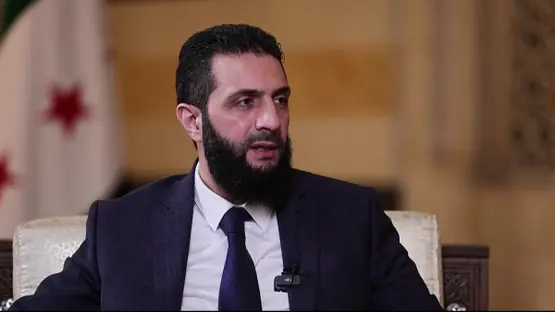
He entered like a gladiator stepping into an arena—not with a sword in hand, but with a tailored suit hugging his broad shoulders, a silk tie gleaming under the chandeliers, and English boots polished to perfection. Each step echoed against the marble floor of Syria’s parliament as lawmakers rose to greet him. It was not just respect; it was awe.
Ahmed al-Sharaa, the man who had fought through trenches, dusty alleyways, and prison cells to topple Bashar al-Assad, had arrived to oversee Syria’s first parliamentary vote in the post-Assad era. In that moment, the chamber was transformed into something larger than politics: a theater of rebirth, where the new Syria unveiled itself under the watchful gaze of a leader whom many had already begun to call the people’s messiah.
From the Battlefield to the Parliament Hall
Sharaa’s rise has been the stuff of legend. A decade ago, he was a rebel fighter with little more than a rifle on his shoulder and conviction in his heart. His comrades recall him as fearless, the man who would take the front line in battles and rally others when hope seemed lost. But unlike many fighters hardened into bitterness, Sharaa carried with him a vision that transcended war: a dream of a Syria not just liberated from dictatorship, but reborn as a nation of dignity, faith, and opportunity.
When Assad’s rule finally crumbled in December, it was Sharaa’s voice that rose above the rubble. He was not the most senior rebel commander, nor the wealthiest, but he was the one Syrians trusted—because he had bled with them, starved with them, and endured exile with them. That bond, forged in suffering, became his greatest weapon.
Now, standing in parliament draped not in fatigue and dust but in bespoke suits, he has mastered the art of transformation. His journey is not a betrayal of his past but its fulfillment. To his supporters, Sharaa’s polished image signals that Syria’s long war is ending, and its rebirth has begun.
The Charisma of a Messiah
Tall, lean, and sharply featured, Sharaa possesses a presence that silences rooms. His piercing eyes and carefully measured smile convey both authority and approachability. Ordinary Syrians describe him as someone who can disarm with warmth but command with fire.
READ MORE: Trump’s Gift to Syria: Sanctions Lifted, A Nation Reborn
“He has the aura of a prophet,” said Samira, a doctor in Hama. “When he speaks, he is not just addressing parliament—he is speaking to the wounded soul of Syria itself.”
Even his detractors admit he has what Assad never had: genuine charisma. Where Assad often seemed cold, detached, and imperious, Sharaa radiates energy, the kind that makes Syrians lean forward when he takes the podium. His speeches are laced with metaphors of light, rebuilding, and brotherhood. He rarely uses notes. His voice—steady, deep, and almost lyrical—carries the cadence of a man who has lived the pain he describes.
ALSO READ: Netanyahu Says Israel and Hamas Are on the Brink of a Hostage Deal
The fact that he has chosen Western attire over traditional military garb is itself a statement. To his admirers, the suits are symbols of civility, refinement, and an embrace of a new world where Syria belongs not as an isolated fortress but as a respected member of the international community.
A Parliament of Renewal
Sunday’s parliamentary vote was designed to select two-thirds of the 210-seat legislature. Nearly 6,000 electors filed into regional colleges, casting ballots in an atmosphere that felt more sacred ritual than bureaucratic duty.
In a country scarred by fourteen years of bloodshed, the very act of voting—even in a limited, indirect system—felt monumental. Streets across Damascus buzzed with anticipation. Radios blared updates in corner shops; families huddled around television sets; exiles abroad refreshed their phones compulsively.
For Sharaa, this was not about numbers. It was about proving that Syria, despite its brokenness, could build anew. That was why he entered parliament as if entering an arena: because every vote was a battle in the war for legitimacy.
Yes, nineteen seats remain empty—provinces where minorities hold sway and security is fragile. Critics see this as exclusion; Sharaa’s allies argue it is caution. “Better to leave a chair vacant than to fill it with chaos,” said Fawaz, a political aide close to the president. In Sharaa’s calculus, even an incomplete parliament is a step toward renewal.
The People’s Messiah
What sets Sharaa apart is not only what he has done, but what he represents. To millions of Syrians, he is a mirror of their own suffering and endurance.
He speaks of mothers who buried sons, of families torn apart, of the exile of millions. He does not distance himself from these tragedies; he claims them as his own. His time as a fighter—once seen as a liability because of his ties to radical militias—has been rebranded as testimony of sacrifice. “Who else among our leaders has tasted war the way we have?” asked Khaled, a taxi driver in Aleppo. “He carries our pain because he lived it.”
This is why the comparison to a messiah has taken hold. In mosques and marketplaces, people describe him as the leader sent to heal their fractured nation. His image in a suit, striding confidently into parliament, has already begun circulating on social media with captions like “The man who rose from the ashes.”
The Burden of Choices
But Sharaa knows symbolism alone is not enough. The future of this parliament will depend on the 70 lawmakers he appoints directly. Here lies his greatest test: will he choose diversity—women, minorities, technocrats—or will he fill the seats with loyalists who guarantee obedience?
His allies argue he must first consolidate power before experimenting with openness. His critics warn that repeating Assad’s mistakes will doom Syria to another cycle of autocracy. Sharaa himself has remained enigmatic, promising both inclusivity and stability without revealing how he will balance the two.
Yet many Syrians believe in him precisely because of his unpredictability. “He has always surprised us,” said Rana, a university professor in Damascus. “No one thought he could topple Assad. No one thought he could unite the fighters. No one thought he would stand in a suit in parliament. And yet, he did.”
A Nation Watching
As night fell, results began trickling in. The names of new lawmakers were read aloud on state television. Applause broke out in parliament. In living rooms across the country, families clapped too. Even among skeptics, there was an acknowledgment: history had shifted.
“This is our first parliament without Assad,” said Hossam, a baker in Hama. “For that alone, Sharaa deserves respect.”
For exiles abroad, the moment was bittersweet. “We want to believe,” said Lina, a refugee in Lebanon. “We want to come home. If Sharaa is really the man they say he is, maybe we will.”
Gladiator Turned Statesman
As Sharaa adjusted his tie and lowered himself into the central chair of parliament, the symbolism was impossible to ignore. The boots that once trudged through the dust of battlefields now gleamed under the chandeliers of power.
He had entered like a gladiator, but he sat like a statesman. And for Syrians who had endured fourteen years of despair, that image alone was enough to rekindle hope.
Ahmed al-Sharaa, the messiah of the people, had arrived not to end their story—but to begin a new one.