



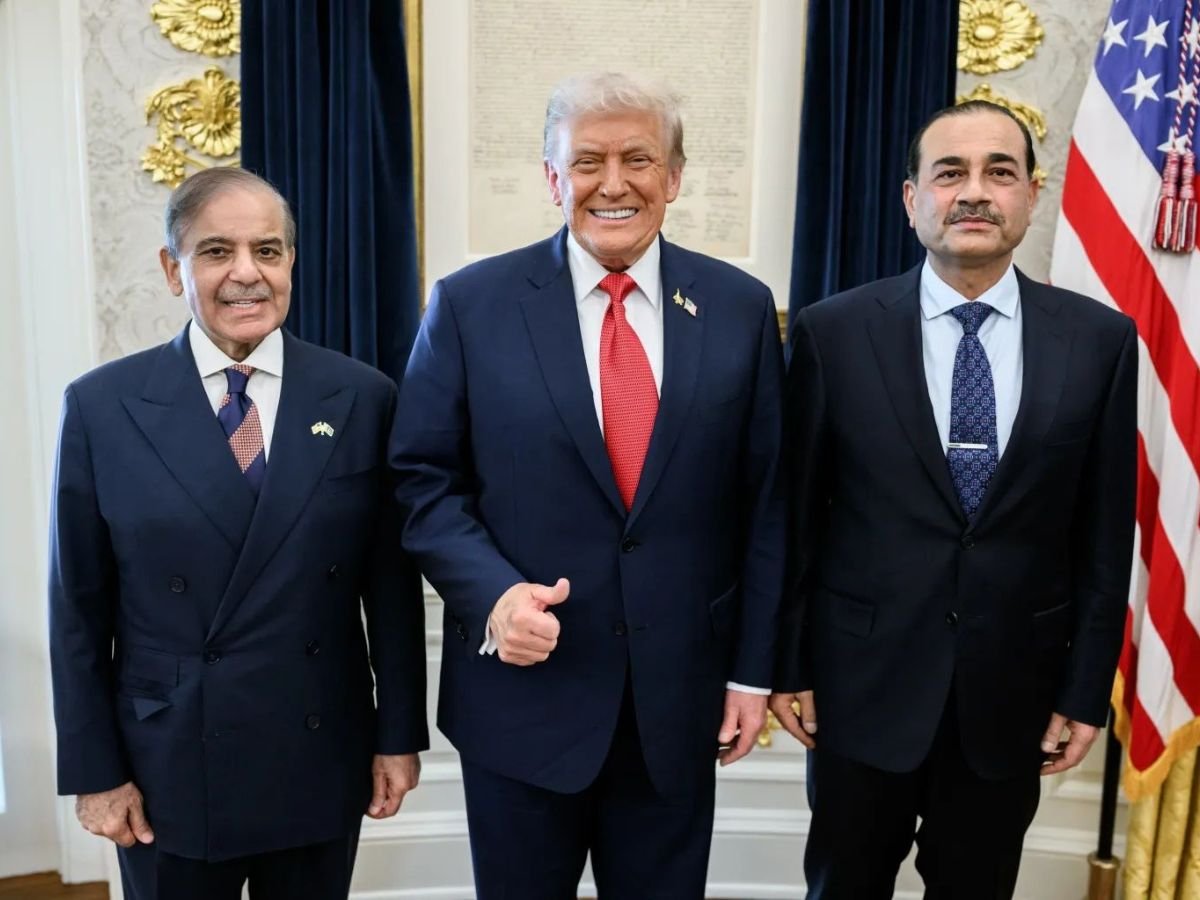
- Highlights the unique synergy between President Trump and Field Marshal Asim Munir built on discipline, delivery, and strategic clarity.
- Explains how Munir’s performance during the May Pakistan–India conflict confirmed his exceptional military leadership.
- Shows how Trump recognized Munir’s capabilities early, establishing a foundation for a stronger U.S.–Pakistan relationship.
- Analyzes how this partnership signals a major geopolitical reset with long-term implications for South Asian stability.
Trump–Asim Munir Strategic Partnership: In a world where alliances shift with the winds of politics, the rare partnership between U.S. President Donald Trump and Pakistan’s Field Marshal Asim Munir stands out as something far deeper than diplomatic coincidence. It is a synergy built on mutual recognition—Trump seeing in Munir a leader of rare discipline and capability, and Munir finding in Trump a partner who values strength, delivery, and unflinching commitment. Their symmetry is striking, and their convergence signals a momentous opportunity for U.S.–Pakistan relations to reach unprecedented heights.
Only a year ago, the notion that Pakistan could transform its standing in Washington seemed unthinkable. Yet under Field Marshal Asim Munir, the country has navigated Trump’s second term with remarkable finesse. Trump’s warmth toward Munir—whom he has boldly described as “my favorite field marshal,” “a great, great guy,” and “an inspiring personality”—reflects more than flattery. It reflects Trump’s admiration for a man whose leadership qualities he recognized long before the world witnessed them in full force.
After Triumph Over India, Asim Munir Redefines Pakistan’s Power Doctrine
That moment of revelation came this May, during the limited war between Pakistan and India. While most capitals were stunned by the professionalism, precision and calm resolve of the Pakistan Armed Forces, one man wasn’t surprised—Donald Trump. For Trump had already sensed that Asim Munir was not just another military commander. He was a leader with a rare blend of strategic clarity, operational mastery, and the unbending ability to deliver exactly what he promises, exactly when it matters.
Analysts, foreign policy experts, and the most seasoned geopolitical minds have since echoed the same assessment: Asim Munir is a leader who understands timing, messaging, and action. And Trump, above all others, understood his capacity first.
READ MORE: A Razor’s Edge Between India and Pakistan
Pakistan’s diplomatic resurgence under Munir is no accident. It is the manifestation of a disciplined leader who has consolidated domestic power, pacified political turbulence, restored institutional authority, and projected a coherent foreign-policy vision. Munir’s firm grip over the armed forces—across air, land, and naval branches—was affirmed not only by his elevation to Field Marshal but also by constitutional reforms that place him at the center of Pakistan’s long-term defense strategy.
Unlike leaders who rely on rhetoric, Munir relies on delivery. This is precisely the quality that appeals most to Donald Trump, who himself entered the White House for a second term promising efficiency, results, and clarity in foreign relations. Trump and Munir speak the same political language: strength.
ALSO READ: Forged in Fire: Field Marshal Asim Munir Elevates Pakistan as the Global Guarantor of Security
The turning point in U.S.–Pakistan ties began in March when Pakistan handed over to the U.S. the alleged mastermind of the 2021 Abbey Gate bombing—a gesture that Trump immediately recognized as both a strategic win and a historic moment of cooperation. It allowed Trump to contrast his own leadership with the chaos of the previous administration’s withdrawal from Afghanistan, and it showed him that Asim Munir was a man who honored his commitments.
From that moment, the reset accelerated.
The Kashmir crisis of April and May further cemented this partnership. When India blamed Pakistan for attacks and triggered a brief but explosive conflict, Trump’s rapid engagement, coupled with Munir’s disciplined military response, showcased how coordination between Washington and Rawalpindi had quietly matured. India may have been unsettled by Trump’s bold announcement of the cease-fire before Modi could address his own nation. But for Pakistan, it was a confirmation that Trump took Munir’s assurances seriously.
And why wouldn’t he? Munir’s forces likely downed multiple Indian jets on the first night—an achievement that analysts worldwide described as a demonstration of Pakistan’s restored military confidence. For Trump, this only validated what he had long believed: that Asim Munir possessed the discipline and strategic vision required to stabilize a region that often teeters on the edge of war.
The relationship has since expanded into trade, investment, resource diplomacy, and even ambitious cryptocurrency cooperation tied to Trump’s inner circle. Pakistan has presented itself as a resource-rich country ready for investment, and Trump—who admires bold economic messaging—found this narrative compelling. The minerals box presented by Munir and Prime Minister Shehbaz Sharif at the White House symbolized Pakistan’s intent to pursue a new chapter in bilateral commerce.
Critics may dismiss these overtures as theatrics, but in geopolitical terms, symbolism matters—and Trump responds to leaders who understand that.
Munir, for his part, has consolidated power at home with unmistakable confidence. With constitutional amendments granting him oversight across all branches of the armed forces and immunity comparable to the president, he is positioned to drive long-term stability and strategic continuity. For Trump, who values partners capable of ensuring order and decisiveness, this only strengthens their bond.
Pakistan’s relations with the U.S. may have historically wavered, but the Munir–Trump alignment represents something more durable: a partnership grounded in mutual respect for capability, delivery, and strategic clarity. It is not built on dependency but on recognition.
Trump sees in Munir a leader who can deliver. Munir sees in Trump a president who rewards results, not rhetoric.
And the world has noticed. Foreign-policy scholars say Munir has triggered a “geostrategic reset.” Diplomats praise Pakistan’s newfound coherence. Analysts point to the rare phenomenon of Trump nominating Pakistan for the Nobel Peace Prize.
The global landscape is shifting, but the Munir–Trump synergy offers a stabilizing axis in a region long defined by uncertainty.
It is time to acknowledge what this partnership truly represents: the beginning of a stronger, more confident era in U.S.–Pakistan relations.
One built on trust.
One built on delivery.
One built on the undeniable symmetry between two leaders who understand power—and how to use it.
The world may have been surprised by Asim Munir.
Trump was not.
And that, more than anything, explains why this new chapter between Washington and Islamabad is only just beginning.