



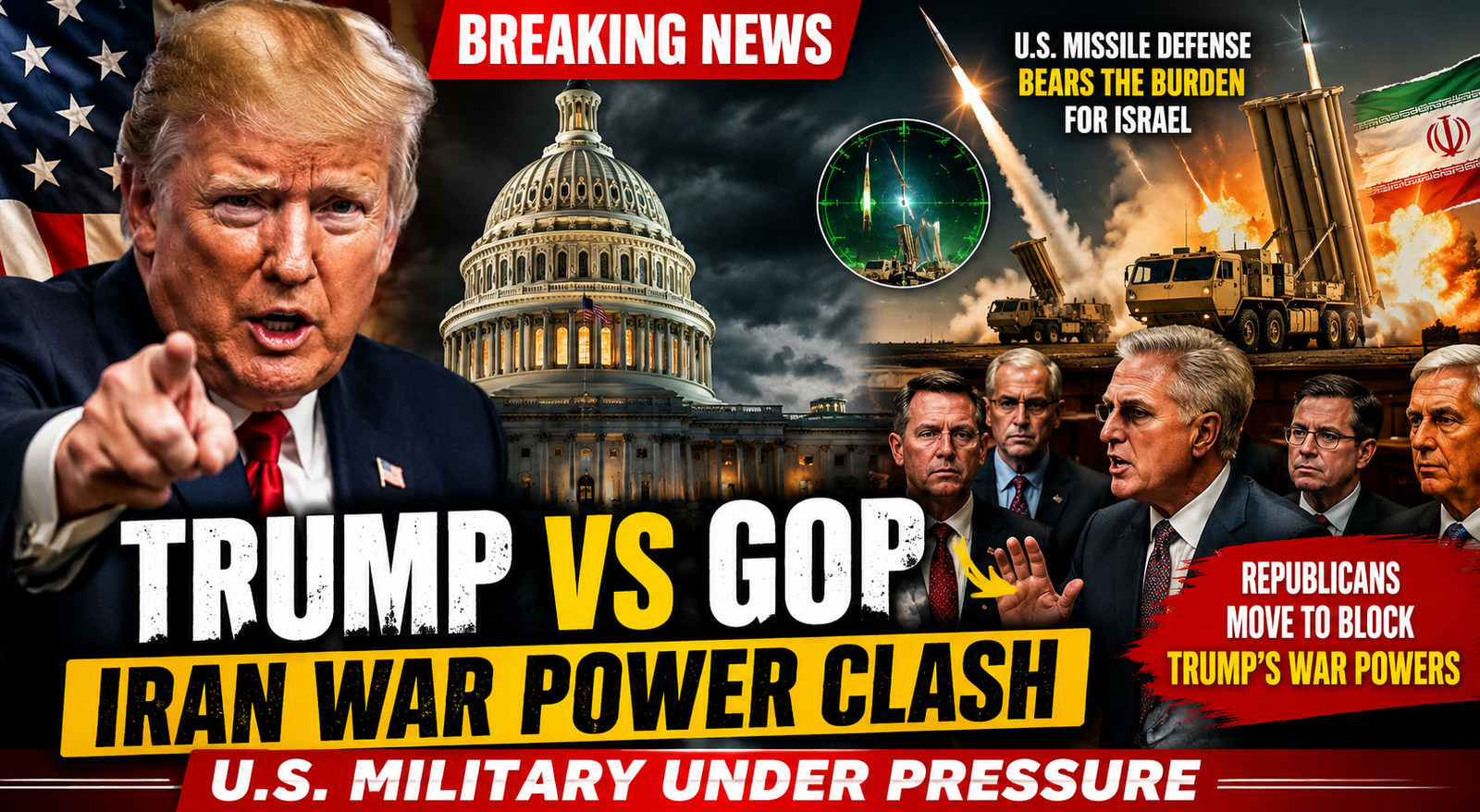
- Trump Faces Revolt as Republicans move to block Trump’s war powers as Iran conflict sparks political divide in Washington
- Pentagon reveals U.S. used far more missile interceptors than Israel during hostilities
- Analysts say Trump unlikely to back down despite congressional pressure
- Global markets rally as signs emerge that Iran war may be approaching an end
WASHINGTON — A deepening political rift within the Republican Party is threatening to complicate President Donald Trump’s strategy to end the Iran war on his own terms, even as his administration signals it is entering the final phase of a conflict that has rattled global markets and strained U.S. military resources.
According to sources familiar with developments relayed to The Islamabad Telegraph, a bipartisan resolution aimed at restricting Trump’s authority to conduct military operations against Iran had gathered enough momentum in the House of Representatives to pass—prompting Republican leadership to abruptly pull the vote at the last minute.
The resolution, pushed by Democrats, would require explicit congressional authorization for continued U.S. involvement in hostilities against Iran. Its passage would have marked a rare and symbolic rebuke of a sitting president by his own party during wartime.
“You don’t have the votes!” Democrats shouted on the House floor as Republican leaders moved to delay proceedings until after the Memorial Day recess, underscoring the intensity of the standoff.
Iran War Ending: Markets Explode as U.S., China and Russia Seal the Final Deal
Analysts say the move reflects growing discomfort among Republicans over the political and economic costs of the war, which began in late February and triggered a spike in energy prices, supply chain disruptions, and public disapproval. Recent polling indicates that a majority of Americans oppose continued military engagement.
Yet despite the mounting pressure, experts believe Trump is unlikely to retreat—even if Congress ultimately passes legislation aimed at limiting his war powers.
House Republicans Pull Vote to Limit Trump’s Iran War Powers
“Even if such a bill clears both chambers, it would face a presidential veto,” said a Washington-based policy analyst. “And there simply isn’t the two-thirds majority needed to override it. Trump retains the upper hand—and he knows it.”
Indeed, Trump has already demonstrated a willingness to sidestep congressional constraints. Earlier this year, the White House declared hostilities effectively concluded in April following a temporary ceasefire with Iran—allowing it to bypass a statutory 60-day deadline requiring congressional approval.
U.S. bears brunt of Israel’s missile defense, Pentagon assessments show
Behind the political drama lies a more complex military reality. Pentagon assessments reveal that the United States has borne a disproportionate share of the burden in defending Israel from Iranian missile attacks during the conflict.
According to defense officials, U.S. forces launched more than 200 Terminal High Altitude Area Defense (THAAD) interceptors—roughly half of America’s total inventory—along with over 100 naval-based Standard Missile interceptors. In contrast, Israel deployed significantly fewer of its own high-end systems, relying more heavily on U.S. capabilities to counter ballistic threats.
The Straitjackets of Diplomacy: Trump’s High-Stakes Gamble as Iran Ceasefire Teeters
“The numbers are striking,” said one defense expert. “The United States effectively absorbed the bulk of the missile defense mission.”
The imbalance has raised concerns about U.S. military readiness, particularly in other strategic theaters such as East Asia, where allies like Japan and South Korea depend heavily on American deterrence capabilities.
Despite these concerns, the Pentagon has defended the operational framework, emphasizing that missile interceptors represent just one component of a broader, integrated defense network jointly managed by the United States and Israel.
Diplomatic Gridlock: High-Stakes US-Iran Negotiations Falter Despite Islamabad’s Mediation
Still, the strain on U.S. stockpiles—and the prospect of renewed hostilities—has fueled unease within parts of the Republican Party, adding another layer of complexity to Trump’s war calculus.
Complicating matters further are signs of friction between Washington and Tel Aviv. Israeli Prime Minister Benjamin Netanyahu, who initially encouraged aggressive action against Iran, has reportedly pushed for a resumption of military operations—despite growing fatigue within Israeli forces and mounting pressure on U.S. resources.
Meanwhile, Iran retains a significant portion of its missile arsenal—estimated at around 70 percent of its prewar capacity—raising questions about the long-term effectiveness of the campaign.
Yet Trump remains publicly resolute.
“We’re in the final stages,” he told reporters this week. “We’ll either have a deal, or we’re going to do some things that are a little bit nasty.”
For now, diplomatic efforts led by major global powers—including the United States, China, and Russia—appear to be converging toward a negotiated end to the conflict. Markets have responded positively to signs of de-escalation, with investors betting that a resolution could stabilize energy prices and restore economic momentum.
But as political divisions widen in Washington and military pressures mount abroad, the path to ending the war remains as uncertain as ever—hinging largely on Trump’s willingness to balance force with diplomacy, and whether his own party ultimately stands with him or against him.