



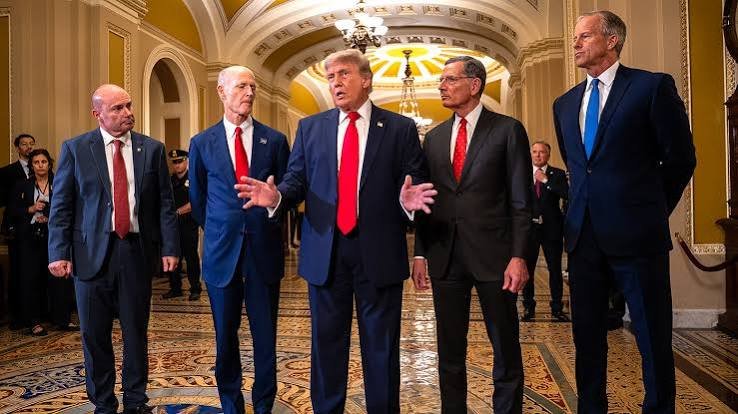
- Trump Iran Senate reversal reshaped Washington’s power dynamics within 24 hours
- Republican senators flipped positions after intense pressure from President Trump
- The failed War Powers resolution highlights weakening congressional authority
- Trump strengthened his negotiating leverage with Iran amid ongoing nuclear talks
There are moments in American politics when power does not merely assert itself—it recalibrates the entire system around it. This week, in Washington, such a moment unfolded. Under mounting pressure from Donald Trump, a Republican-led Senate that had only a day earlier rebuked his Iran policy reversed course with striking سرعة, exposing not only the fragility of congressional dissent but also the enduring gravitational pull of presidential authority in times of geopolitical uncertainty.
The sequence was as dramatic as it was revealing. On Tuesday, a bipartisan coalition passed a War Powers resolution aimed at restraining Trump’s ability to escalate military action against Iran—a symbolic yet pointed challenge to executive dominance in matters of war. By Wednesday night, that challenge had largely evaporated. The Senate rejected a follow-up resolution designed to enforce those limits, with key Republicans flipping their votes after a closed-door confrontation with the president.
At the center of this reversal was not merely political maneuvering, but a calculated display of presidential leverage. Trump, according to multiple accounts, did not engage in quiet persuasion. He berated dissenters publicly and privately, accusing members of his own party of undermining delicate negotiations with Tehran. His message was blunt: legislative defiance in the midst of diplomacy is not independence—it is sabotage.
Critics might describe this as coercion. But from another vantage point, it was a demonstration of strategic clarity. Trump recognized a fundamental contradiction in the Senate’s posture. How could lawmakers simultaneously demand a diplomatic resolution with Iran while signaling, through legislative constraint, that the president lacked the authority to negotiate from a position of strength? In Trump’s calculus, such signals weaken America’s hand.
READ MORE: “Sit Down, Loser”: Inside Trump’s War Room as Iran Strategy Shocks Washington
This is where the episode becomes more than a story of partisan discipline; it becomes a case study in the modern presidency. Trump’s approach to power has always defied institutional niceties. He does not merely operate within the system—he tests its limits, often reshaping it in the process. His confrontation with senators like Bill Cassidy and the calculated accommodation by figures such as Rand Paul illustrate a broader truth: in moments of crisis, the balance between Congress and the White House is less about statutes and more about political will.
Paul’s decision to vote “present,” explicitly to give the president “space and leverage,” encapsulates this shift. It was not a change in principle, he insisted, but a concession to circumstance. Yet that distinction may be less meaningful than it appears. When principle yields to executive necessity, even temporarily, it reinforces a precedent that future presidents—of either party—may invoke.
Read More: Trump Stuns Republicans With Whirlwind Day of Frustration and Finger-Pointing
For Democrats, the reversal was a bitter disappointment. Figures like Tim Kaine framed the Senate’s initial vote as a reassertion of congressional authority, a reminder that the Constitution vests the power to declare war in the legislative branch. The subsequent collapse of that effort, in their view, underscores how difficult it has become to sustain institutional checks in an era of hyper-partisan loyalty and presidential dominance.
But the deeper story lies within the Republican Party itself. Trump’s relationship with Senate Republicans has been anything but harmonious. He has actively campaigned against some incumbents, reshaped the party’s ideological contours, and shown little patience for dissent. And yet, when confronted directly, most senators ultimately aligned with him. This is not simply fear of political reprisal; it is recognition of where power—and political survival—resides.
Senate Majority Leader John Thune and his leadership team moved swiftly after the contentious White House meeting, working in tandem with the administration to secure the necessary votes. The speed of this coordination suggests that the reversal was not an accident but a deliberate recalibration—a decision to prioritize party unity and presidential strategy over institutional assertion.
The implications extend far beyond this single vote. At stake is the evolving nature of American governance in an age of perpetual crisis. The War Powers Resolution of 1973 was designed to constrain presidential adventurism after Vietnam, yet its effectiveness has long been debated. This week’s events add another chapter to that debate, illustrating how easily its intent can be overridden by political dynamics.
Trump’s defenders argue that this is precisely what leadership looks like in a volatile world. Negotiations with Iran, they contend, require flexibility, ambiguity, and the credible threat of force. Congressional micromanagement, in this view, risks undermining diplomacy before it has a chance to succeed. By forcing the Senate to reconsider its stance, Trump did not weaken democracy—he strengthened America’s negotiating position.
His critics see something more troubling: a presidency that demands loyalty not only from allies but from institutions designed to check its power. They warn that such precedents erode the constitutional balance, concentrating authority in ways that may outlast any single administration.
Both interpretations contain elements of truth. What is undeniable, however, is the effectiveness of Trump’s intervention. In less than 24 hours, he transformed a legislative rebuke into a political victory, reasserting control over his party and reframing the narrative around his Iran strategy.
In the end, this episode is not just about Iran, or even about Trump. It is about the enduring tension at the heart of American democracy: the struggle between deliberation and decisiveness, between institutional constraint and executive action. This week, decisiveness prevailed.
Whether that outcome will yield a lasting peace with Iran—or merely postpone a deeper reckoning—remains to be seen. But one lesson is already clear. In Washington today, power does not drift. It is seized, shaped, and, when necessary, enforced. And in that arena, Donald Trump continues to prove that he is not merely a participant—he is the central force.