


- Trump Iran surgical strikes: Trump Iran surgical strikes intensify after Apache helicopter incident
- US targets Iranian radar and air defense systems near Strait of Hormuz
- Iran denies downing helicopter, calls incident unintentional
- Pakistan-mediated ceasefire continues to prevent full-scale conflict
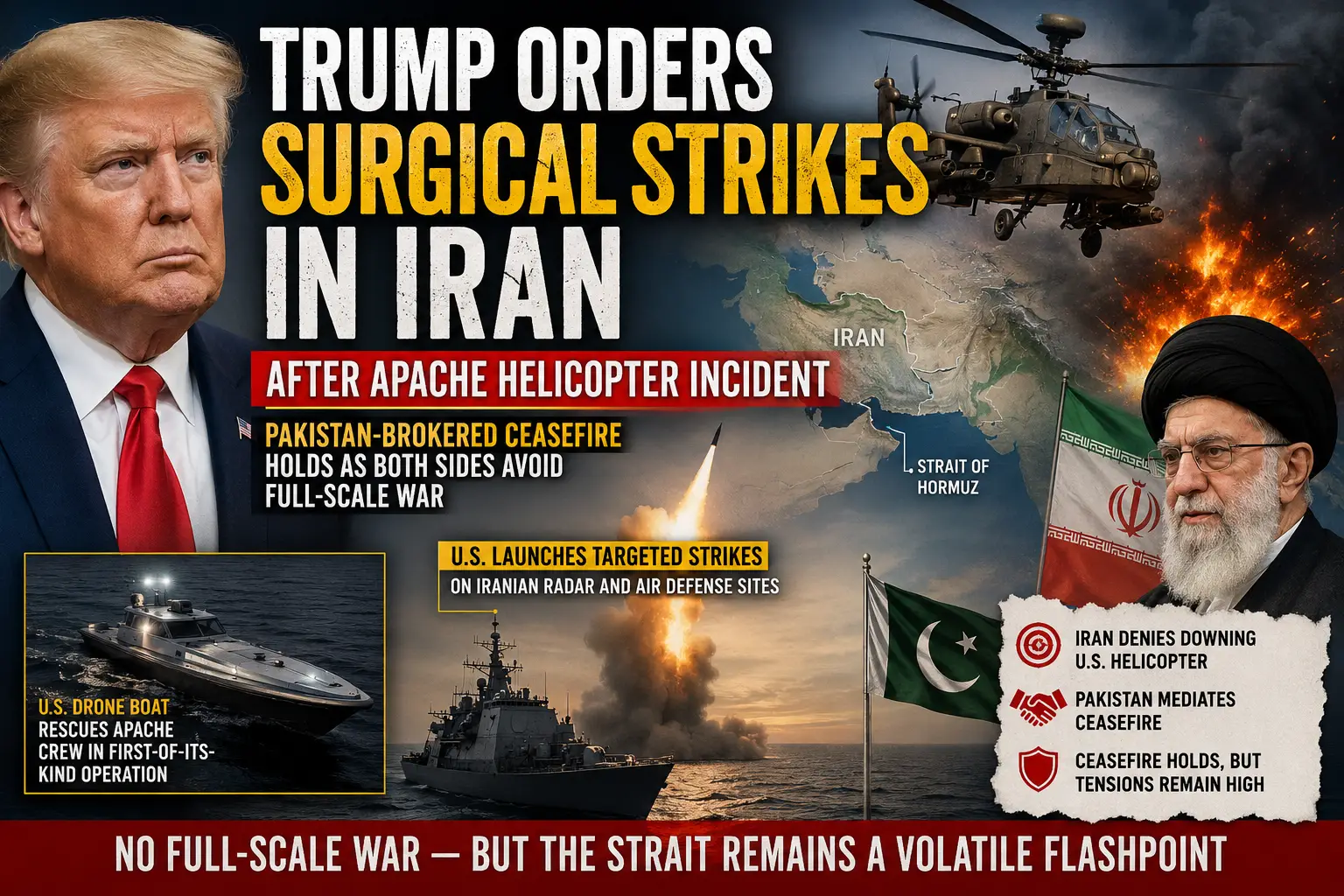
The United States has launched a fresh wave of calibrated military strikes inside Iran, signaling that the Trump administration’s doctrine of “controlled retaliation” remains firmly in play—even as a fragile, Pakistan-brokered ceasefire continues to hold between the two adversaries.
The latest escalation was triggered after President Donald Trump accused Iran of downing a highly sophisticated U.S. Apache attack helicopter patrolling over the Strait of Hormuz, one of the world’s most strategically vital maritime corridors. According to U.S. Central Command (CENTCOM), the helicopter was struck by what American officials described as an Iranian-origin Shahed drone off the coast of Oman late Monday, forcing the aircraft down into contested waters.
Despite the dramatic nature of the incident, both crew members survived in what one senior U.S. official described as a “near-miraculous escape,” later rescued in a first-of-its-kind operation involving an unmanned U.S. Navy drone vessel. The episode, however, quickly became a flashpoint.
Within hours, President Trump authorized what the Pentagon termed “proportional, self-defense strikes” targeting Iranian air defense systems and radar installations near the Strait of Hormuz. “The mission is a proportional response to unjustified Iranian aggression,” CENTCOM said in an official statement, emphasizing that the operation was limited in scope and designed to avoid broader escalation.
The Day the Ceasefire Died: Israel–Iran Trade Blows as Netanyahu Defies Washington
Iran, for its part, has categorically denied deliberately targeting the U.S. helicopter. Officials in Tehran insisted that while Iranian forces have intensified drone activity in the region—particularly against commercial vessels perceived to be cooperating with U.S. naval operations—they did not intentionally engage the American aircraft. The ambiguity surrounding the incident has done little to ease tensions.
What makes this moment particularly delicate is the continued existence of a Pakistan-brokered ceasefire agreement between Washington and Tehran, first established in early April after weeks of intense confrontation. While the ceasefire has been repeatedly tested by skirmishes, drone attacks, and limited strikes, both sides have so far stopped short of plunging into a full-scale war.
U.S. launches new strikes on Iran after downing of U.S. helicopter
Diplomatic sources suggest that Islamabad has been quietly working behind the scenes to ensure that both capitals maintain restraint. The current pattern—localized Iranian drone operations met with targeted U.S. strikes—appears to reflect a mutual, if uneasy, understanding: escalate tactically, but avoid strategic rupture.
Even President Trump appeared to downplay the severity of the helicopter incident in public remarks, noting that the pilots were “safe and uninjured” and describing the episode as “not a big deal”—even as he ordered retaliatory action. The dual messaging underscores a broader strategy: demonstrate strength without triggering uncontrollable conflict.
Military analysts note that the Strait of Hormuz has effectively become a pressure valve in the ongoing standoff. Iran has attempted to assert leverage by threatening maritime traffic, while the United States has responded with naval patrols and a tightening blockade on Iranian ports—measures that Trump claims are economically squeezing Tehran.
Yet, the risks remain high. According to a recent Congressional assessment, at least 42 U.S. aircraft—including drones and fighter jets—have been damaged or destroyed since the conflict began earlier this year. The downing of the Apache helicopter adds to a growing list of incidents that highlight the volatility of the theater.
For now, both Washington and Tehran appear to be walking a tightrope—engaging in limited العسكري exchanges while carefully avoiding a direct, large-scale confrontation. The continuation of the Pakistan-mediated ceasefire, despite mounting provocations, suggests that neither side is ready to cross that threshold.
But as the Strait of Hormuz grows increasingly militarized and miscalculations become more likely, the sustainability of this delicate balance remains deeply uncertain.