



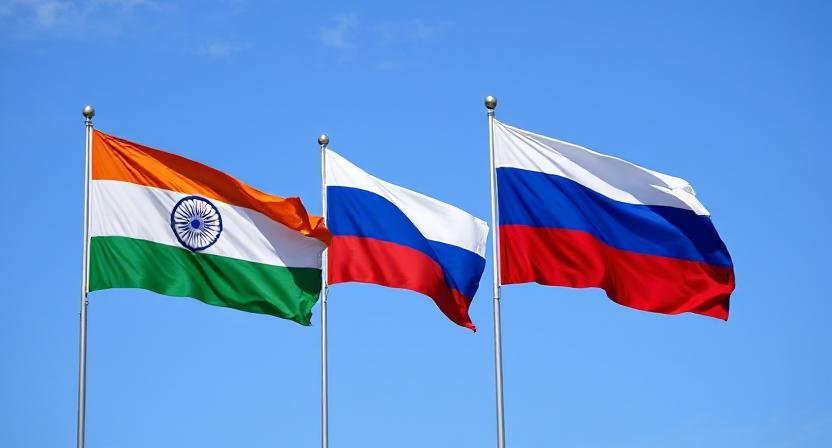
- President Trump doubles tariffs on Indian exports to pressure New Delhi over Russian oil and arms ties.
- India’s decades-old strategic partnership with Russia, rooted in Cold War history, resists U.S. economic coercion.
- Discounted Russian crude and defence technology transfers remain critical to India’s economic and military security.
- Analysts warn that punitive tariffs could backfire, pushing India closer to Moscow and undermining U.S. Indo-Pacific goals.
President Donald Trump is once again betting that economic muscle can achieve what diplomacy has not. His latest target is India — and more specifically, its decades-old strategic embrace of Russia. By threatening and now imposing steep tariffs, Trump hopes to pry Prime Minister Narendra Modi away from Moscow, thereby tightening the screws on Vladimir Putin over Ukraine.
But this is not a garden-variety trade dispute. It is an attempt to undo a Cold War-era partnership that has weathered wars, sanctions, regime changes, and shifting global fault lines. And it is precisely that historical resilience that makes Trump’s strategy both audacious and perilous.
For Trump, the logic is straightforward: penalize India’s exports, raise the economic cost of buying Russian oil, and force Modi to reconsider his energy and arms pipeline from Moscow. The execution has been swift — doubling tariffs on Indian goods from 25% to 50% in less than a month. The message is clear: keep buying from Russia, and you will pay for it.
For Modi, however, the calculus is far more complex. India’s relationship with Russia is not transactional; it is structural. Since the 1960s, Moscow has been more than a supplier — it has been a political backer when Washington leaned toward Islamabad, a source of cheap oil when India’s foreign reserves were meagre, and an arms partner willing to transfer technology rather than merely sell hardware. These are not ties that dissolve because of tariff headlines.
Even today, with Russian forces mired in Ukraine and Western sanctions tightening, India’s reasons for holding firm are pragmatic. Discounted Russian crude has saved Indian refiners an estimated $17 billion in the past three years. Those savings translate into cheaper domestic fuel, lower inflation, and profitable fuel exports. For an economy of 1.4 billion people with a surging appetite for energy, that is not a luxury — it is economic survival.
The military dimension is equally binding. Over half of India’s arsenal remains Russian or Soviet in origin. While New Delhi has diversified its suppliers, replacing Russian systems would take decades. More importantly, Moscow continues to share sensitive technology and allow domestic manufacturing — a trust that Washington, despite promises, has not consistently matched. It is telling that as recently as last month, India commissioned a Russian-built stealth frigate and is still assembling others with Russian assistance.
Trump’s gamble assumes that India’s economic pain threshold is low enough to make it abandon these benefits. That assumption ignores India’s long-standing doctrine of “strategic autonomy” — a refusal to be pushed into exclusive alignments. New Delhi has abstained from UN votes condemning Russia’s invasion, resisted Western sanctions, and maintained high-level dialogue with Putin. When Modi publicly called the Russian president his “friend” and reaffirmed their “Special and Privileged Strategic Partnership,” it was not diplomatic fluff; it was a pointed signal of defiance.
There is also a danger here for Washington. Punitive tariffs might hurt Indian exporters, but they also risk alienating a country the U.S. needs in its Indo-Pacific strategy against China. Push too hard, and the result could be the opposite of what Trump intends — driving Russia and India even closer, or worse, nudging New Delhi toward deeper security coordination with Beijing.
If the United States truly wants India to pivot away from Moscow, it must replace — not merely remove — the Russian benefits. That means offering competitive oil deals, accelerating defence technology transfers without bureaucratic delay, and providing tangible security assurances against both China and Pakistan. Carrots, not just sticks, will be required.
Trump’s tariff blitz may satisfy a domestic appetite for toughness, but history shows that enduring strategic shifts are rarely achieved by economic punishment alone. The India–Russia bond is not a loose thread that can be yanked free; it is a knot tied over decades of shared interests and geopolitical necessity. Breaking it will require more than tariffs. It will require a patient, credible alternative that makes walking away from Moscow worth India’s while.