



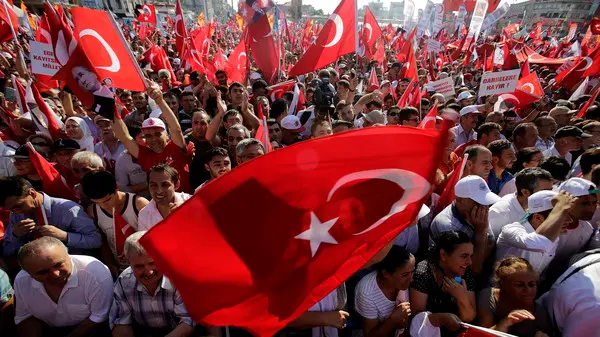
- Turkey Gülen movement arrests highlight Ankara’s ongoing post-coup security operations.
- 88 suspects detained in coordinated raids across multiple provinces.
- Investigations targeted alleged covert networks within public institutions.
- Analysts say Gülen’s 2024 death may reshape the organization’s future.
Istanbul/Kayseri — Turkish authorities have detained 88 suspects in coordinated nationwide operations targeting individuals accused of links to the Gülen movement, signaling that Ankara’s long-running campaign against the network it blames for the failed 2016 coup attempt remains firmly active nearly a decade later.
According to statements released Tuesday by prosecutors, the arrests were carried out under two separate investigations led by judicial authorities in the central Anatolian province of Kayseri and in Istanbul. Officials described the operations as part of an ongoing effort to dismantle what the Turkish state calls the “FETÖ terrorist organization,” the official designation used by Ankara for the movement founded by cleric Fethullah Gülen.
Nationwide Raids After Months of Surveillance
The Kayseri Chief Public Prosecutor’s Office said 70 suspects were detained following an eight-month surveillance operation. Simultaneous raids were conducted across multiple provinces, including Kayseri, Istanbul, Adana, and Mersin.
Authorities deployed a large security apparatus for the operation, involving 144 teams, 676 personnel, and special operations units. Police reported seizing concealed audio recording and camera devices, unlicensed firearms, ammunition, and a range of organizational documents and digital materials believed to be linked to alleged underground networks.
Officials said the investigation focused on individuals suspected of maintaining covert communications and continuing organizational activities despite years of state crackdowns.
In a separate probe led by the Istanbul Chief Public Prosecutor’s Office, 18 additional suspects were detained across eight provinces. Prosecutors said 16 of those detained were public officials accused of membership in the organization, while two suspects allegedly held senior internal roles.
The operations underline Ankara’s assertion that remnants of the movement continue to operate within state institutions and civil society structures, even years after extensive purges.
Background: The 2016 Coup Attempt
The Turkish government accuses Fethullah Gülen — a once-influential Muslim preacher who lived in self-imposed exile in the United States from 1999 until his death in 2024 — of orchestrating the failed military coup of July 15, 2016.
That night marked one of the most traumatic episodes in modern Turkish history. Rogue military units seized bridges, bombed parliament, and attempted to overthrow President Recep Tayyip Erdoğan’s government. The coup was defeated within hours after mass civilian mobilization and loyal security forces regained control.
At least 251 people were killed and more than 2,200 injured.
Ankara argues that Gülen’s followers had infiltrated key state institutions, forming what officials describe as a “parallel state.” Gülen and his supporters denied involvement, and Washington repeatedly declined Turkish requests for his extradition, citing insufficient legal evidence.
A Decade-Long Crackdown
Following the coup attempt, Türkiye launched one of the largest internal security purges in its modern history. More than 77,000 people were arrested, and approximately 150,000 state employees — including teachers, judges, police officers, and soldiers — were suspended or dismissed.
Authorities shuttered schools, charities, banks, and media outlets allegedly affiliated with the movement. The campaign has continued annually, with new investigations regularly targeting suspected financial networks, encrypted communication channels, and alleged sleeper cells.
While some foreign governments, including the United Arab Emirates, later designated the movement as a terrorist organization, analysts emphasize that the dismantling of Gülen-linked structures has primarily been driven by Turkish state institutions rather than external actors.
Turkey has also pursued international cooperation, seeking extraditions and deportations of suspected members from Europe, Asia, and Africa, with mixed success depending on bilateral legal frameworks.
After Gülen’s Death
The death of Fethullah Gülen in October 2024 introduced a new phase in the movement’s trajectory. Analysts believe the absence of its founder may weaken organizational cohesion but could also push remaining networks to operate more discreetly.
In Istanbul’s historic Fatih district — one of the focal points of resistance during the 2016 coup — memories of that night still shape public attitudes. Many residents view continued investigations as necessary to prevent future instability, while others hope the end of Gülen’s leadership could eventually ease political polarization.
Political observers note that Gülen’s passing removed one of the most contentious issues in Turkey’s relations with the United States, where disagreements over extradition had strained ties between NATO allies for years.
Domestic and International Debate
Human rights organizations have repeatedly criticized the scale of post-coup purges, arguing that anti-terror laws have sometimes been applied too broadly. Turkish officials reject those accusations, maintaining that the country faced an existential security threat requiring decisive action.
Government supporters across the political spectrum largely agree that preventing renewed infiltration of state institutions remains a priority. Even some opposition figures acknowledge the coup attempt fundamentally reshaped Turkey’s political and security landscape.
Future Perspective: Security vs. Normalization
The latest detentions suggest Ankara intends to maintain pressure on suspected Gülen networks well into the next decade, indicating that the issue remains central to Turkey’s internal security doctrine.
Experts say the future trajectory will depend on several factors: whether fragmented leadership emerges within the movement abroad, how Western governments handle asylum cases involving alleged members, and whether Turkey shifts toward institutional normalization after years of emergency-style security policies.
For President Erdoğan’s government, continued operations reinforce a narrative of vigilance against hidden threats. For critics, they raise ongoing questions about balancing national security with judicial transparency and civil liberties.
Nearly ten years after tanks rolled onto Turkish streets, the legacy of the 2016 coup attempt continues to define the country’s politics — and the latest arrests demonstrate that, in Ankara’s view, the struggle against its alleged architects is far from over.