



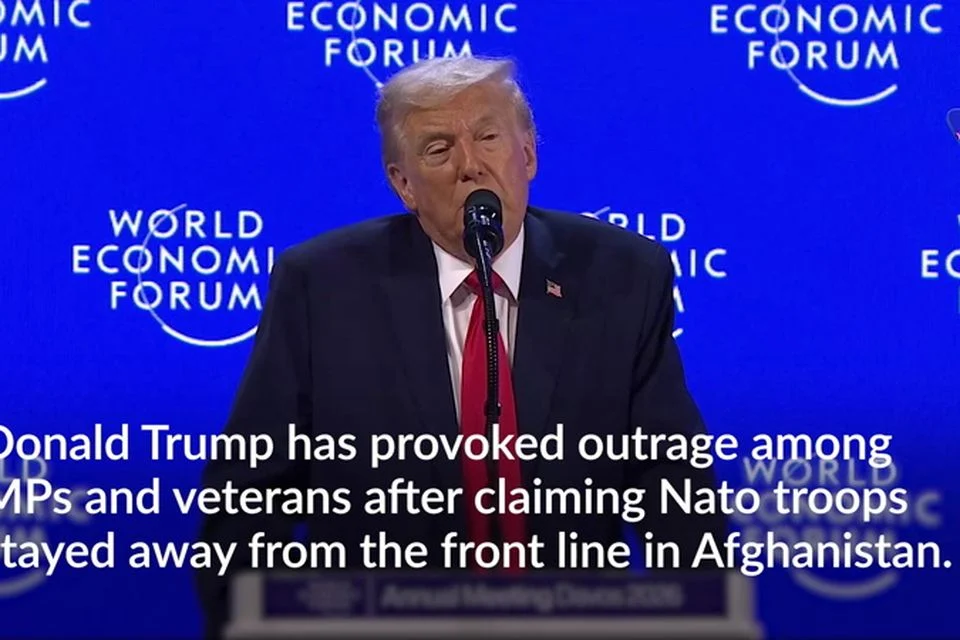
- U.K. Outrage erupted after Trump claimed NATO troops “stayed back” from the front lines in Afghanistan, ignoring the 457 British lives lost.
- Prince Harry, a veteran of two frontline tours, reminded the world that NATO’s Article 5 was invoked specifically to protect the United States.
- Prime Minister Keir Starmer labeled the remarks “appalling,” suggesting the President owes a direct apology to the families of the fallen.
- Analysts suggest these “irreparable cracks” in the U.S.-EU relationship signal a shift toward European strategic autonomy and away from American reliance.
U.K. Outrage at Donald Trump’s latest assertions has reached a fever pitch, as the former president dismisses the valor of British and NATO forces in Afghanistan. Prime Minister Keir Starmer and Prince Harry have broken diplomatic silence to condemn the comments as “insulting” and “disrespectful,” highlighting a growing rift in the transatlantic alliance
The Transatlantic Fracture
The relationship between the United States and its closest allies has hit a historic low point. On January 23, 2026, the United Kingdom—traditionally the most loyal of American partners—issued a stinging rebuke of President Donald Trump. The catalyst was a Fox News interview from Davos where Trump inaccurately claimed that NATO allies “stayed a little back, a little off the front lines” during the twenty-year conflict in Afghanistan.
A Royal and Political Rebuke
Prince Harry, who served as an Apache helicopter pilot, rarely weighs into political fray, yet the “belittling” of his fellow soldiers forced a public statement. He reminded the President that the only time NATO invoked its mutual-defense provision, Article 5, was in direct support of the U.S. after 9/11. “Allies answered that call,” Harry stated, noting the 457 British personnel who made the ultimate sacrifice.
Similarly, Prime Minister Keir Starmer abandoned the “special relationship” pleasantries. Calling the remarks “insulting and frankly appalling,” Starmer’s anger reflected a nation that feels its blood sacrifice has been traded for political rhetoric. This isn’t just about hurt feelings; it’s about the erosion of the foundation of Western security.
The Reality of NATO’s Strength
While analysts at the Islamabad Telegraph and elsewhere have noted that Trump’s assessment of NATO’s current conventional readiness to defend the U.S. may contain grains of hard truth, his delivery has been seen as a strategic disaster. By questioning the “ultimate test” of whether NATO would defend America, Trump has effectively signaled to adversaries that the alliance is a house divided.
The “irreparable cracks” mentioned by observers refer to the shift in European thinking. Leaders in London, Paris, and Berlin are no longer asking if they can rely on Washington, but are moving forward with the assumption that they cannot. The pursuit of Greenland and the use of “coercion” as a diplomatic tool have normalized a transactional relationship where loyalty is secondary to leverage.
Trump’s dismissiveness of the British role in Helmand Province and beyond echoes his previous controversies with Gold Star families. However, by insulting the military history of a nuclear-armed ally like the U.K., he has accelerated a global pivot. The world now sees a U.S. president who views the most successful military alliance in history as a “financial burden” rather than a strategic asset
NATO Negotiations
NATO Negotiations for the 2026 fiscal cycle have taken on a dramatic and high-stakes tone following the World Economic Forum in Davos. While European leaders expressed outrage over President Trump’s dismissal of their sacrifices in Afghanistan, the diplomatic fallout has paradoxically accelerated defense spending. Secretary General Mark Rutte has acknowledged that Trump’s “electroshock” tactics have forced a pivot toward a staggering 5% GDP spending target by 2035, effectively ending the era of European reliance on the American “umbrella.”
Cracks are visible in the US-NATO relationship.