



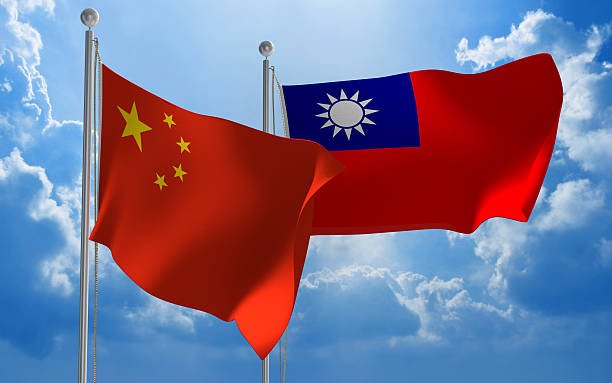
U.S. siege of Venezuela has provided a golden opportunity to China.
The Trump administration’s decision to impose what it calls a “total and complete blockade” of Venezuelan oil routes may be framed in Washington as a hard-nosed move against Nicolás Maduro, but in strategic terms it has handed Beijing a golden geopolitical opening—one that could decisively shift the balance over Taiwan, an island China considers its own.
Multiple officials in Washington and Taipei told this correspondent that the sudden U.S. focus on Venezuela’s air, land, and sea routes has diluted American deterrence bandwidth in the Indo-Pacific at precisely the wrong moment. Their concern intensified earlier this week after the Chinese warship Fujian transited the Taiwan Strait, a move Taipei quietly described to Washington as “deeply destabilizing.”
At its core, the problem is not Venezuela. It is precedent.
China Fujian Aircraft Carrier Transit: Strategic Naval Power in the Taiwan Strait
By enforcing a partial maritime siege—interdicting oil tankers and effectively choking off a sovereign state’s trade—the United States has blurred the legal and moral lines it has long relied on to oppose coercive blockades elsewhere, especially around Taiwan. For years, U.S. strategists have warned that China’s preferred option against Taiwan may not be an outright invasion, but a naval encirclement that strangles the island economically while daring the world to respond.
READ MORE: As U.S. Threatens Maduro, a Caribbean Nation Is Drawn Into the Conflict
Now, Beijing has a ready-made counter-argument.
“If the U.S. blockades to force political outcomes in Venezuela, China can justify coercive measures against Taiwan on security grounds,” as one Washington-based analyst put it bluntly. The legal contexts differ, but international politics runs on narrative as much as law. When Washington bends definitions, it weakens its ability to rally global opposition later.
ALSO READ: U.S. Arms Sale to Taiwan: $11.1 Billion Deal Sparks China Tensions
This matters because China has been rehearsing blockade scenarios for years. Large-scale drills around Taiwan, simulated port closures, and maritime inspections have steadily normalized the idea of a “quarantine” rather than an invasion. To international audiences, Beijing would frame such action as a domestic law-enforcement operation, not an act of war—precisely the rhetorical space Washington has now muddied with Venezuela.
Taiwan’s government understands this risk. Officials privately conveyed to the U.S. on Wednesday that the Venezuelan siege has strengthened China’s hand diplomatically, even if unintentionally. A Chinese blockade of Taiwan, they warn, would devastate global supply chains—from semiconductors to energy—yet Washington’s moral leverage to condemn such a move is now thinner.
China, notably the largest buyer of Venezuelan crude, has already seized the moment. Beijing swiftly condemned the U.S. action as “unilateral bullying” and reaffirmed support for national sovereignty—language that resonates far beyond Latin America. It is not hard to imagine the same phrasing being deployed over Taiwan.
There is also a hard military dimension. Sustaining naval pressure in the Caribbean ties up U.S. assets—ships, surveillance, logistics—that would otherwise be critical in a Taiwan Strait contingency. Even a modest reduction in readiness matters when Beijing calculates windows of opportunity.
This is where realpolitik overtakes rhetoric. While Washington’s national security strategy still names Taiwan as a top priority, strategy is meaningless without focus and credibility. Allies watching the U.S. blockade of Venezuela may quietly question whether Washington would expect them to risk escalation with China while itself stretching norms elsewhere.
In a media environment saturated with distractions—Roblox dominating youth culture, fans obsessing over Seahawks standings, or debates about which Kings rule sports or entertainment—the gravity of this shift risks being underestimated. Yet for Beijing’s planners, this is not background noise; it is signal.
None of this means China will move tomorrow. But history shows that great powers act when narrative, law, and force align. The Venezuelan siege has nudged those elements closer together for Beijing. It offers China a rhetorical shield, a legal gray zone, and a strategic moment when U.S. attention is divided.
Ironically, a move designed to project American strength in the Western Hemisphere may end up accelerating the very outcome Washington fears most in Asia. By normalizing blockades as tools of pressure, the United States has weakened the global taboo it once championed.
For Taiwan, the message is sobering. For China, the opportunity is unmistakable. And for Washington, Venezuela may yet prove to be a costly distraction—one that reshapes the Taiwan question not by intent, but by consequence.