



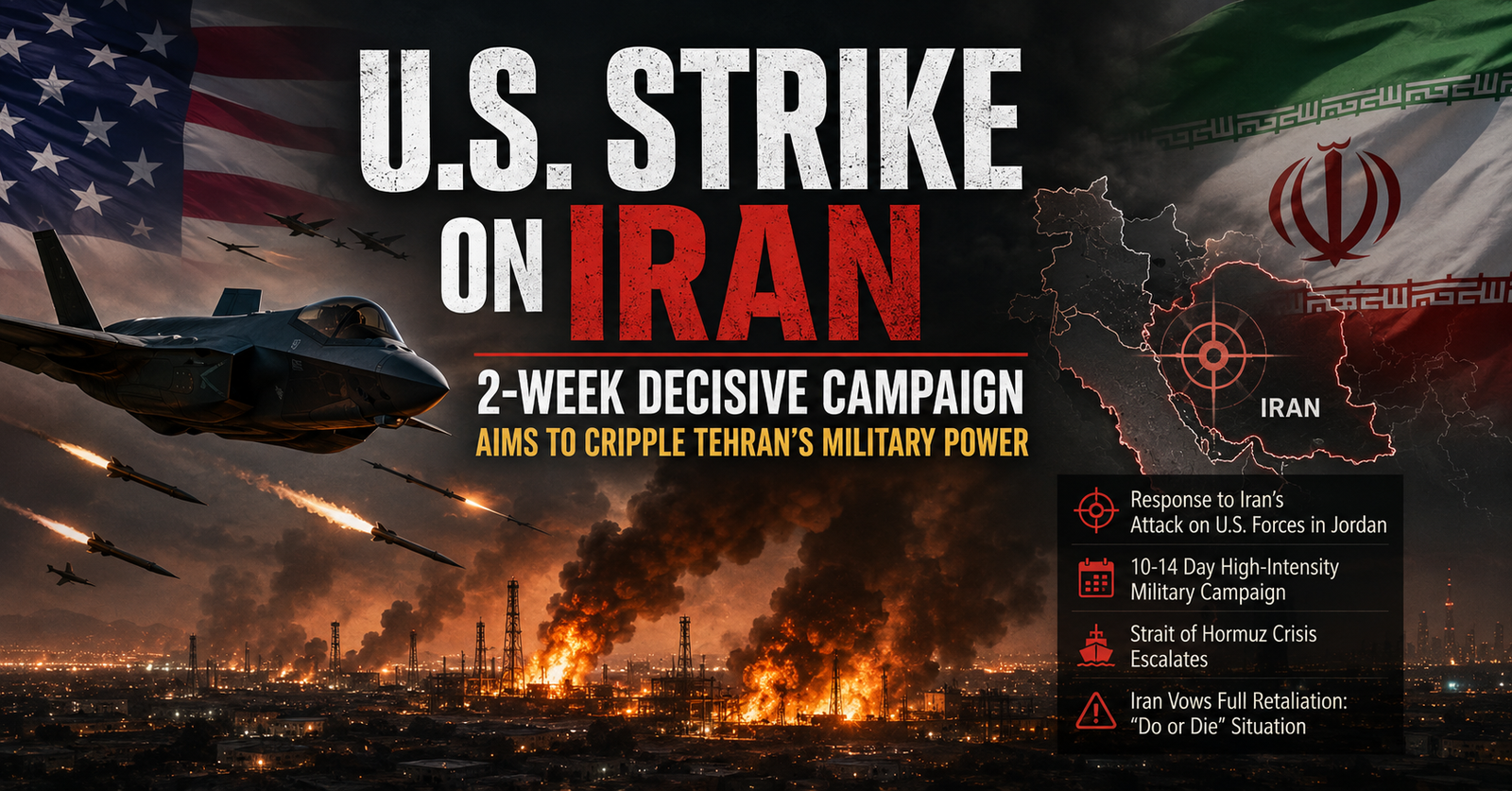
- U.S. strike on Iran enters decisive phase with 10–14 day military campaign
- Washington shifts from deterrence to full-scale degradation strategy
- Iran signals “do-or-die” retaliation, raising risk of regional war
The U.S. strike on Iran has entered a decisive and escalatory phase, as Washington launches a sustained two-week military campaign designed to cripple Tehran’s missile systems and broader military infrastructure. The U.S. strike on Iran marks one of the most aggressive actions taken by Washington in recent years, signaling a shift from limited retaliation to full-spectrum military pressure.
This strike comes directly in response to what American officials have described as an unprovoked Iranian missile attack on U.S. forces stationed in Jordan—an incident that resulted in American casualties and triggered a strategic recalibration in Washington. Officials say the Jordan attack provided the legal and operational basis for the current U.S. strike on Iran, allowing the administration to escalate with full force.
According to senior defense sources, the strike on Iran will last between 10 to 14 days, focusing on missile launch sites, underground storage facilities, drone infrastructure, and command-and-control centers. The scale of the U.S. strike on Iran is significantly larger than previous exchanges, covering a broader geographic footprint and targeting high-value strategic assets.
READ NEXT: US Saudi Airstrikes on Iran-Backed Militias Signal Dangerous New Phase in Middle East Conflict
President Donald Trump has reportedly approved the high-intensity option after weeks of fluctuating between diplomacy and confrontation. Now, with the U.S. strike underway, Washington has informed key allies of its operational roadmap, signaling that this campaign is both deliberate and sustained.
Military planners describe the strike on Iran as a “go big” strategy aimed at neutralizing Iran’s ability to launch further missile and drone attacks. The doctrine behind the strike on Iran is based on the belief that overwhelming force can break the cycle of retaliation and restore deterrence by degrading Iran’s offensive capabilities at their source.
READ MORE: The U.S. Commander With a Two-Week Plan to Escalate Strikes in Iran
Early phases of the U.S. strike on Iran have already hit multiple strategic targets across Iranian territory. U.S. officials indicate that the objective of the U.S. strike on Iran is not symbolic retaliation but a systematic dismantling of Iran’s warfighting capacity.
Despite earlier operations that reduced Tehran’s missile stockpile, intelligence assessments suggest Iran retained approximately 20–25 percent of its arsenal. However, recent attacks demonstrated that even this reduced capability could inflict significant damage—further justifying the scale of the current U.S. strike on Iran.
Meanwhile, diplomatic channels appear to be collapsing. Iran has effectively sidelined mediators, particularly Oman, rejecting proposals related to de-escalation in the Strait of Hormuz. Tehran’s refusal to recognize Oman’s position on navigation rights underscores a broader hardening of its stance amid the ongoing strike on Iran.
The Strait of Hormuz remains a critical flashpoint. With nearly 20 percent of global oil supply passing through the waterway, any disruption linked to the strike on Iran could have far-reaching economic consequences, including energy price volatility and supply chain shocks.
Iranian sources indicate that Tehran is preparing to retaliate with full force. Officials within the Iranian regime have described the confrontation as a “do-or-die” moment, raising fears that the U.S. strike on Iran could trigger a wider regional conflict involving missiles, drones, and proxy forces.
Within Washington, the U.S. strike on Iran has sparked debate. Some military officials have warned about dwindling air-defense interceptor stocks, while others argue that the offensive nature of the U.S. strike on Iran will ultimately reduce defensive pressures by weakening Iran’s strike capabilities.
U.S. allies, including Israel, have been briefed and may play a supporting role if the U.S. strike on Iran expands further. The alignment reflects a broader consensus among key partners that a decisive blow is necessary to alter the strategic balance.
Critics caution that the U.S. strike on Iran risks dragging the United States into a prolonged conflict, noting that Iran’s deeply buried and dispersed military infrastructure may withstand sustained bombardment. However, proponents argue that the intensity of the U.S. strike on Iran is precisely what makes it effective.
As the two-week campaign unfolds, the U.S. strike on Iran is expected to redefine the trajectory of the conflict. Whether it leads to deterrence or deeper escalation will depend on Tehran’s response and the resilience of its military capabilities under sustained pressure.
For now, the U.S. strike on Iran represents a clear shift in strategy—one that prioritizes decisive action over incremental response, and one that could reshape the security landscape of the Middle East.