



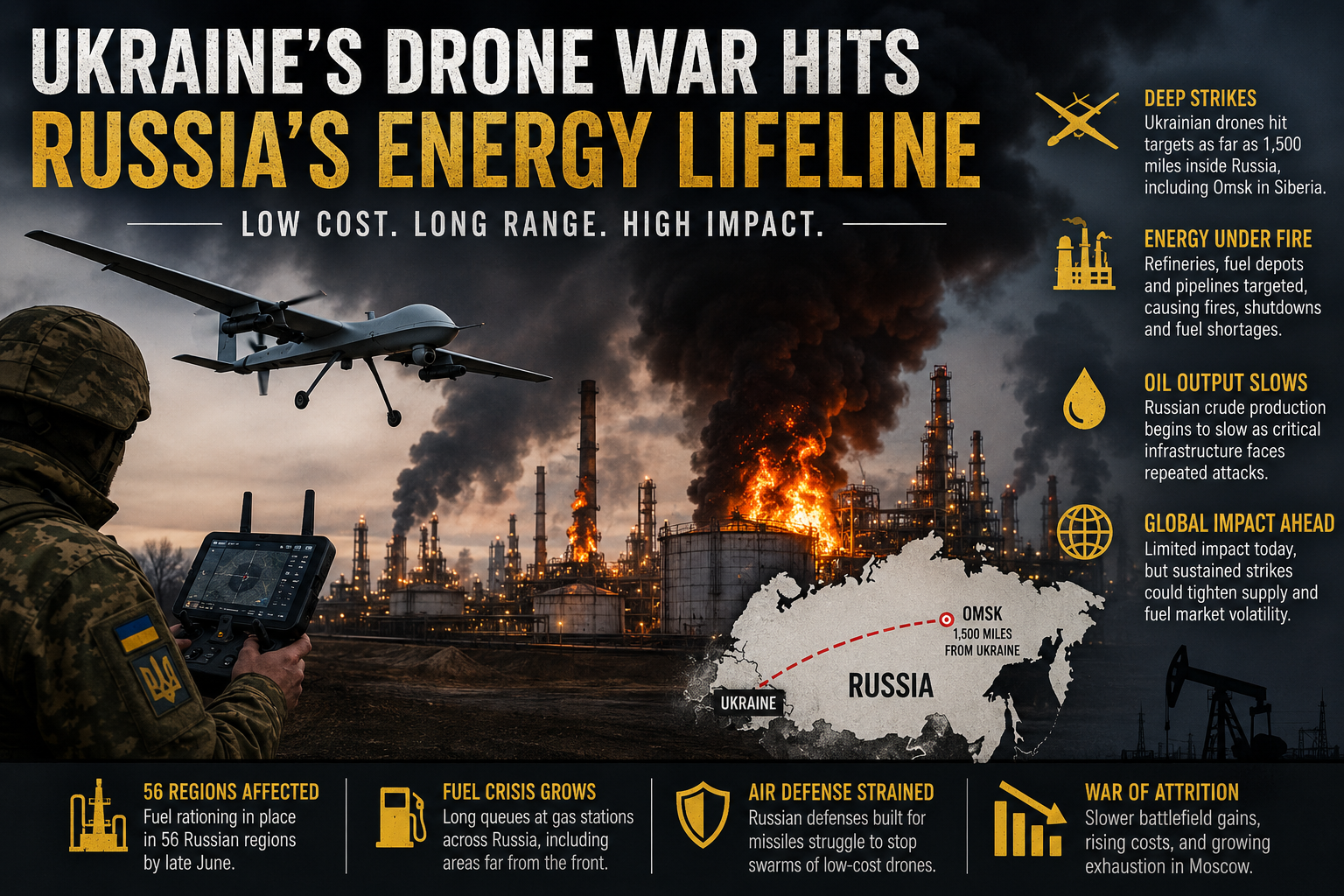
- Ukraine drone attacks on Russia energy infrastructure are disrupting refineries, fuel depots, and military supply chains deep inside Russian territory.
- Low-cost, long-range drones are overwhelming Russia’s air defenses, exposing critical vulnerabilities in its strategic depth.
- Fuel shortages and slowing crude oil output are emerging as tangible consequences of repeated Ukrainian strikes on key facilities.
- While the global impact remains limited for now, sustained attacks could tighten energy markets and trigger price volatility in the months ahead.
In the long shadow of Europe’s most destructive conflict since World War II, Ukraine has quietly engineered a transformation in the art of war—one that is forcing Russia onto an unfamiliar defensive footing. The battlefield is no longer confined to trenches in Donetsk or artillery duels along a 700-mile front line. Instead, it stretches deep into Russian territory, where swarms of low-cost, long-range drones now strike with precision at oil refineries, fuel depots, and military installations once considered untouchable.
This is not merely tactical innovation; it is strategic disruption.
For years, Moscow wagered that time would be its greatest ally in a war of attrition. Russia’s vast geography, resource wealth, and manpower reserves were expected to outlast Ukraine’s resilience. Yet Kyiv’s expanding drone arsenal is steadily eroding that assumption. By targeting critical energy infrastructure—the backbone of Russia’s economy and war logistics—Ukraine is imposing costs that extend far beyond the battlefield.
Satellite imagery and social media footage—despite official bans—have captured plumes of smoke rising from refineries across Russia. Strikes have reached as far as Omsk in Siberia, nearly 1,500 miles from Ukrainian territory, underscoring the growing reach and sophistication of Kyiv’s capabilities. These are not symbolic attacks; they are calculated operations aimed at disrupting fuel production, constraining military supply lines, and undermining domestic confidence in the Kremlin’s ability to protect its own territory.
READ MORE: US Troop Withdrawal Europe: Hegseth’s NATO Shock Signals Strategic Shift and Rising Risk for Russia-Ukraine War
The consequences, while still limited in macroeconomic terms, are becoming increasingly visible. Fuel shortages have been reported across multiple Russian regions, with rationing measures introduced in dozens of areas. Long queues at petrol stations—once unthinkable in one of the world’s largest energy producers—signal a deeper vulnerability. Moscow’s decision to curb diesel exports reflects a reactive posture, suggesting that internal supply pressures are no longer negligible.
More concerning for global markets is the emerging trend in Russia’s crude output. While the decline remains modest, the trajectory is unmistakable. Repeated strikes on processing units—many built with Western technology that is difficult to replace under sanctions—are gradually degrading operational capacity. If sustained, this could tighten global supply chains at a time when energy markets remain highly sensitive to geopolitical shocks.
For an energy-hungry world, the implications are significant. Even marginal disruptions in Russian production can ripple through global pricing mechanisms, affecting everything from inflation trajectories in Europe to fuel costs in Asia. The current impact may be contained, but the strategic intent behind Ukraine’s campaign suggests a long-term play: to incrementally raise the economic and political cost of Russia’s war.
RELATED NEWS: The War in Ukraine Is Shifting Against Putin but He Isn’t Giving In
Equally striking is the psychological dimension of this campaign. Russia’s air defense systems, designed primarily to counter ballistic missiles and conventional aircraft, are increasingly strained by the sheer volume and adaptability of Ukrainian drones. The asymmetry is stark: relatively inexpensive platforms are forcing a far costlier defensive response, stretching resources and exposing gaps in coverage.
This dynamic has contributed to what many analysts describe as growing exhaustion within Russia’s military and political establishment. Battlefield gains have slowed, casualties are reportedly exceeding recruitment, and the prospect of another round of mobilization looms—an option fraught with domestic risk for President Vladimir Putin. The Kremlin’s narrative of inevitable victory is becoming harder to sustain as the war’s costs mount and its timeline extends indefinitely.
Yet it would be premature to declare a निर्णsing shift in Ukraine’s favor. Russia retains significant advantages, particularly in ballistic missile capabilities, which continue to inflict heavy damage on Ukrainian cities and infrastructure. Kyiv’s reliance on Western air defense systems, such as Patriot interceptors, underscores its own vulnerabilities.
Still, the balance of initiative appears to be shifting. Ukraine is not only defending its territory but actively contesting Russia’s strategic depth. Its drone campaign represents a form of warfare tailored to its constraints—leveraging innovation, decentralization, and cost efficiency to offset conventional disadvantages.
Perhaps the most critical question now is not whether Ukraine can sustain this momentum, but whether Russia can adapt quickly enough to neutralize it. History suggests that Moscow is capable of recalibration, but the pace and effectiveness of that response remain uncertain.
For President Putin, the war is increasingly defined by diminishing returns. Territorial gains are incremental, costs are rising, and the promise of a decisive victory appears ever more distant. For Ukraine, the objective is clearer: survive, endure, and impose enough pressure to force a strategic reconsideration in Moscow.
In this evolving contest, drones have emerged as the great equalizer—silent, persistent, and transformative. They are not ending the war, but they are reshaping its trajectory in ways that few could have predicted.
And for global energy markets watching closely, the message is equally clear: what burns in Russia’s refineries today could reverberate across the world tomorrow.