



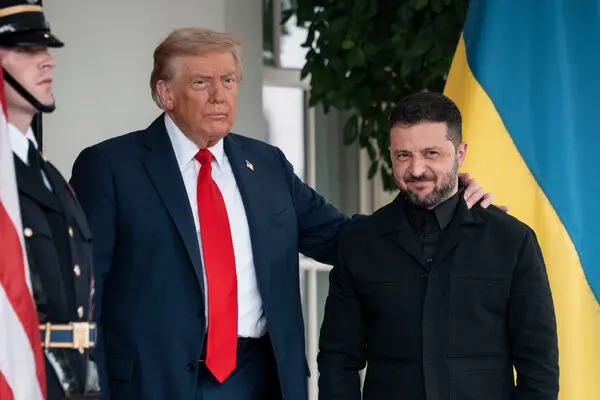
- Zelensky’s intensified strikes inside Russia undermine momentum toward ending the Ukraine war.
- Trump’s 28-point peace plan signals a dramatic U.S. shift toward ending hostilities fast.
- European states encourage Kyiv’s hard line, complicating Washington’s diplomatic initiative.
- Kyiv risks losing U.S. support as Trump insists on a decisive, negotiated settlement.
The fourth year of the Ukraine war has opened with two very different political instincts on display. On one side is former U.S. President Donald Trump, now steering Washington’s policy with an unambiguous pledge: end the war—no matter the diplomatic discomfort it causes. On the other side stands Ukrainian President Volodymyr Zelensky, who has dramatically increased the frequency and intensity of attacks inside Russia, signaling a posture that looks far from readiness for peace.
The latest escalation came on Sunday, when Ukrainian drones struck the Shatura Power Station, 120 kilometers east of the Kremlin, triggering a massive fire, disabling heating networks, and pushing Moscow’s emergency systems into overdrive. Flames shot into the night sky; entire districts were left without heat in freezing temperatures.
Trump the Peacemaker: How Washington’s Unconventional Leader Is Pushing to End the Ukraine War
While Russia has repeatedly hit Ukrainian energy infrastructure, Ukraine had until recently limited its long-range operations to oil depots and border-region installations. Targeting a major power station so deep inside Russian territory is a new, provocative escalation.
Striking such a facility at a moment when Washington is attempting to push both sides toward talks is not a coincidence. It is part of a pattern—a deliberate attempt, many analysts argue, to raise the political cost for Russia just as it signals readiness to consider a negotiated ceasefire.
Trump Pushes for Peace While Kyiv Signals Defiance
The U.S. political establishment was stunned last month when news emerged of a closed-door meeting in Miami involving Trump’s special envoy Steve Witkoff, Jared Kushner, and Russian presidential envoy Kirill Dmitriev. Despite Dmitriev being under sanctions, Trump’s team issued a waiver allowing discussions to proceed—an unprecedented diplomatic move that underscores Trump’s willingness to act decisively outside traditional bureaucratic structures.
READ MORE: Trump says Zelensky can agree to peace plan or ‘fight his little heart out’
The result was a 28-point peace plan, now circulating through Washington, Kyiv, and major European capitals. Trump has made no secret of his confidence. He wants Zelensky to sign by Thanksgiving. And he is willing to leverage the full weight of U.S. support—military, financial, and diplomatic—to compel cooperation.
But Zelensky has responded with defiance. Rather than signaling openness to talks, he has escalated attacks, including the Shatura strike, drone attacks on Moscow airports, and intensified operations near Russian-controlled regions. His public messaging has also hardened, warning Ukrainians that accepting U.S. proposals could mean “losing dignity and freedom”—even as Washington quietly signals that patience is thinning.
Europe Encourages Zelensky’s Escalation
Zelensky’s motive becomes clearer when viewed through the lens of European politics. In Johannesburg, on the sidelines of the G20 summit, European leaders scrambled to soften Trump’s plan and draft a counter-proposal.
ALSO READ: Trump Peace Plan for Ukraine Gains Momentum as Secret Trump–Putin Diplomacy Moves Into Final Phase
France, Germany, Britain, and several Nordic and Baltic states openly stated that Trump’s plan “requires additional work.” The message to Kyiv was unmistakable: hold firm, resist U.S. pressure, and wait for Europe to negotiate better terms.
That encouragement appears to have emboldened Zelensky. European governments fear that a rapid end to the Ukraine war under Trump’s terms would elevate Moscow’s influence and diminish Europe’s strategic role. For Brussels and Berlin, the war is not only about Ukraine—it is about shaping the post-war European order.
The result is an unusual diplomatic triangle: Trump pushing for peace, Russia framing the U.S. plan as acceptable groundwork, and Europe quietly urging Kyiv not to yield too quickly.
Is Zelensky Attempting to Provoke Russia?
The Shatura strike raises a difficult but unavoidable question: Is Zelensky deliberately provoking Russia at a moment when Moscow is signalling readiness to stop the war?
Russia’s response has remained relatively restrained. It downed 75 drones on the night of the attack, temporarily halted flights at Vnukovo Airport, and deployed mobile heating systems to Shatura. But beyond tactical retaliation, Moscow has kept diplomatic channels open—even describing Trump’s plan as “the basis” for a possible settlement.
Zelensky’s calculus appears driven by three factors:
- Maintain European leverage by appearing uncompromising.
- Avoid internal backlash from hard-line nationalist factions.
- Delay negotiations until military conditions improve—which U.S. intelligence assessments say is unlikely.
But by escalating now, Kyiv risks undermining support in Washington. Trump has already warned that Ukraine “does not have the cards,” reminding Zelensky that rejecting the plan may cost him U.S. military backing.
Trump’s Momentum Is Real
For all the controversy, Trump has accomplished something few Western leaders have achieved since 2022: he has both Moscow and European allies discussing a negotiated settlement. European leaders admitted they were caught off guard—but they also acknowledged that Trump’s draft is now the unavoidable basis for talks.
As one U.S. official bluntly put it: “Nothing will be agreed until Trump and Zelensky sit down—but the direction is set.”
Conclusion: Kyiv Risks Isolation
The Ukraine war has drained Ukraine’s economy, depopulated entire regions, and cost more than four years of destruction. Trump’s plan—whatever its weaknesses—has pushed the conflict toward the first serious diplomatic window in years.
But Zelensky’s escalating attacks risk derailing this opening. The more Kyiv strikes deep into Russia, the more it appears unwilling—not unable—to end the conflict. Europe may applaud the defiance, but Washington is sending a different message: peace first, politics later.
As things stand, Trump is marching determinedly toward a negotiated end to the Ukraine war, while Zelensky appears determined to prolong it—regardless of the consequences.