



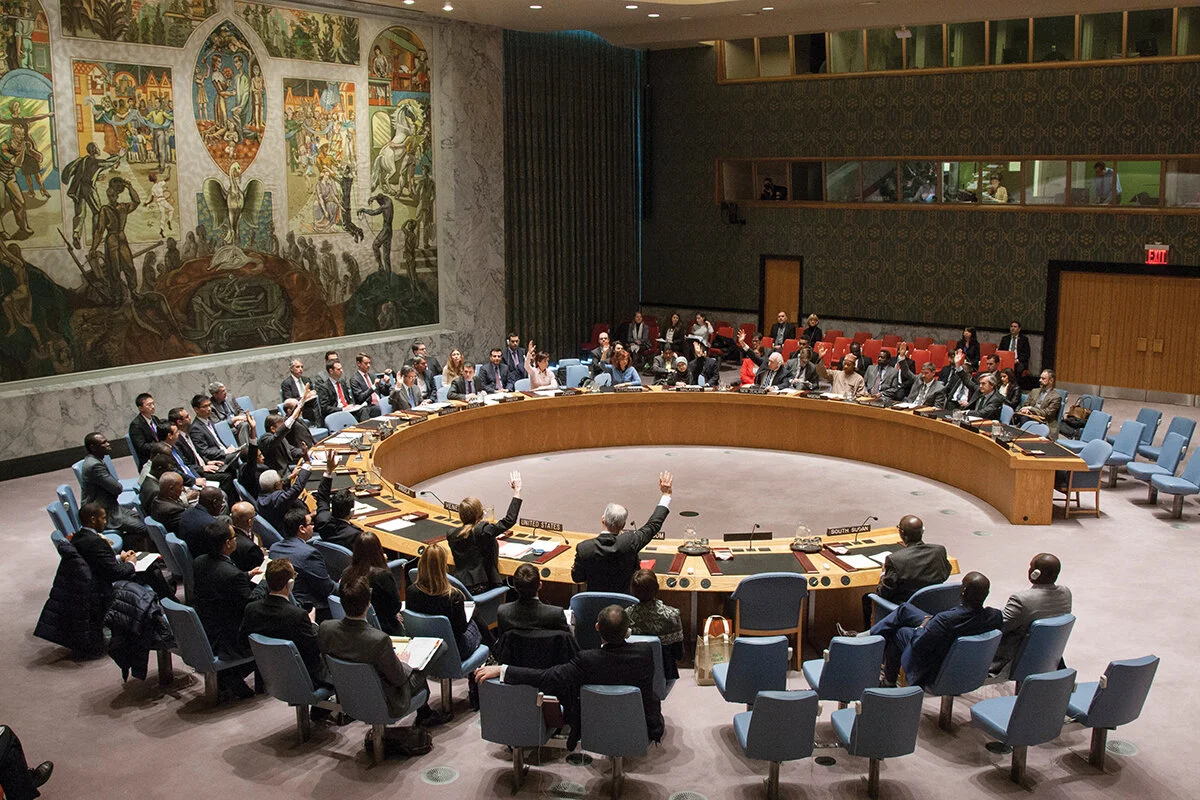
- The UN Security Council unanimously condemned Israel’s unprecedented airstrike on Qatar, warning it threatens regional peace.
- President Trump’s muddled response has raised questions about U.S. credibility and its ability to restrain Israel.
- Qatar’s Prime Minister accused Israel of deliberately sabotaging peace talks hosted in Doha at Washington’s request.
- Netanyahu doubled down, vowing further action against nations harbouring Hamas leaders, defying global criticism.
The plumes of smoke rising over Doha on Tuesday were more than just the remnants of a brazen airstrike—they were the first signs of a geopolitical storm now gripping Washington, Tel Aviv, and the corridors of the United Nations in New York. Israel’s targeted strike against Hamas leaders in the Qatari capital was unprecedented, a deliberate attack inside a sovereign U.S. ally, and it has left the global order teetering on the edge of a new crisis.
The United Nations Security Council (UNSC), often paralysed by divisions, acted with rare unanimity. All 15 members—including the United States, Israel’s most powerful protector—condemned the strike and called for de-escalation. It was not the strongest statement the Council has ever issued, but the symbolism was unmistakable: Israel had crossed a red line.
“Council members underscored the importance of de-escalation and expressed their solidarity with Qatar,” the carefully worded statement read. Drafted by France and the United Kingdom, it avoided naming Israel directly, but the target was obvious.
Exclusive: Trump and Netanyahu’s Heated Clash: Can Trump Restore His Dignity Among Gulf Allies?
At stake was more than just Qatar’s sovereignty. The tiny Gulf nation has long been the hub of delicate negotiations—most recently hosting talks between Hamas leaders and U.S. envoys on a ceasefire deal. That the attack happened in the very moment these negotiations were underway sent shockwaves across the diplomatic world.
Trump’s Uneasy Balancing Act
The immediate question was: what did Washington know, and when?
President Donald Trump, who only months earlier had toured the Gulf celebrating “unbreakable” ties with Qatar, was caught off guard. White House officials admitted the president had not been notified in advance. By the time his envoy Steve Witkoff tried to warn Qatari officials, the missiles were already in the air.
Publicly, Trump expressed unease but stopped short of outright condemnation. “I feel very badly about the location of the attacks,” he told reporters. Later, on social media, he admitted he was “not thrilled” by Israel’s actions.
READ MORE: UN Security Council members condemn Israel over deadly strike on Qatar
His diplomats were less restrained. Acting U.S. Ambassador to the UN Dorothy Shea declared, “Unilateral bombing inside Qatar, a sovereign nation working bravely alongside the United States to broker peace, does not advance Israel’s or America’s goals.” For a U.S. envoy to rebuke Israel so openly at the UN was extraordinary.
Yet, analysts said Trump’s overall response was muddled. “The reaction was contradictory, lacking in substance, and deeply unbefitting of a superpower,” said Khalil Jahshan, executive director of the Arab Center Washington DC. “What Trump has put in jeopardy is whatever is remaining— which is not much—of U.S. credibility in the Middle East.”
Qatar’s Defiance
Inside the Security Council chamber, Qatar’s Prime Minister Sheikh Mohammed bin Abdulrahman bin Jassim Al Thani cut a defiant figure. He reminded the Council that Doha had hosted talks at Washington’s request, and condemned Israel’s “arrogance” and “treachery.”
ALSO READ: Netanyahu’s Qatar Strike and Trump’s Dilemma: What It Means for the Middle East
“This attack was designed to sabotage peace,” he said. “We will continue our humanitarian and diplomatic efforts, but we will not tolerate further breaches of our sovereignty.”
His words carried added weight because Qatar is not just another Gulf state—it hosts Al Udeid, the largest U.S. airbase in the region, less than 20 miles from the building Israel struck. Analysts noted the irony: Israel had bombed within the shadow of America’s most significant military installation in the Middle East.
Global Reaction: Rare Unity, Lingering Doubts
World leaders rushed to condemn the strike. Germany, usually cautious in its criticism of Israel, called the attack “unacceptable.” India, a country that has leaned closer to Israel under Prime Minister Narendra Modi, warned of dangerous escalation. Even Washington’s closest NATO allies expressed unease, with Spain going so far as to announce a formal arms embargo.
But beyond the rhetoric, action remains limited. “Israel has crossed red line after red line and nothing has happened,” said Rob Geist Pinfold, lecturer in international security at King’s College London. “Every time it’s crossed the Rubicon, it’s gone right back and done it again.”
For many in the Arab world, the Doha strike was the final straw. Algeria’s ambassador to the UN, Amar Bendjama, thundered: “Israel behaves as if law does not exist, as if sovereignty is a dispensable notion, as if the UN Charter is ephemeral.”
Rosemary DiCarlo, the UN’s Under-Secretary-General for Political Affairs, went further. “The Israeli attack on Doha potentially opens a new and perilous chapter in this devastating conflict, seriously threatening regional peace and stability,” she warned.
Netanyahu’s Defiance
If the world expected remorse from Israel, it was sorely disappointed. Prime Minister Benjamin Netanyahu doubled down, insisting Hamas leaders were “terrorists” using Doha as a safe haven. In a provocative flourish, he appeared at a U.S. embassy event the next day, joking he had been “otherwise engaged” overseeing the strike.
Later, Netanyahu threatened further action: “To Qatar and all nations who harbour terrorists—you either expel them or bring them to justice. If you don’t, we will.”
This brazenness was not lost on analysts. “Israel is not merely testing the boundaries of international law—it is shattering them,” said Karim Emile Bitar, professor of international relations at Saint Joseph University of Beirut.
A Question of Credibility
For Trump, the dilemma is acute. On one hand, Israel remains America’s closest Middle Eastern partner, recipient of billions in military aid. On the other, Qatar is indispensable: a host of U.S. forces, a major investor in the American economy, and an essential mediator in conflicts from Afghanistan to Gaza.
“Striking a major non-NATO ally like Qatar, during negotiations brokered by the United States, is beyond reckless,” said Matt Duss, vice president at the Center for International Policy. “It raises serious questions about U.S. deterrence and its so-called security umbrella in the Gulf.”
The credibility gap is not new. In 2019, Trump’s first term saw Washington hesitate after attacks on Saudi oil facilities, prompting Gulf states to seek rapprochement with Iran. Now, analysts fear the Doha strike could accelerate Gulf states’ pursuit of “strategic autonomy” away from Washington.
What Happens Next?
The UNSC statement was significant, but non-binding. Israel has ignored similar rebukes before. Whether this time is different hinges on Washington.
“The only figure who can stop them is Donald Trump,” said Geist Pinfold. “The U.S. supplies Israel with weapons, shields it diplomatically, and guarantees its military edge. Without U.S. support, Israel cannot continue this course.”
Yet, there is little sign Trump is ready to wield that leverage. Behind closed doors, he has promised Qatar’s Emir that “such an attack would not happen again.” But Netanyahu, less than 24 hours later, hinted it might.
For many, the suspicion remains that Israel could not have acted without at least tacit American approval. The Al Udeid base’s radars and surveillance systems would almost certainly have detected the strike. “Netanyahu is aggressive, but he is not suicidal,” said Jahshan. “They must have cleared it with the U.S., even if Washington now wants plausible deniability.”
A Perilous Chapter
The attack on Doha has changed the contours of the conflict. It was not merely another strike in Gaza or Lebanon—it was an attack on the soil of a U.S. ally, in the midst of negotiations sanctioned by Washington itself.
As plumes of smoke drifted over Doha’s skyline, the symbolism was stark: if even Qatar is not safe, no capital in the region is.
For now, the world waits to see if Trump will confront Netanyahu, or if the U.S. will again swallow its unease and shield Israel from consequences. The answer may determine not only the trajectory of the Gaza war but the future of America’s role in the Middle East.
“Israel has declared war on international norms,” said Bendjama, the Algerian ambassador. “The question is whether the United States will continue to fight that war alongside it—or finally draw the line.”