



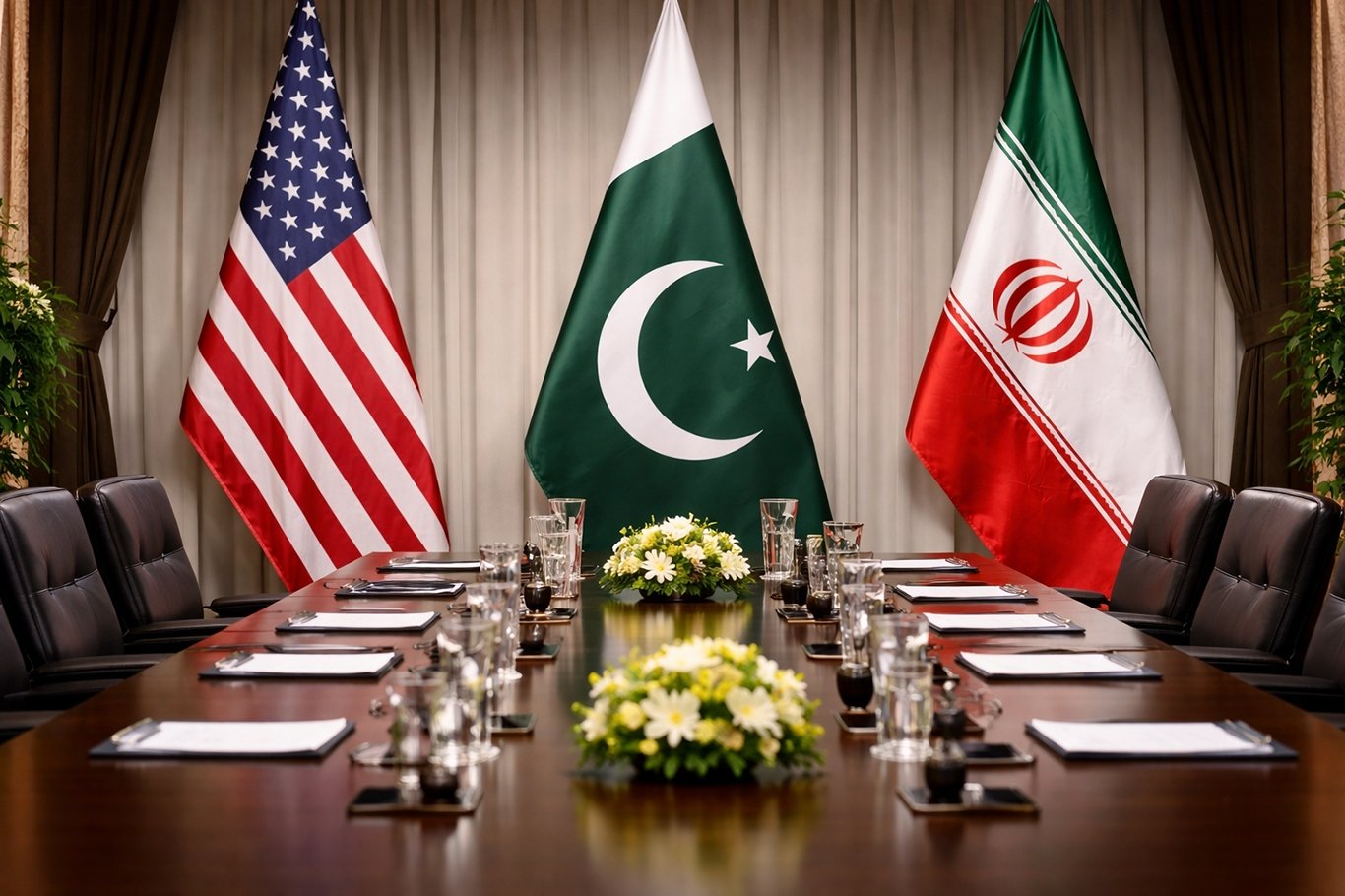
- US-Iran Talks in Islamabad: Islamabad hosts critical US-Iran ceasefire negotiations
- Kushner-Witkoff duo leads Trump’s diplomatic push
- Pakistan emerges as a global peace broker
- Iran demands sanctions relief and control over Hormuz
- Oil prices surge amid supply disruption fears
- Visa-on-arrival policy boosts global participation
Islamabad is poised to host one of the most consequential diplomatic engagements in recent years, as high-stakes talks between the United States and Iran unfold under intense global scrutiny. With tensions in the Middle East still simmering and a fragile ceasefire hanging in the balance, all eyes are on Pakistan’s capital—now emerging as an unlikely but decisive arena for peace.
At the center of this unfolding drama is a powerful American trio led by Jared Kushner, flanked by Steve Witkoff and U.S. Vice President J. D. Vance. The Kushner-Witkoff duo, in particular, is widely expected to show its charisma and diplomatic muscle, having already earned a reputation as two of Donald Trump’s most trusted and loyal lieutenants.
Their rise to prominence has been nothing short of remarkable. Kushner, Trump’s son-in-law, carved his place in the former president’s inner circle through a series of high-risk diplomatic assignments, often succeeding where seasoned policymakers hesitated. Witkoff, a close confidant of Trump, complemented that approach with quiet but effective backchannel negotiations across volatile regions. Together, they represent a blend of loyalty, ambition, and unconventional diplomacy that has come to define Trump-era foreign policy.
Trump himself has often described Kushner in almost mythic terms, calling him a rare blend of “three bigs”—Sun in Capricorn, Moon in Pisces, and Rising in Taurus. According to those close to the former president, this combination symbolizes discipline, intuition, and steadiness—qualities Trump believes make Kushner uniquely suited for daunting geopolitical tasks. Observers say this perception has elevated Kushner to the center stage of some of Washington’s most sensitive diplomatic missions.
Known for his relentless drive, Kushner is said to pursue excellence with near tunnel vision. Reserved in public yet deeply loyal in private, his calm demeanor often masks a sharp strategic mind. Witkoff, standing firmly beside him, brings a pragmatic edge, while Vance—widely seen as one of the administration’s more anti-war voices—adds political depth to the delegation. Together, the trio is expected to dominate the tone and trajectory of the Islamabad talks.
On the Pakistani side, the stage has been meticulously set by Field Marshal Asim Munir and Prime Minister Shehbaz Sharif. Munir, often described as a disciplined and strategic thinker shaped by his Capricorn alignment in Vedic astrology, is increasingly being viewed as the kingmaker behind Islamabad’s emergence as a global diplomatic hub. His calculated approach, combined with Sharif’s political stewardship, has positioned Pakistan as a credible mediator at a critical juncture.
In a significant facilitative move, Deputy Prime Minister and Foreign Minister Ishaq Dar announced visa-on-arrival access for foreign delegates and journalists attending the Islamabad Talks 2026. In a public statement, he confirmed that airlines had been instructed to allow boarding without prior visas, with immigration authorities issuing visas upon arrival. The move is widely seen as an effort to boost global participation and signal Pakistan’s openness as a host of a major diplomatic initiative.
Iran’s delegation, led by Parliament Speaker Mohammad Bagher Qalibaf and Foreign Minister Abbas Araghchi, arrives with firm demands. These include sanctions relief, control over the Strait of Hormuz, guarantees against future military action, and the release of frozen assets—conditions that remain contentious in Washington and among Western allies.
The stakes could not be higher. The Strait of Hormuz, through which nearly a fifth of the world’s oil supply passes, has become a central flashpoint. Iran’s threat to regulate or even restrict passage has already rattled global markets. Oil prices surged in early trading, with Brent crude nearing $97 per barrel and U.S. West Texas Intermediate climbing close to $99, reflecting mounting fears of prolonged disruption.
Energy analysts warn that continued instability could push prices dramatically higher. Some estimates suggest Brent could soar to as much as $190 per barrel if flows through the strait remain constrained. The situation has been further aggravated by attacks on Saudi energy infrastructure, cutting production and intensifying what analysts describe as a “measurable supply shock” to global markets.
Despite a two-week ceasefire brokered with Pakistan’s involvement, fighting continues in parts of the region, including Israeli strikes in Lebanon. Disagreements over whether Lebanon is covered under the ceasefire have exposed deep mistrust between the parties. While Trump has described Lebanon as a “separate track,” he has also urged restraint, signaling concern that escalation could derail negotiations.
Behind closed doors in Islamabad, negotiators face the daunting task of reconciling these differences. Iran’s proposal to charge transit fees in the Strait of Hormuz has already drawn resistance from Western powers and international maritime authorities, further complicating the path to a durable agreement.
Yet, there remains cautious optimism. The White House has described the talks as “ongoing,” and Trump has indicated that a workable framework may still be within reach. For Pakistan, the moment represents more than diplomatic hosting—it is a chance to redefine its global role as a mediator capable of bridging some of the world’s most entrenched divides.
What makes these talks particularly compelling is the convergence of powerful personalities shaping their outcome. From Kushner’s calculated ambition and Witkoff’s quiet diplomacy to Munir’s strategic discipline and Vance’s political pragmatism, Islamabad’s corridors of power are witnessing a rare alignment of influence.
As the world watches, Pakistan stands at the heart of a defining geopolitical moment—hosting not just negotiations, but the possibility of averting a wider regional catastrophe and stabilizing a fragile global order.