



- US-Iran talks Islamabad begin with arrival of JD Vance-led high-level US delegation
- Pakistan transforms Islamabad with elaborate स्वागत, security, and diplomatic arrangements
- Israel halts Lebanon strikes while Iran signals release of American detainees
- Parallel diplomacy underway as Washington prepares Israel-Lebanon talks
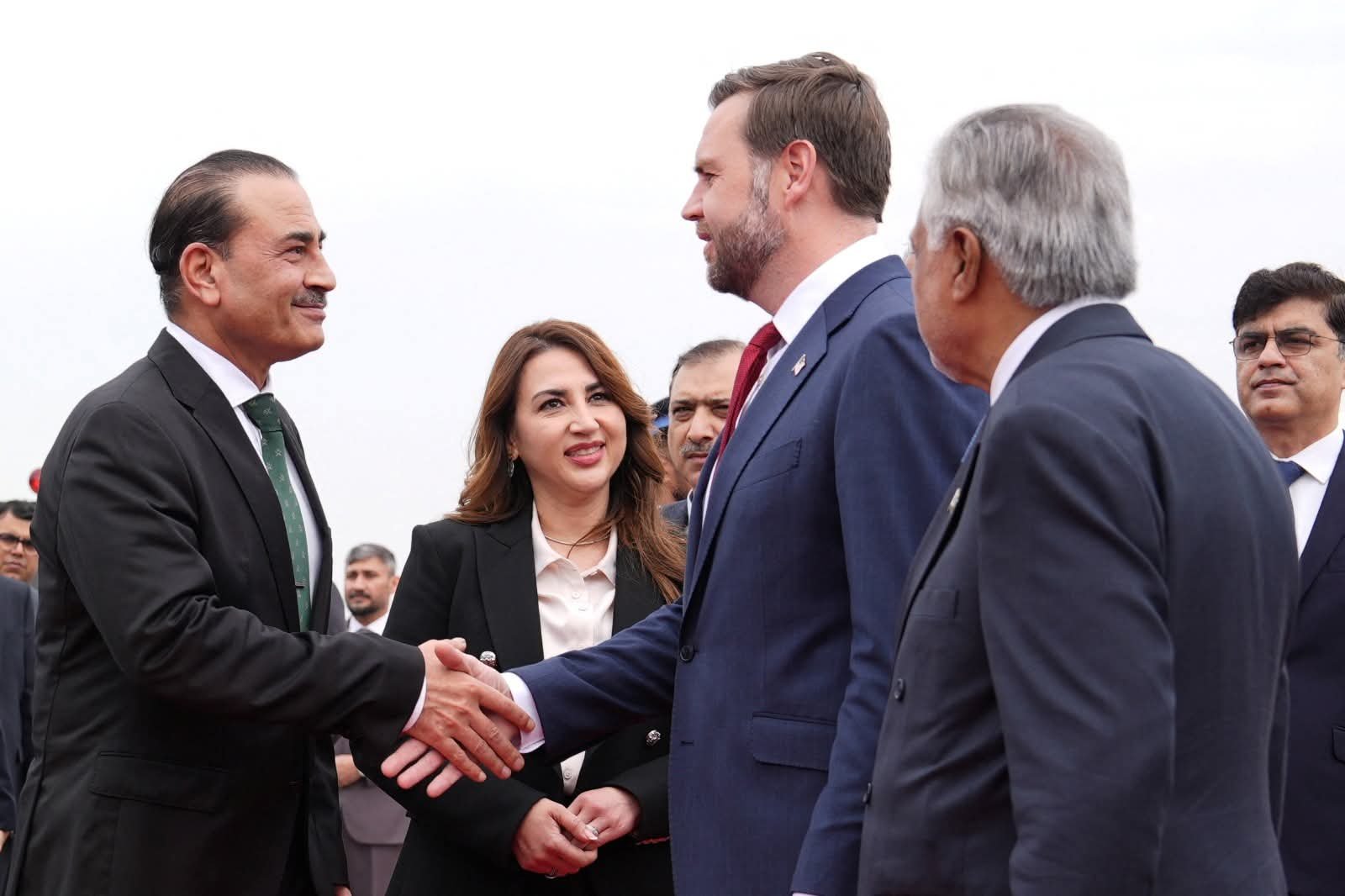
Islamabad — A high-powered United States delegation led by Vice President JD Vance arrived in Islamabad on Saturday, marking the formal commencement of what could become one of the most consequential diplomatic engagements in recent history. Accompanied by senior envoy Steve Witkoff and former presidential adviser Jared Kushner, the delegation was received with full state protocol, underscoring Pakistan’s central role in mediating between Washington and Tehran.
At the airport, the American delegation was welcomed by Deputy Prime Minister and Foreign Minister Ishaq Dar, Chief of Army Staff Field Marshal Asim Munir, and Interior Minister Mohsin Naqvi. The reception reflected not just diplomatic courtesy, but a carefully calibrated signal: Pakistan is fully invested in ensuring that the talks yield a meaningful breakthrough.
Across Islamabad, the atmosphere has been transformed. Key boulevards, from Constitution Avenue to the Diplomatic Enclave, have been adorned with large billboards and banners celebrating “Pakistan–U.S. Friendship” and “Pakistan–Iran Brotherhood.” Streets have been lined with flags of all three nations, while security has been tightened with precision—yet without disrupting the rhythm of the capital. Government buildings have been illuminated, and welcome signage in English, Urdu, and Persian has been installed, projecting a message of unity and diplomatic hospitality.
Officials described the preparations as “unprecedented in scale,” with multiple ministries working in coordination to ensure seamless logistics, security, and protocol. Special routes have been designated for delegations, while high-level meeting venues have been upgraded with advanced communication and security infrastructure.
“This is not just about hosting talks; it is about creating an environment of trust,” a senior Pakistani official told The Islamabad Telegraph. “Every detail—from the streets to the meeting rooms—has been designed to facilitate dialogue.”
The mood of the negotiations had already been set even before the delegations arrived. In a significant diplomatic move, the administration of Donald Trump successfully pressed Israel to halt its military operations in Lebanon, removing a major obstacle that had threatened to derail the fragile ceasefire framework. The decision by Benjamin Netanyahu to suspend strikes has been widely interpreted as a signal of Washington’s seriousness in pursuing a negotiated outcome.
Equally important, Iran has indicated its willingness to release American detainees—a step seen by diplomats as a critical confidence-building measure. While details remain under negotiation, the move has already generated cautious optimism among officials and observers.
“The fact that both sides have taken parallel steps before even sitting at the table is significant,” said a senior diplomat. “It suggests there is genuine intent to find common ground.”
Despite the positive signals, challenges remain formidable. The talks are expected to address contentious issues including Iran’s nuclear program, sanctions relief, and control over the strategically vital Strait of Hormuz. Public rhetoric has remained sharp, with both Washington and Tehran accusing each other of bad faith in the lead-up to negotiations.
Yet behind closed doors, there is growing recognition that the costs of continued conflict are unsustainable. For the Trump administration, rising fuel prices and domestic political pressure have added urgency to the search for a diplomatic resolution. For Iran, prolonged isolation and economic strain have created incentives to explore an exit from confrontation.
As negotiations begin in Islamabad, parallel diplomatic efforts are also unfolding elsewhere. In Washington, preparations are underway for separate U.S.-brokered talks between Israel and Lebanon, aimed at consolidating the ceasefire and preventing a broader regional escalation. The dual-track diplomacy underscores a coordinated effort to stabilize multiple flashpoints simultaneously.
Vice President Vance, speaking briefly before departure, struck a cautiously optimistic tone. “If the Iranians are willing to negotiate in good faith, we are ready to extend an open hand,” he said.
For Pakistan, the stakes are both strategic and symbolic. By bringing adversaries to the negotiating table, Islamabad is positioning itself as a credible mediator on the global stage—an outcome that could reshape its diplomatic profile for years to come.
As motorcades moved through Islamabad’s decorated avenues and delegations settled into high-level discussions, a sense of guarded hope prevailed. The road ahead is uncertain, and the gaps between the two sides remain wide. But for now, in a city dressed for diplomacy, the possibility of peace—however fragile—feels within reach.