



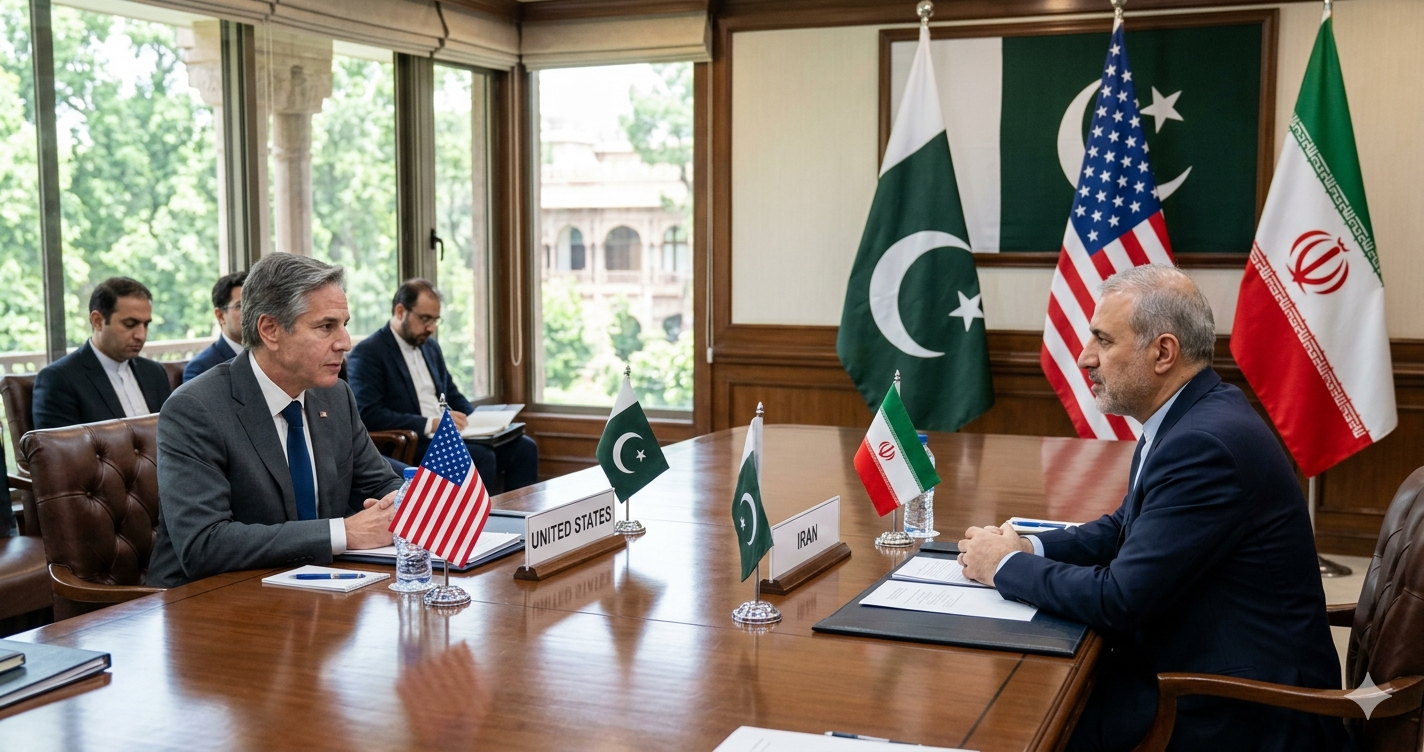
- US Iran talks Islamabad enter critical phase as ceasefire nears expiry
- Trump administration pushes maximalist demands on Iran’s nuclear program
- Strait of Hormuz tensions raise fears of global oil disruption
- Pakistan emerges as key mediator amid rising geopolitical stakes
The next round of U.S.–Iran negotiations in Islamabad is shaping up less like a peace conference and more like a stress test for two governments boxed in by their own public narratives. Pakistan’s leadership is still preparing the venue, the security perimeter, and the diplomatic choreography, but the core question remains unchanged: can Washington and Tehran convert a collapsing ceasefire into a political framework, or are both sides simply buying time before the war resumes?
Where the Talks Stand Now
The first Islamabad round on April 11–12 ended without an agreement, despite 21 hours of direct and indirect exchanges. The U.S. delegation—Vice President JD Vance, special envoy Steve Witkoff, and Jared Kushner—pressed Iran on six redline issues: ending all uranium enrichment, surrendering enriched uranium stockpiles, dismantling major enrichment facilities, halting support for Hezbollah, Hamas, and the Houthis, establishing a broader regional security framework, and fully reopening the Strait of Hormuz without tolls. Iran rejected these demands outright.
Trump’s Iran Confusion Deepens as Contradictory Statements Shake Washington Ahead of Islamabad Talks
The breakdown triggered immediate escalation. Within hours, President Trump announced a naval blockade of the Strait of Hormuz, ordering the U.S. Navy to intercept any vessel entering or leaving Iranian ports. He framed the move as a refusal to “be extorted,” and warned that any Iranian attack on U.S. or civilian vessels would be met with overwhelming force.
Since then, the situation has only grown more volatile. Iran closed the Strait again, global oil prices spiked, and both sides accused each other of violating the twoweek ceasefire that expires on April 22. Tehran has not yet committed to attending the second round, though Pakistani officials insist the refusal is “posturing” aimed at extracting concessions.
What the U.S. Is Bringing to Islamabad
Washington’s position is unusually transparent because Trump has been broadcasting it in real time. The administration’s demands remain maximalist: Iran must abandon any pathway to a nuclear weapon, reopen the Strait unconditionally, and halt support for regional proxy groups. Vance has reiterated that without an “affirmative commitment” on the nuclear issue, no agreement is possible.
Iran-US Talks in Islamabad: Iran Sends High-Powered Delegation Despite Strait of Hormuz Crisis
The U.S. delegation is prepared to return to Islamabad “soon,” though the White House has contradicted Trump’s own statements about timing. Trump told reporters the team would arrive Monday night; officials later clarified no departure had occurred.
The U.S. strategy appears to rely on pressure rather than compromise. The blockade is designed to force Iran back to the table under worsening economic strain. But it also risks hardening Tehran’s position, especially as Iranian leaders face domestic pressure not to appear weak.
What Iran Is Bringing—If It Comes at All
Iran’s stance is equally rigid. Tehran insists the U.S. blockade violates the ceasefire and has accused Washington of “excessive demands” and shifting positions.
U.S. delegation’s departure for Islamabad delayed as Iran ceasefire nears expiration
Iranian officials say they will not transfer enriched uranium “under any circumstances,” calling it as sacred as Iranian soil. They also reject any suggestion that they agreed to halt support for regional militias. Tehran’s messaging emphasizes sovereignty, resistance, and mistrust of U.S. intentions.
Still, Pakistani intermediaries say Iran is “willing for a second round,” even if it has not formally committed. The refusal to confirm attendance may be a negotiating tactic rather than a final decision.
Trump’s Current Stance on Social Media
Trump’s Truth Social posts over the last several days have swung between triumphalism and threat.
On April 17, he claimed Iran had “agreed to everything,” including surrendering enriched uranium and permanently opening the Strait of Hormuz. Iranian officials immediately denied this.
Why the UAE Cannot Be Ignored in Iran Talks
He later escalated his rhetoric, warning that if Iran did not sign a U.S.-backed deal, the “whole country is getting blown up.”
On April 21, he posted that “Iran has violated the cease fire numerous times,” without providing details.
This pattern—publicly declaring victory, then threatening annihilation—has complicated the diplomatic environment. Analysts note that Trump’s statements have repeatedly forced Iranian officials to publicly contradict him, narrowing Tehran’s room for maneuver and undermining backchannel progress.
What to Expect in Islamabad
If Iran attends, expect a negotiation defined by three immovable obstacles:
- The nuclear file: The U.S. demands total rollback; Iran insists on its right to a civilian program.
- The Strait of Hormuz: Washington wants unconditional reopening; Tehran views the blockade as an act of war.
- Proxy groups: The U.S. wants Iran to cut support; Iran sees these networks as strategic depth.
Pakistan’s mediators remain optimistic, and the EU has publicly endorsed Islamabad’s role, calling the world “watching with great expectation.” But optimism alone cannot bridge structural gaps.
The talks may produce a temporary extension of the ceasefire—if only because neither side wants to be blamed for its collapse. But a comprehensive agreement remains unlikely unless one party recalibrates its public position. So far, neither Washington nor Tehran shows any sign of doing so.