



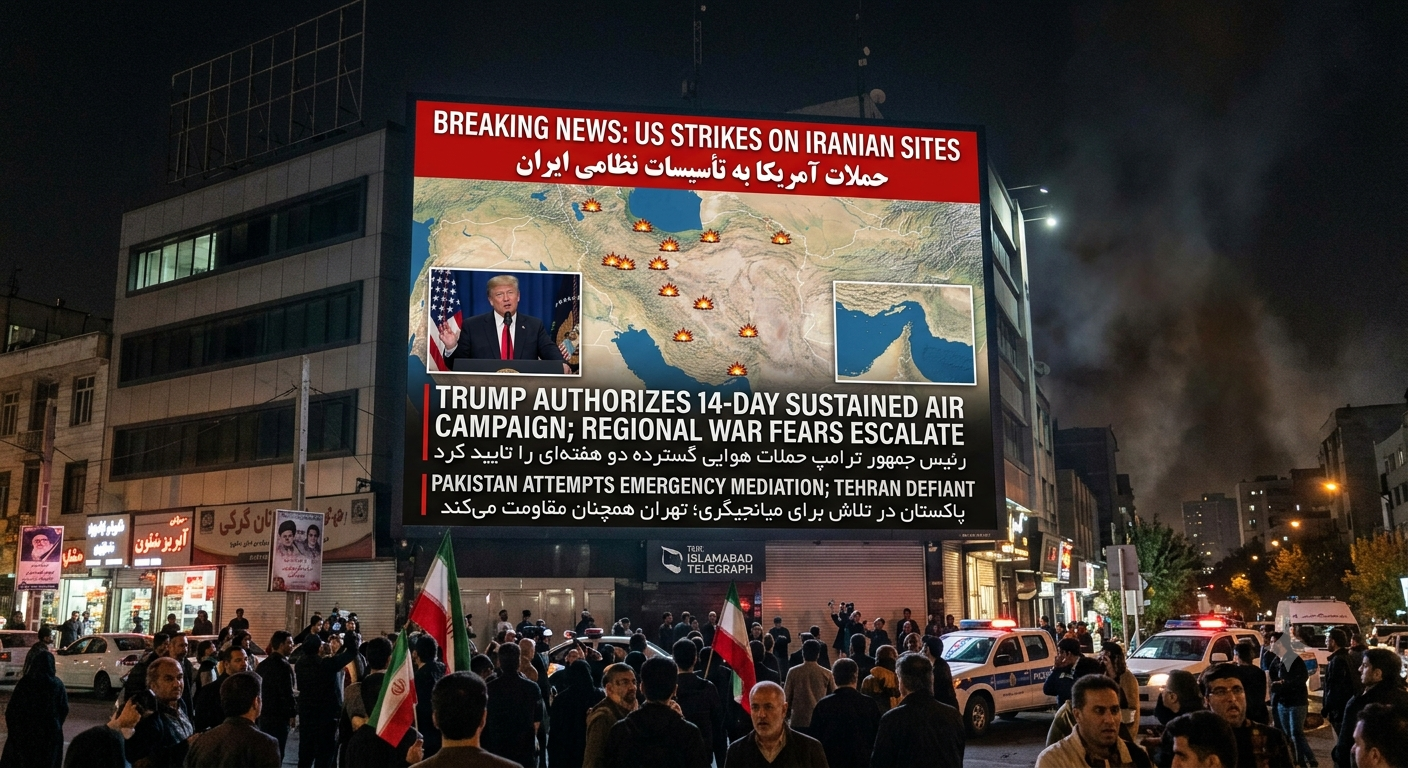
- US strike on Iran greenlit by President Donald Trump as a sustained 14-day military air campaign targeting subterranean missile silos and coastal command infrastructure.
- Sustained escalation chokes off global crude routes along the Strait of Hormuz, driving Brent crude toward record high price surges.
- Pakistan maintains open diplomatic mediation channels to bring Washington and Tehran back to negotiations, ignoring sharp public rhetoric from Iranian analysts.
- Joint operations across the GCC and the Red Sea amplify regional defense alerts following retaliatory strikes on Middle Eastern trade corridors.
WASHINGTON / ISLAMABAD — The military confrontation in the Middle East has escalated into a decisive, high-intensity conflict. President Donald Trump has formally authorized U.S. Central Command (CENTCOM) to execute a sustained, two-week military air campaign targeting critical Iranian military installations.
According to senior intelligence and defense sources in Washington, the upcoming offensive represents the largest and most aggressive U.S. aerial operation in the region to date, engineered specifically to neutralize Tehran’s ballistic missile infrastructure, drone command nodes, and coastal defense systems.
The formal authorization follows a landmark report broken earlier this week on July 30, 2026, by The Islamabad Telegraph, which first revealed President Trump’s intent to approve a broad, 14-day bombardment strategy. Building on initial targeting frameworks greenlit on July 1, 2026, White House press secretary Karoline Leavitt confirmed the strategic shift, noting that the administration will take all necessary action to dismantle Iran’s warfighting capacity and restore deterrence.
“We will be hitting them very hard,” President Trump stated during a high-level briefing at Camp David, citing repeated breakdowns in backchannel negotiations and recent Iranian-backed strikes on U.S. positioning in Jordan. “At some point, they are going to realize they just can’t take it anymore.”
Pakistan Pushes Diplomacy as U.S. Strike on Iran Threatens Wider Conflict
US Strike on Iran: Escalation Map & Regional Impact
US strike on Iran is a reality. The target set for the two-week campaign covers deep-inland and coastal defense infrastructure across the Islamic Republic, alongside active operating zones across the Persian Gulf:
- Primary Target Zones: Deeply buried centrifuges and underground storage facilities at Pickaxe Mountain, missile launch corridors in Bushehr, coastal anti-ship batteries in Bandar Abbas, and drone assembly nodes on Qeshm Island.
- Active Proxy Hubs: Joint U.S. and Saudi airstrikes continue to target Houthi offensive installations in Yemen along the Bab-el-Mandeb corridor.
- Gulf Security Axis: Air defense forces across GCC nations—including Kuwait, Bahrain, and the UAE—remain on peak intercept alert following Iranian retaliatory drone and missile vectoring against regional infrastructure.
+-------------------------------------------------------------------------+
|                    MIDDLE EAST WAR ESCALATION MATRIX                   |
+-------------------------------------------------------------------------+
|  THE RED SEA / SUEX        |  THE PERSIAN GULF        |  DIPLOMATIC HUB  |
|  Bab-el-Mandeb Strait      |  Strait of Hormuz        |  Islamabad /     |
|  • US-Saudi Strikes        |  • 20M bpd Bottleneck     |  Muscat          |
|  • Houthi Anti-Ship Ops    |  • IRGC Mining & Jams    |  • Emergency     |
|  • Commercial Rerouting    |  • 300%+ Insurance Hikes  |    Mediation     |
+-------------------------------------------------------------------------+
GCC Conflict Expands as Western Allies Maintain Strategic Silence
The approval of full-spectrum deep US strike on Iran signals a total shift away from targeted containment. Coordinated U.S. and Saudi Arabian aerial operations have intensified against Iran-backed Houthi forces in Yemen to protect commercial lanes, yet counter-strikes have expanded the operational envelope. Almost every state across the Gulf Cooperation Council (GCC) has endured Iranian missile, drone, or electronic-warfare retaliatory attacks.
READ NEXT: U.S. Strike on Iran: 2-Week Decisive Military Campaign Aims to Cripple Tehran’s War Capabilities
While major European and NATO allies have largely maintained a cautious diplomatic silence regarding Washington’s expanding target list, Pentagon planners emphasize that destroying Iran’s remaining 20% to 25% missile reserve is an operational imperative to shield international maritime transit and military outposts.
Islamabad Pushes Mediation Amid Defiant Rhetoric from Tehran
Against the backdrop of imminent US strike on Iran, Pakistan continues to spearhead emergency diplomatic efforts to bring the U.S. and Iran back to the negotiating table. Working alongside regional facilitators, Pakistani authorities have maintained open backchannels to broker a temporary cessation of hostilities and prevent a full-scale regional crisis.
However, diplomatic efforts face severe ideological friction. Iranian state media and policy commentators have publicly dismissed Western pressure, issuing sharp warnings against underestimating Tehran’s resilience:
“Iran is not Egypt, Pakistan, Turkey, or Saudi Arabia. Iran will defeat the USA.”
Despite the explicit reference to regional powers, Pakistani authorities have deliberately refrained from responding to the Iranian analysts’ remarks, choosing instead to maintain a strictly non-confrontational posture focused entirely on immediate de-escalation and regional stabilization.
READ MORE: Trump Orders Fresh Attack Against Iran as War Enters Sixth Month
Global Economic Impact: Hormuz Bottleneck & Energy Volatility
The persistent military escalation has sent shockwaves through global commodity markets, placing unprecedented strain on global energy distribution:
| Economic & Energy Metric | Current Status / Impact | Regional & Global Consequence |
| Crude Oil Prices (Brent) | Surged past $96–$100+ / barrel | Spiking transport overhead and accelerating global headline inflation. |
| Strait of Hormuz Bottleneck | ~20 Million bpd (20% of global supply) disrupted | Commercial shipping traffic halted due to IRGC mine-laying and vessel interception. |
| Maritime Insurance | War-risk premiums up >300% | Global container lines rerouting around the Cape of Good Hope. |
| GCC Agricultural Imports | 70%+ food import routes impacted | Regional emergency stockpiling and airlift maneuvers across Gulf states. |
| Fertilizer & LNG Trade | 30% of global urea, 20% of LNG stalled | Impending supply chain bottlenecks for Asian and European manufacturing hubs. |
US Strike on Iran: The Strategic Horizon
As U.S. naval assets and strategic bomber wings prepare for the execution phase of the two-week campaign, global markets and regional capitals remain on high alert. Military strategists note that while the campaign aims to degrade offensive launch capacity, Iran’s dispersed and subterranean defense network presents significant resistance.
Trump’s Middle East Strategy
Whether Pakistan’s non-aligned diplomatic channel can secure a last-minute operational pause before the full weight of the U.S. strike force descends will dictate whether the Middle East enters a prolonged multi-year conflict or finds an avenue toward de-escalation.