



-
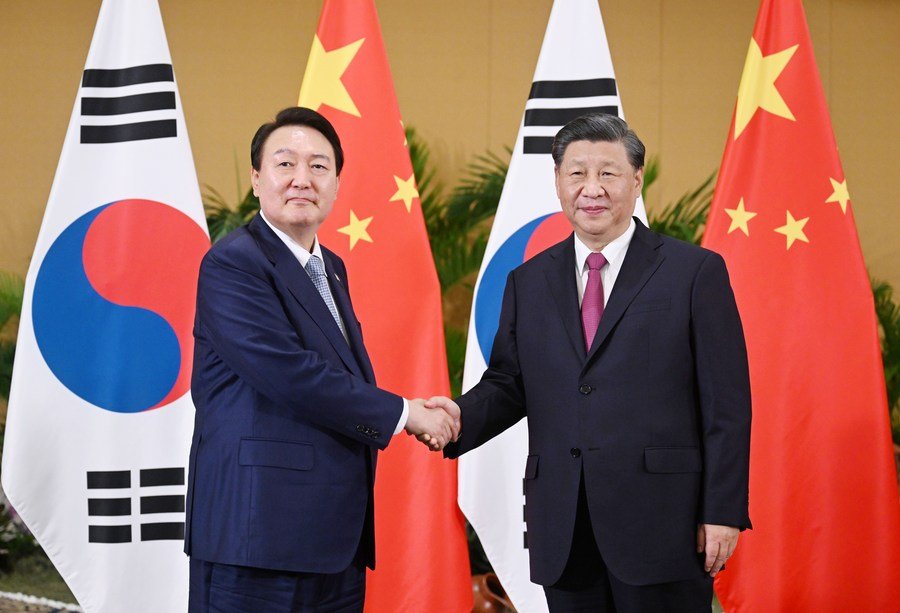
Xi Jinping’s visit to South Korea in 11 years signals Beijing’s renewed diplomatic focus on the Korean Peninsula.
-
President Lee Jae Myung seeks to balance U.S. military security with Chinese economic integration.
-
Trump’s absence at APEC gave China the opportunity to position itself as a stable global leader.
-
Seoul’s strategy may define whether Asia tilts toward bipolar confrontation or cooperative coexistence.
Chinese President Xi Jinping’s first visit to South Korea in 11 years has become a geopolitical test case for how middle powers navigate great power rivalry. As Xi wraps up his three-day stay in the historic city of Gyeongju, newly elected South Korean President Lee Jae Myung finds himself at the intersection of competing demands — a deep military alliance with Washington and an economic dependency on Beijing that defines Seoul’s prosperity.
Lee, who took office in June after his predecessor’s downfall over a failed martial law attempt, is now crafting a doctrine of “strategic balance.” It’s a delicate maneuver — one where a single diplomatic misstep could alter the stability of Northeast Asia.
A TALE OF TWO SUMMITS
In a rare diplomatic convergence, President Lee hosted both U.S. President Donald Trump and Chinese President Xi within the same week. Trump’s whirlwind visit yielded a surprise trade deal — a reduction in U.S. tariffs in exchange for billions of dollars in South Korean investment in American industries. The arrangement, while politically rewarding for Trump’s reelection campaign, tied South Korean corporations even more closely to the U.S. supply chain.
Xi’s visit, however, sought to tilt the balance. On Saturday, during the closing day of the Asia-Pacific Economic Cooperation (APEC) summit, Xi held an expansive bilateral meeting with Lee.
When Trump Met Xi: Inside the Seoul Summit That Shook the World Economy
They discussed denuclearization, artificial intelligence cooperation, and regional trade frameworks — all framed within China’s broader push to present itself as a predictable champion of global stability amid Trump’s erratic foreign policy.
THE BALANCING ACT: CHINA VS. U.S.
South Korea’s challenge is structural. It is America’s seventh-largest trading partner but China’s fourth. In 2024, South Korea’s exports to China reached $136 billion, representing about 25% of its total trade, while trade with the U.S. stood at $93 billion. Yet, Seoul hosts 28,500 U.S. troops, and its national defense strategy is built around the U.S. nuclear umbrella.
This dual dependency creates friction. When South Korea deployed the U.S.-led THAAD missile defense system in 2017, Beijing retaliated with informal sanctions — banning Korean cultural exports and tourism. The entertainment ban cost South Korea an estimated $7.5 billion in 2018 alone. Lee’s government hopes Xi’s visit will mark the end of that informal boycott, reviving a lucrative cultural pipeline from K-pop to dramas that once captivated Chinese audiences.
READ MORE: Trump Goes Nuclear: U.S. to Resume Atomic Tests After 33 Years, Igniting a Global Shockwave and Fears of a New Arms Race
But security concerns remain. China’s construction of new structures in disputed maritime zones near South Korea’s exclusive economic area has reignited maritime tensions, even as both sides avoid escalation.
THE APEC ANGLE: AI AND GLOBAL LEADERSHIP
At APEC, Xi unveiled a proposal for a World Artificial Intelligence Cooperation Organization, a move interpreted as a bid to shape global technology governance. South Korea, a global tech powerhouse, supported the proposal conditionally, calling for AI transparency and data ethics. President Lee’s remarks emphasized regional collaboration on demographic and technological transformation — a subtle signal that Seoul sees innovation as a bridge between rival blocs.
ALSO READ: Trump hails ‘amazing’ meeting with China’s Xi but no formal trade deal agreed
The United States, meanwhile, skipped the summit’s main session, with Trump delegating much of the APEC engagement to his trade officials. This absence gave Beijing room to project itself as the steady hand of globalization, a role historically dominated by Washington.
A South Korean diplomat speaking anonymously told Reuters, “Trump’s absence gave Xi a stage — and he used it skillfully. South Korea wants to stay close to the U.S., but it cannot afford to alienate China when its economic recovery depends on exports.”
PYONGYANG’S SHADOW
No summit in Korea is complete without the North. Xi and Lee reaffirmed their commitment to denuclearization of the Korean peninsula, though Pyongyang swiftly dismissed it as a “pipe dream.” North Korea’s statement was a blunt reminder that despite Xi’s leverage, Beijing’s influence over Kim Jong Un is not absolute.
Trump had floated another direct meeting with Kim during his brief stay, but there was no response from Pyongyang. Analysts suggest that North Korea is watching Seoul’s diplomatic juggling act closely, using the rivalry to extract concessions from both Washington and Beijing.
COMPARING APPROACHES: XI’S CALM VS. TRUMP’S TRANSACTIONALISM
Xi’s diplomacy during this tour contrasts sharply with Trump’s approach. While Trump’s visits are characterized by rapid deal-making and visible transactional gains, Xi prefers slow, symbolic diplomacy that builds influence over time.
Trump’s tariff reductions are immediate but reversible; Xi’s charm is subtle but persistent.
Under Trump, the U.S. has maintained a tariff wall averaging 15% on Chinese goods, even after limited rollbacks this week in exchange for crackdowns on fentanyl exports and resumed soybean imports. In contrast, China continues to present itself as the anchor of free trade, announcing that it will host APEC 2026 in Shenzhen, signaling continuity and openness.
Economists note that China’s bilateral trade with South Korea surpassed $300 billion in 2023, compared to $216 billion between the U.S. and South Korea, underscoring that Seoul’s economic fate remains deeply tied to Chinese markets, despite its military alliance with the U.S.
SEOUL’S STRATEGIC CROSSROADS
As Xi departs Gyeongju, South Korea’s balancing act becomes more precarious. President Lee’s twin summits have amplified Seoul’s global relevance — but also its vulnerability. To Washington, South Korea is a reliable ally in containing China; to Beijing, it’s a test case for non-alignment in the Pacific.
The next year will reveal whether Lee can sustain this tightrope walk. If he fails, South Korea risks becoming a casualty of the new Cold War — trapped between the ambitions of two superpowers it cannot afford to anger.