



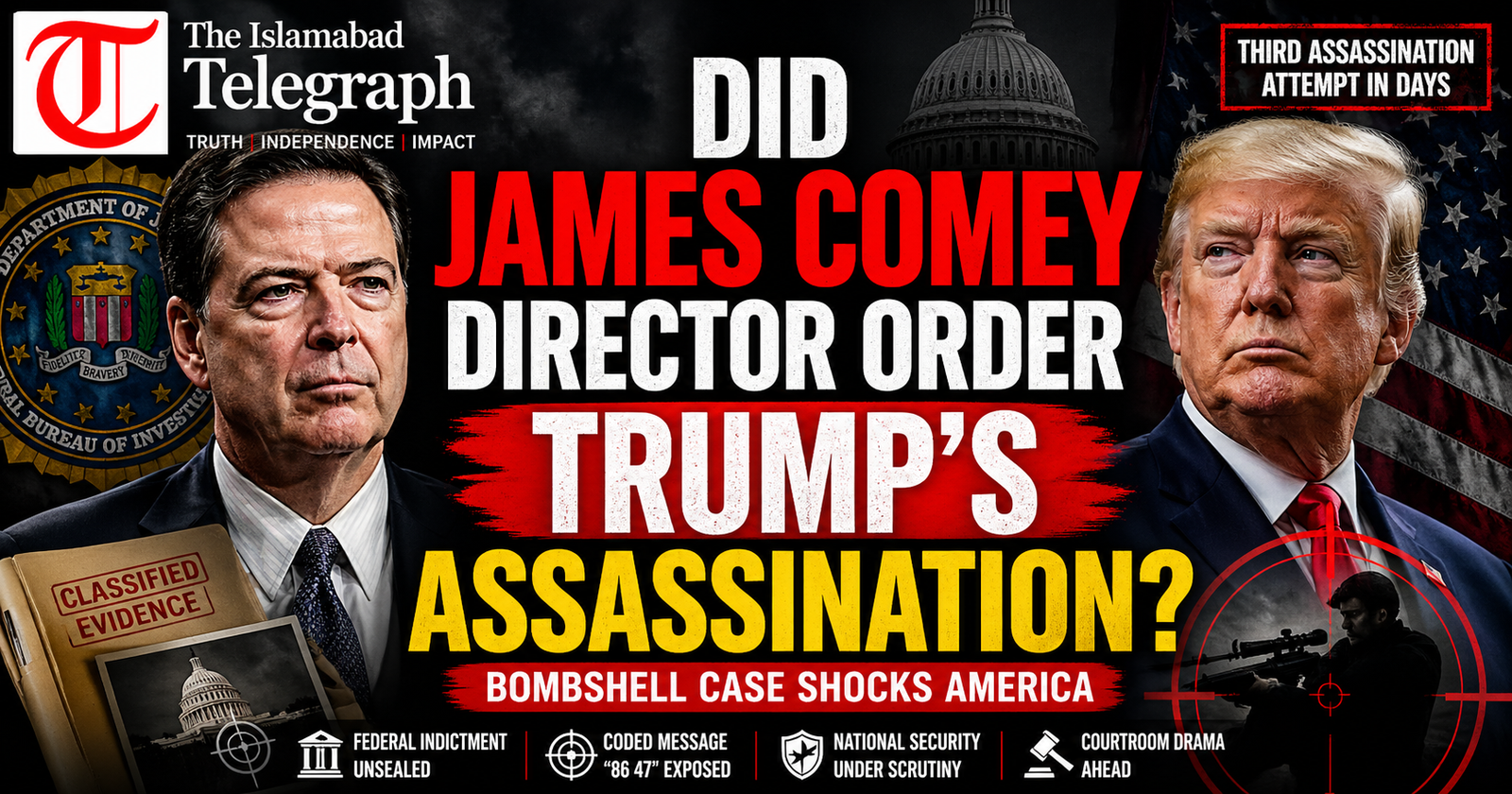
- Former FBI Director Indictment sends shockwaves across the United States amid rising political violence
- Case linked to cryptic “86 47” message and alleged incitement concerns
- Follows third assassination attempt targeting the U.S. President, raising security fears
- Legal experts call it a defining test for America’s justice system and free speech limits
The indictment landed with the force of a thunderclap.
In a sealed courtroom in Raleigh, North Carolina, under heightened security and an air thick with suspicion, a federal grand jury returned charges against a former director of the nation’s most powerful investigative agency—a man once entrusted with guarding the republic’s deepest secrets.
Now, he stood accused of something far darker: incitement linked to a chilling coded message that prosecutors argue foreshadowed violence against the Commander-in-Chief.
The timing could not have been more explosive. Just days earlier, the country had reeled from its third attempted assassination against the President in less than a year. Each attempt had raised urgent questions about security failures. But this latest development struck at something even more unsettling: whether the threat had roots not just in fringe extremism—but within the corridors of power itself.
Inside the Trump Assassination Attempt That Turned a White House Gala Into Chaos
At the center of the case was a photograph. Innocuous at first glance, it showed seashells scattered across a quiet stretch of beach. But arranged among them was a sequence of numbers: “86 47.”
To most, it meant nothing.
To investigators, it meant everything.
“Eighty-six” has long been slang for removal—sometimes, in darker contexts, elimination. “Forty-seven” referred unmistakably to the President.
Prosecutors would later argue that the image was not случайность—an accident—but a signal.
A message.
Perhaps even a trigger.
Trump Iran Proposal Shift After Mystery Call Signals Possible Breakthrough in Strait of Hormuz Crisis
The former director had posted the image casually, captioning it as a curious discovery during a morning walk. Within hours, backlash erupted. Critics accused him of endorsing violence. The post vanished. A clarification followed: he had assumed it was “a political message,” nothing more.
But the damage had been done.
Behind closed doors, federal investigators had already begun connecting threads—digital footprints, timing correlations, and the broader climate of escalating threats against the presidency. The attempted attacks, once viewed as isolated incidents, were now being examined through a new and more ominous lens.
James Comey indicted for second time by Justice Department
Was there coordination?
Or worse—was there encouragement from figures once sworn to uphold the law?
Legal experts were divided. Some called the case unprecedented, warning that proving criminal intent from symbolic language would be extraordinarily difficult. Others argued that in an era of coded extremism, symbols are the language—and must be treated as such.
“This is not just about a photograph,” one former federal prosecutor said. “It’s about whether influence, position, and implication can amount to incitement in a climate already primed for violence.”
Iran US Talks Islamabad Resume Without VP JD Vance as High-Stakes Negotiations Enter Critical Phase
The defense wasted no time pushing back. Attorneys for the accused dismissed the charges as speculative, politically charged, and dangerously thin.
“There is no evidence my client created that arrangement,” one lawyer said outside the courthouse, surrounded by cameras. “There is no evidence of intent. And there is certainly no evidence linking this image to any act of violence.”
But inside the Justice Department, the calculus had shifted.
This was no longer just a case about a man.
It was a case about precedent.
The accused had once stood at the apex of federal law enforcement, appointed during a previous administration and later dismissed amid political turmoil. His tenure had been marked by controversy, investigations, and deepening divides within Washington’s power structure.
Now, his past and present had collided in a courtroom drama that many believe could redefine the boundaries of free speech, political expression, and criminal liability in America.
Public reaction was swift—and polarized.
Across the country, citizens struggled to reconcile the image of a former guardian of justice now facing allegations tied to violence against the very office he once swore to protect.
Israel, Lebanon Talks Set for Washington as Iran–U.S. Dialogue in Islamabad Faces Uncertainty Amid Escalating Maritime Tensions
“How does someone fall this far?” one commentator asked on national television. “From defending the Constitution to being accused of undermining it?”
Others warned against rushing to judgment, cautioning that the case could set a dangerous precedent if symbolic expression were criminalized without clear evidence of intent.
Yet beneath the legal arguments and political noise lay a deeper unease.
The attempted assassinations had already shaken public confidence in the nation’s security apparatus. Now, with this indictment, the question had grown more existential:
Was the threat to the presidency coming from the shadows—or from within the system itself?
As the accused prepared to face trial, analysts described the case as a test of the American justice system at its most fragile edge.
Could the courts navigate the intersection of symbolism and intent?
Could they deliver justice without inflaming division?
And most critically—could they restore public trust in institutions that now seemed, to many, dangerously exposed?
For now, the courtroom lights remained dim, the evidence sealed, and the nation waiting.
Because in this case, the verdict would not just determine guilt or innocence.
It would define the limits of power, speech, and accountability in a republic already on edge.