



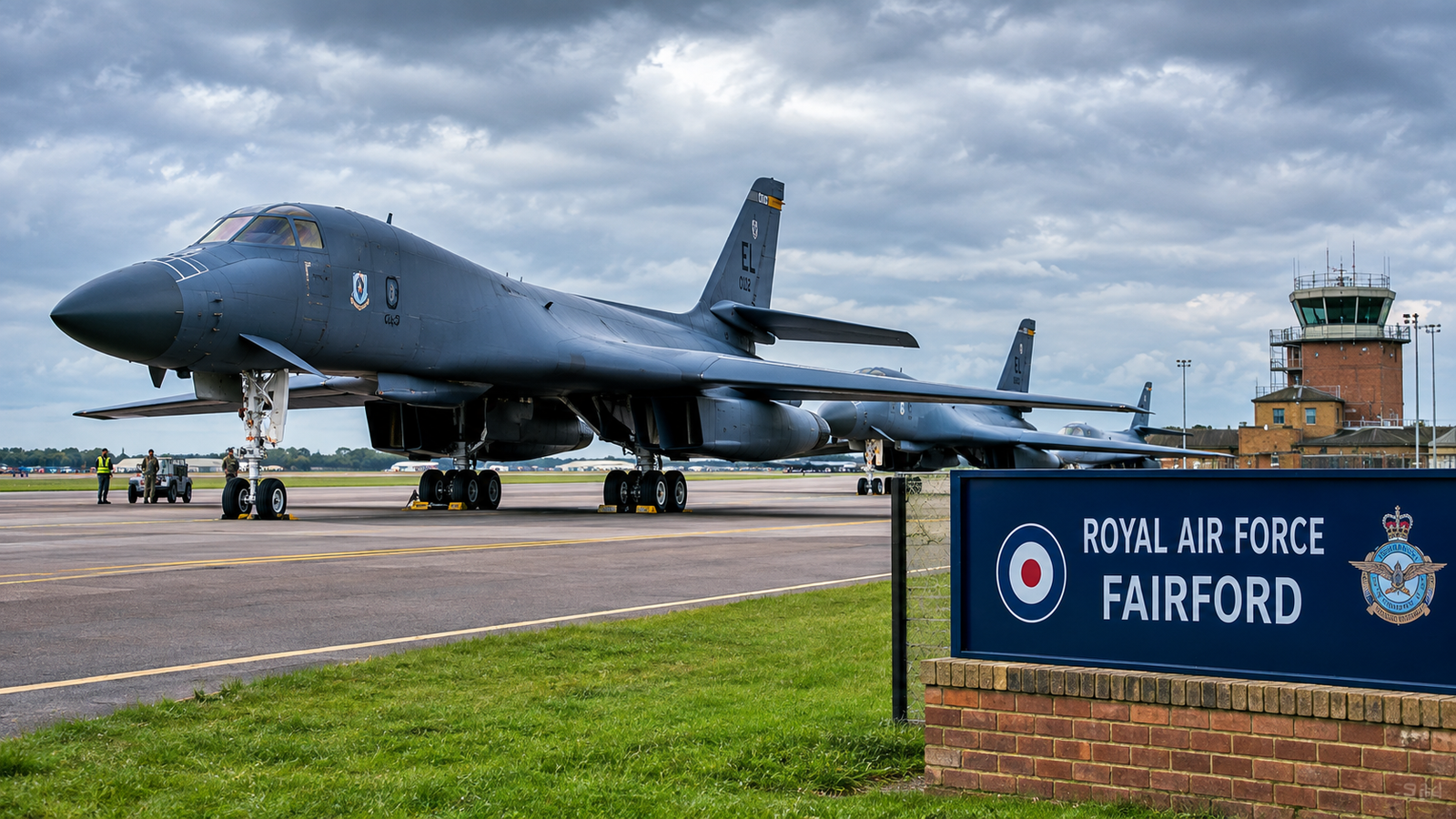
- US bombers RAF Fairford withdrawal appears closely linked to heightened security concerns following the September 27 incident.
- Fresh intelligence reportedly warned of a possible Iran-backed threat against the British airbase.
- The move reduces America’s forward presence in Europe but does not prevent the US from conducting long-range strikes from American bases.
The United States has abruptly withdrawn all of its bombers from RAF Fairford, raising questions about whether a suspected terrorist plot near the British airbase has exposed a serious vulnerability in one of Washington’s most important military footholds in Europe.
The Pentagon confirmed that all U.S. bombers deployed to Fairford had returned to their home stations in the United States. The aircraft are understood to include around a dozen B-1 bombers. The Pentagon described the move as part of normal global bomber operations and stressed that American aircraft remain capable of conducting precision strikes from the continental United States.
But the timing is difficult to ignore.
On September 27, British counter-terrorism police arrested five men after three suspicious vehicles were reported moving toward RAF Fairford. A sixth man, a British-Iranian national, was subsequently arrested in London. All six have since been released on bail while the investigation continues. Police found petrol and other materials in the vehicles, although authorities have not established publicly that an attack was imminent or that the suspects had a confirmed operational link to Iran.
Shadow Proxy Tactics: How the US-Iran Conflict Spilled Into RAF Airbase
The incident became far more significant because Fairford has been used by the U.S. Air Force to support operations against Iran. Tehran had already warned that British bases facilitating attacks on Iranian territory could become legitimate targets. Iranian authorities have denied involvement in the suspected plot.
The strongest indication that the withdrawal is connected to security concerns came from U.S. officials cited by American media. Reports said American commanders received fresh intelligence about a possible Iran-backed threat against Fairford, with specific information emerging shortly before the bombers were moved. The withdrawal was reportedly carried out with unusual speed.
That distinction matters.
The September 27 arrests did not necessarily cause Washington to evacuate its bomber force. Rather, the arrests appear to have triggered or reinforced a broader security assessment. A military base can survive one suspicious incident without changing its operational posture. But when an initial incident is followed by intelligence pointing to another potential threat, commanders have to consider whether the aircraft themselves have become unnecessarily exposed.
US removes all bombers from RAF Fairford base
For the United States, the calculation is straightforward. A B-1 bomber is a highly valuable strategic asset. Keeping several of them parked at a known forward location creates a predictable target for sabotage, drones, missiles or other attacks. Moving the aircraft back to the United States removes that vulnerability while preserving the ability to conduct long-range operations.
That is why the withdrawal should not automatically be interpreted as a retreat from the region.
The B-1 can conduct long-distance missions from American bases with aerial refuelling and can reach targets thousands of miles away. The United States demonstrated the broader principle during earlier long-range operations, including Operation Midnight Hammer, when American bombers operated from the continental United States.
What Washington loses by leaving Fairford is therefore not the ability to strike. It loses proximity.
Fairford gave American commanders a valuable forward operating location in Europe. Missions against targets in the Middle East could be launched with less transit time and with a logistical infrastructure already positioned closer to the theatre. Removing the bombers means longer flight paths, greater dependence on aerial refuelling and potentially more complicated mission planning.
That makes the decision significant even if it is temporary.
There is also a wider political message. Fairford has been an important symbol of Britain’s willingness to support American military operations. Britain owns the base, but the U.S. military operates it as a major bomber forward operating location in Europe. Its use during the Iran conflict turned Fairford from a relatively remote military installation into a potential target in a wider confrontation.
The question now is whether Britain can provide the level of security Washington requires.
The United Kingdom and United States remain deeply integrated militarily and through intelligence cooperation. There is no evidence that the Fairford withdrawal represents a rupture in the bilateral relationship. Indeed, British and American authorities have been working closely on the investigation.
But the episode exposes a difficult strategic contradiction.
London can support Washington’s military operations while simultaneously becoming part of the threat environment created by those operations. The more visible Britain’s role becomes in the Iran conflict, the greater the possibility that British territory and American facilities in Britain become targets.
That may explain the Pentagon’s emphasis that U.S. bombers remain ready to operate “anywhere, anytime.” The message is designed to prevent an operational redeployment from being interpreted as a loss of American military capability.
The real test will come next.
If the bombers return to Fairford after British and American security services complete their investigation, the withdrawal will look primarily like a temporary force-protection measure. If they remain away for an extended period, it could indicate that Washington has concluded that the strategic advantage of basing bombers in Britain no longer outweighs the security risks.
For now, the evidence points to a force-protection decision rather than a breakdown in the U.S.-UK alliance.
But the speed of the withdrawal tells its own story. Fairford was supposed to provide America with strategic reach into the Middle East. Instead, the base has become a potential vulnerability in the very conflict that made it strategically important.
That is the central lesson of the Fairford episode: modern warfare does not begin and end at the battlefield. When a bomber base thousands of miles from the front becomes a target, the geographical distance between Europe and the Middle East suddenly means very little.