



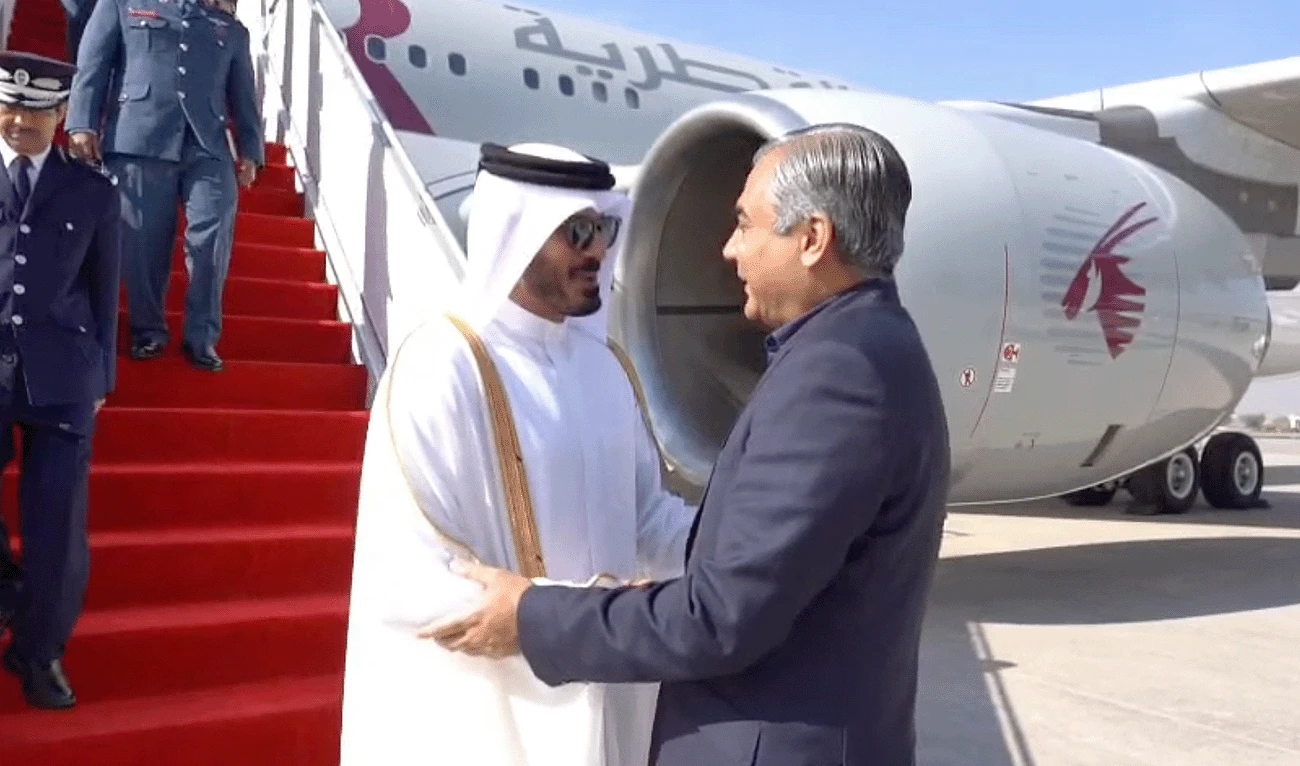
- Qatar Interior Minister Pakistan Visit begins in Islamabad as Federal Interior Minister Mohsin Naqvi warmly receives Sheikh Khalifa bin Hamad Al Thani to solidify bilateral security ties.
- Islamabad and Doha strengthen their joint backchannel mediation role with Iranian authorities to de-escalate ongoing US-Iran tensions and protect regional maritime trade corridors.
- Building on the landmark Badr Defence Cooperation Pact, the two interior ministers aim to expand intelligence sharing, counter-terrorism coordination, and Lekhwiya security partnerships.
ISLAMABAD — Qatar’s Minister of Interior and Commander of the elite Internal Security Force (Lekhwiya), Sheikh Khalifa bin Hamad bin Khalifa Al Thani, arrived in Islamabad on Thursday, November 19, 2026, for a high-stakes official visit aimed at cementing regional security and diplomatic coordination.
On the tarmac, Pakistan’s Federal Interior Minister Mohsin Naqvi personally received the Qatari royal with a warm embrace, welcoming him as a “brother” and underscoring that the visit would further elevate Pakistan-Qatar bilateral relations. Far beyond routine diplomatic protocol, Sheikh Khalifa’s arrival in Pakistan marks a pivotal moment for two nations operating as the primary backchannel architects in a volatile Middle East.
Dual Engines of Backchannel Diplomacy: Pakistan and Qatar
As geopolitical tensions between the United States and Iran continue to strain regional ceasefires and threaten maritime commerce across the Strait of Hormuz, Islamabad and Doha have emerged as indispensable co-mediators. While Qatar has long functioned as the Gulf’s premier diplomatic hub—maintaining direct communication channels with Washington, Tehran, and regional factions—Pakistan has stepped decisively into a frontline mediating role throughout 2026.
Pakistan Qatar US Iran Talks Achieve Breakthrough at Lake Lucerne Summit Amid High-Stakes Diplomacy
At the center of Islamabad’s quiet diplomacy is Mohsin Naqvi. Operating with the backing of Pakistan’s political and military leadership, Naqvi has served as Pakistan’s key envoy in direct engagements with Iranian authorities to de-escalate US-Iran hostilities. From critical consultations in Tehran with Iranian parliamentary and security leadership to helping broker the fragile June 2026 Islamabad Memorandum of Understanding (MoU), Naqvi has established rare trust among Iranian decision-makers wary of Western intermediaries.
Echoing this commitment at Doha’s Global Security Forum in October 2026, Naqvi emphasized that “winning peace is far more important than winning a war.”
READ MORE: Shenzhen Trilateral Summit: Optimism Meets High-Stakes Diplomacy as Trump, Putin, and Xi Gather
By aligning Pakistan’s direct border leverage and historic ties with Tehran alongside Qatar’s financial influence and strategic proximity to Washington, the Islamabad-Doha axis has become the most credible mechanism preventing a wider regional war.
Hardening the Strategic Axis: Pakistan-Qatar Defense Cooperation
Beneath this diplomatic coordination lies an expanding defense and internal security partnership. For decades, Pakistan-Qatar relations have been anchored by multi-billion-dollar liquefied natural gas (LNG) agreements, deep economic investment, and a 300,000-strong Pakistani diaspora contributing to Qatar’s infrastructure and security sectors. Pakistan’s armed forces have continuously trained Qatari military personnel and notably deployed thousands of troops and naval assets to help secure the 2022 FIFA World Cup.
READ MORE: Qatar’s interior minister arrives in Pakistan amid continuing US-Iran hostilities
However, the Middle East security shocks of 2026 have accelerated bilateral goodwill into formal multilateral defense commitments. Following the August 2026 Makkah Joint Defense Agreement among Pakistan, Saudi Arabia, and Türkiye, Islamabad and Doha joined Türkiye and Indonesia in October 2026 to sign the landmark Badr Defence Cooperation Pact. Focused on military interoperability, defense industrial collaboration, and collective security, the Badr Pact reflects a decisive shift among Muslim-majority middle powers toward regional self-reliance as traditional external security umbrellas face unprecedented strain.
Simultaneously, the interior ministries of both countries have institutionalized close operational ties. Following successive security summits in Doha during July and October 2026, Mohsin Naqvi and Sheikh Khalifa—who leads Lekhwiya, Qatar’s specialized counter-terrorism and rapid-response command—have prioritized intelligence sharing, counter-narcotics enforcement, and internal stability.
Behind Closed Doors: What Is on the Islamabad Agenda?
With renewed US-Iran friction, rising maritime security risks in the Persian Gulf, and persistent militancy challenges along Pakistan’s western frontier, Sheikh Khalifa’s meetings in Islamabad carry immediate strategic weight. High-level discussions between the two interior ministers are expected to center on four urgent priorities:
-
Preserving the US-Iran Ceasefire Framework: With recent regional flashpoints testing the durability of the Islamabad MoU, Naqvi and Sheikh Khalifa are positioned to synchronize diplomatic messaging to both Tehran and Washington, exploring fresh confidence-building mechanisms to keep de-escalation on track.
-
Securing Maritime and Energy Lifelines: Threats to commercial shipping and LNG transit routes directly impact Qatar’s export economy and Pakistan’s energy security. Both security chiefs will review joint intelligence frameworks to safeguard critical infrastructure and maritime corridors.
-
Operationalizing Lekhwiya–Pakistan Security Cooperation: Building on their October 2026 internal security accords, the ministers will advance joint counter-terrorism exercises, cybersecurity defense, and real-time intelligence exchanges between Pakistan’s civil armed forces and Qatar’s Lekhwiya.
-
Countering Transnational Militancy and Border Instability: Recognizing that instability along the Afghanistan-Pakistan border can spill over into broader regional networks, Islamabad and Doha share a vital interest in disrupting cross-border militant financing and illicit trafficking.
A New Geopolitical Reality in the Middle East
The arrival of Qatar’s Interior Minister in Islamabad—and the visible rapport between Sheikh Khalifa bin Hamad Al Thani and Mohsin Naqvi—illustrates a fundamental transformation in Middle Eastern geopolitics. As traditional alliances struggle to contain cascading crises, agile middle powers are forging their own security and diplomatic architectures. Through relentless backchannel mediation with Iran and binding defense frameworks like the Badr Pact, Pakistan and Qatar are proving that internal security chiefs have become frontline geopolitical actors—shaping stability across South Asia and the Persian Gulf on their own terms.