



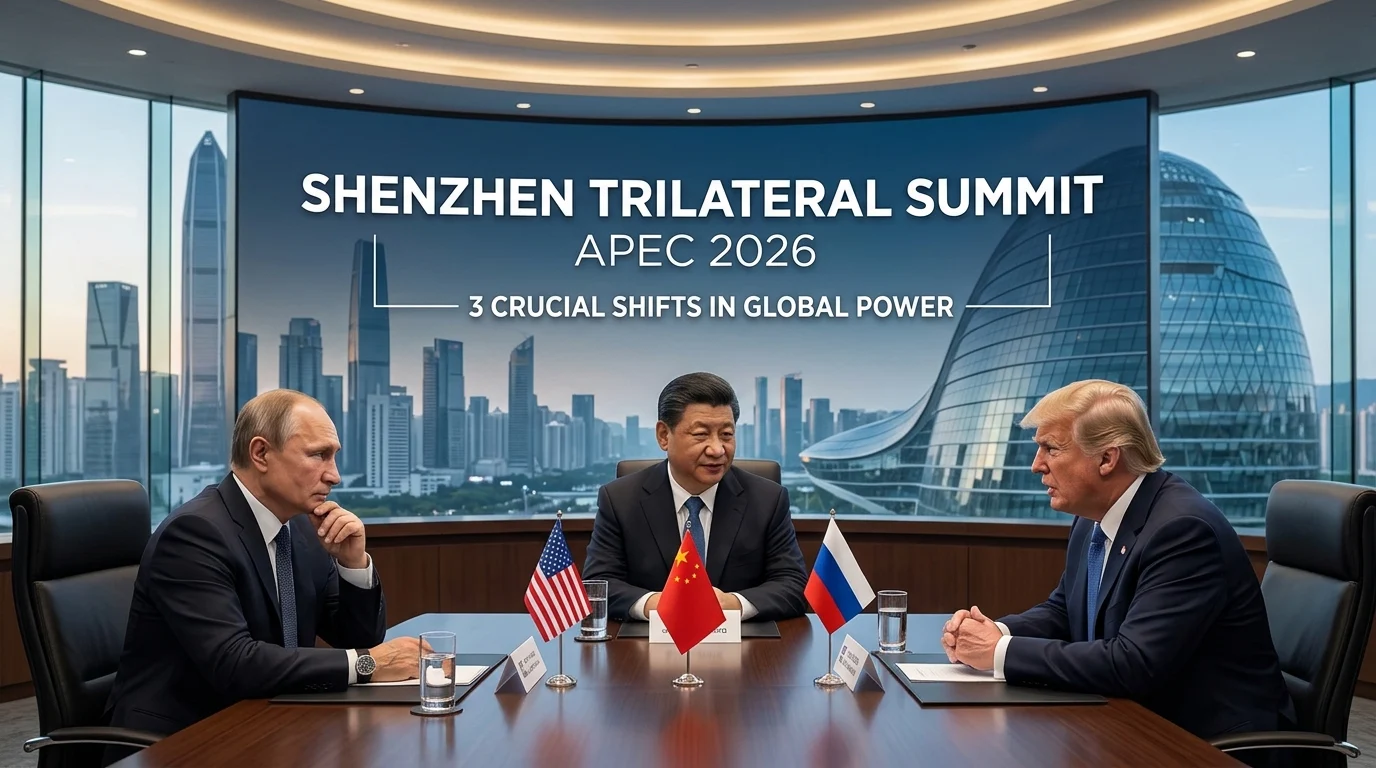
- Shenzhen Trilateral Summit showcased diplomatic symbolism rather than hard deliverables, producing a brief 90-minute communiqué on UN reform, energy output, nuclear risk dialogue, and ICC criticism while omitting Ukraine.
- Beijing’s convening power gained optics of great-power parity alongside Washington, though hosts balanced G2 gestures toward Trump with alternating group-photo placements for Putin and rejected “Yalta 2.0” sphere-division labels.
- Russia and the US navigated contrasting incentives—Moscow sought parity despite structural limits and Kerch Bridge damage, while Trump prioritized dealmaker theater without pushing back on Beijing or Moscow over Ukraine and Iran.
When Chinese President Xi Jinping, Russian President Vladimir Putin, and United States President Donald Trump met on November 19, 2026, on the sidelines of the Asia-Pacific Economic Cooperation (APEC) summit in Shenzhen, they staged a diplomatic first: the opening trilateral gathering of the three leaders.
Yet in a new analysis published by the International Institute for Strategic Studies (IISS), senior fellows Meia Nouwens, Nigel Gould-Davies, and Michael Carpenter argue that the 90-minute encounter mattered far less for tangible policy breakthroughs than for what it signaled in a fracturing world order.
As the IISS authors note, the meeting produced a brief, thin communiqué calling for United Nations reform and higher energy output, proposing dialogue on nuclear risk reduction and non-proliferation, and criticizing the International Criminal Court (ICC) over “the principle of state consent and respect for immunities of State officials.”
READ NEXT: Shenzhen APEC Summit Reality Check: Symbolism Over Substance in Asia
For capitals across Asia, Europe, and the Global South watching great-power realignments, the real takeaway lies beneath the boilerplate text.
Beijing’s Convening Power and Protocol Optics
Writing on China’s role, Meia Nouwens highlights a delicate balancing act in Shenzhen. Hosting the trilateral carried risks—chiefly avoiding any distraction from Xi Jinping’s broader stewardship of the APEC leaders’ summit—alongside an unmistakable prize: projecting China as a great power operating on equal footing with Washington.
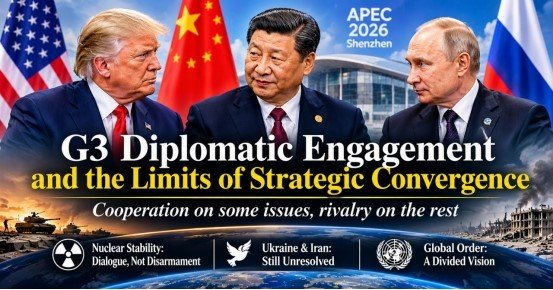
Drawing on a series of Xi–Trump engagements in 2026 and Beijing’s growing leverage over critical supply chains, Nouwens observes that Chinese observers increasingly view US–China relations as reaching a point of parity unprecedented in modern history.
Even as the Chinese Communist Party’s journal Qiushi hailed the summit as “historic” and a model of “major-country relations,” Nouwens points out that early choreography leaned heavily toward bilateral G2 weight—exemplified by Xi greeting Trump personally at the Shenzhen airport and seating him beside him at the opening dinner—before hosts carefully calibrated trilateral optics in group photos, alternating Trump and Putin to Xi’s right.
Within China’s policy community, expectations stayed pragmatic. Citing Fudan University’s Wu Xinbo, Nouwens notes that Chinese scholars rejected any comparison to the 1945 Yalta Conference—from which China was excluded—framing Shenzhen instead not as a division of spheres, but as a stabilizing political opening.
Shenzhen Trilateral Summit: Moscow’s Symbolic Gains and Hard Limits
For Russia, Nigel Gould-Davies argues, the summit was largely a triumph of optics rather than strategic leverage.
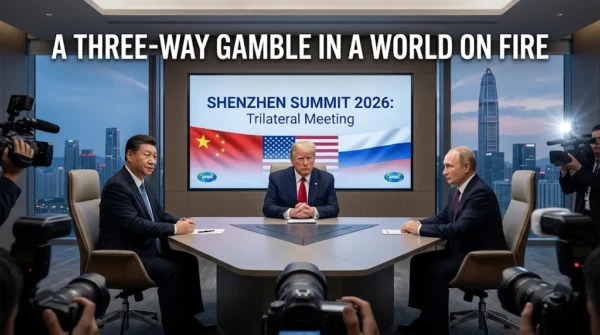
Reportedly pitched by Putin during an October phone call with Trump as Washington’s posture shifted favorably toward Moscow, bringing Xi and Trump to the same table allowed Putin to project parity alongside two heavyweights—even though, outside nuclear weapons, Russia trails both the United States and China across major indicators of state power.
READ MORE: Trump and Putin shake hands as Xi welcomes leaders to summit in China
Gould-Davies notes that while Moscow welcomed the communiqué’s swipe at the ICC—which has indicted Putin and five other senior Russian officials—and its nod toward higher oil output, Kremlin aide Yuri Ushakov admitted negotiations over the text were “difficult.” Crucially, despite Ukraine featuring in the trilateral talks and Putin’s bilateral meetings with Xi and Trump (his first with Trump since August 2025 in Anchorage), the communiqué omitted Ukraine altogether.
Coupled with a Ukrainian strike damaging the Kerch Bridge linking Russia to occupied Crimea just before APEC, Gould-Davies concludes that few Russian specialists buy Putin’s nod toward a “Yalta 2.0,” and deep trilateral divergences leave the format’s durability uncertain.
Washington’s Choreography and Alliance Fallout
Examining the American angle, Michael Carpenter contends that for Trump, Shenzhen was driven by spectacle and a “dealmaker” persona rather than painstaking pre-summit preparation that might have yielded concrete deliverables. Instead, leaders largely reiterated familiar positions.
Carpenter warns that three nuclear-armed powers—one of them the war’s aggressor—discussing Ukraine’s future without Kyiv in the room will rattle US allies and draw scrutiny in Congress, potentially spurring middle powers to hedge against a perceived “P3” dynamic.
Coming alongside Trump’s sharp criticism of European backing for Ukraine during a call with Berlin, and with no visible American pushback over Beijing’s support for Russia’s defense-industrial base or Sino-Russian intelligence sharing with Iran affecting US forces in the Gulf, Carpenter argues many US and European officials see a troubling reluctance to confront strategic rivals without substantive returns.
Read together, the IISS analysis offers a sobering lesson for regional observers: Shenzhen showcased shifting diplomatic theater and raw power politics, yet left core global conflicts unresolved.