



-
Ukraine War, Imminent Aerial Threat & Sabotage: President Volodymyr Zelenskyy warned of a major upcoming Russian barrage after overnight ballistic missile strikes hit Kyiv, while an IISS report noted a 16% rise in Russian sabotage operations across Europe.
-
Strained U.S.–Ukraine Relations: Ties with Washington have deteriorated following Donald Trump’s remarks calling Vladimir Putin his “friend” at a summit in China and Zelenskyy’s sharp rebuke, alongside delays in anti-ballistic missile interceptors.
-
Berlin’s Limits & Domestic Headwinds: Chancellor Friedrich Merz faces an 88% disapproval rating and falling public backing for Ukraine military aid (46% support vs. 53% opposition in a Körber Foundation survey, and 11% in eastern Germany), making German support alone insufficient without broader European unity and U.S. air defenses.
Ukrainian President Volodymyr Zelenskyy has issued an urgent warning that Russian forces are finalizing preparations for a large-scale aerial assault within the coming days.
Speaking during his nightly video address on Thursday, Zelenskyy confirmed that Ukrainian intelligence had detected the buildup, coming on the heels of relentless, round-the-clock bombardments that have battered Kyiv and other urban centers since September. Just overnight, ballistic missiles struck the Ukrainian capital, injuring seven civilians and damaging a shopping center alongside two nearby structures.
While Kyiv has retaliated with deep-strike drone operations—hitting an oil refinery in Krasnodar, fuel reservoirs in Bashkortostan, and the Marinovka military airfield in Volgograd—defending against a massive, coordinated Russian barrage requires substantial air defense replenishment. Simultaneously, Moscow has intensified its shadow campaign across Europe.
READ NEXT: Ukraine war: Kyiv Under Fire as Ukraine Faces a New Winter of War
According to a Thursday report by the London-based International Institute for Strategic Studies (IISS), Russian intelligence agencies have escalated sabotage operations by sixteen percent over the past year, doubling the use of arson and explosives against European military-industrial and transport networks.
Recent foiled plots, including a planned false-flag operation in Kaliningrad, an attempted rail bombing in Poland, an airspace violation, and an assassination plot on Danish soil, prompted Sweden to summon the Russian ambassador in Stockholm on Thursday to condemn Moscow’s destabilization efforts.
Ukraine War: The Diplomatic Rift with Washington
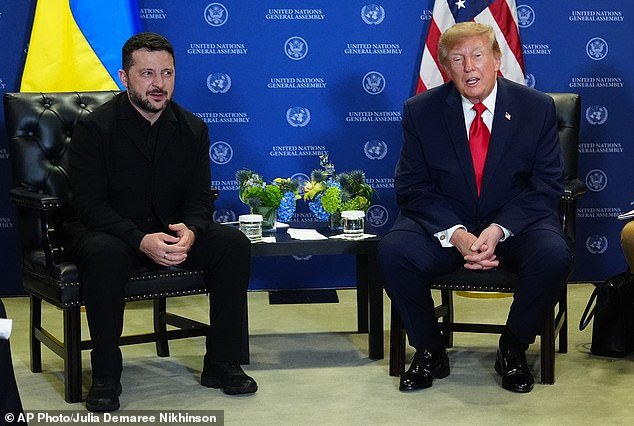
If Kyiv’s intelligence proves accurate, Ukraine’s survival hinges on immediate, robust backing from its Western partners. However, that support is fracturing at a critical juncture. Relations between Kyiv and Washington have deteriorated sharply following U.S. President Donald Trump’s public embrace of Russian President Vladimir Putin as “my friend” at a summit in China last week, which Trump reinforced by posting a photograph of the pair on social media.
READ MORE: At critical juncture, Friedrich Merz finds Germans’ support for Ukraine wavering
In an interview with the BBC on Friday, Zelenskyy delivered a blistering rebuke of Trump’s characterization, calling the friendliness “strange” and drawing a stark historical parallel. “He’s an aggressor and a killer.
He can’t be a friend,” Zelenskyy stated, comparing Trump’s warmth toward Putin to praising Adolf Hitler during World War II. Beyond rhetorical friction, Zelenskyy warned that Washington’s strategic pivot has caused severe delays in delivering anti-ballistic missile interceptors, leaving Ukrainian cities increasingly vulnerable while the White House applies insufficient diplomatic pressure on the Kremlin.
Is German Support Enough to Counter Moscow?
With American commitment waning, Ukraine has leaned heavily on Berlin. German Chancellor Friedrich Merz has positioned himself as Europe’s most vocal advocate for Kyiv, recently threatening to veto the European Union’s broader budget unless all twenty-seven member states back a forty-five-billion-euro loan for Ukraine in 2027—a hardline stance that drew accusations of “blackmail” from Slovak Prime Minister Robert Fico and resistance from Hungary, Czechia, and Bulgaria.
Yet, a sobering assessment reveals that Germany’s support, while vital, is insufficient on its own to offset Russia’s military momentum or replace American firepower. Economically and militarily, Berlin faces severe domestic headwinds. A new Körber Foundation survey indicates that public backing for military aid to Ukraine has collapsed to forty-six percent, with fifty-three percent opposed—a dramatic reversal from the fifty-nine percent approval recorded a year prior.
In eastern Germany, support for arms deliveries sits at a dismal eleven percent, fueled by cost-of-living pressures and surging support for the pro-Kremlin Alternative für Deutschland and left-wing populist BSW.
Saddled with a record eighty-eight percent disapproval rating, Merz is politically isolated at home while struggling to forge a unified continental deterrence strategy abroad.
As the IISS report notes, European nations continue to respond to Russian hybrid aggression piecemeal rather than establishing clear collective red lines. Without cohesive European unity and consistent American air-defense stockpiles, Berlin’s financial pledges alone cannot shield Ukraine from Moscow’s impending offensive, leaving Kyiv perilously exposed as winter deepens and Russian missiles gather on the horizon.