



- Pakistan China space cooperation reaches a new milestone as Wing Commander Muhammad Zeeshan Ali conducts scientific research aboard China’s Tiangong space station during the Shenzhou-24 mission.
- Prime Minister Shehbaz Sharif and Field Marshal Asim Munir held a live broadcast with Zeeshan Ali at 400 kilometers altitude, praising his training, scientific work, and inspiration for Pakistani youth.
- Bilateral collaboration with SUPARCO and the China Manned Space Agency expands ties into space exploration while emphasizing peaceful research and global scientific benefit.
In an unprecedented move, Pakistan’s Prime Minister and Chief of Defence Forces Field Marshal Asim Munir spoke to Pakistan’s first astronaut who was up in the space beyond 400 kilometers.
Millions of Pakistanis glued to TV sets at their homes listened to a conversation that was historic in nature and unprecedented as well.
Broadcasting live from China’s Tiangong space station aboard the Shenzhou-24 mission, the exchange brought together Islamabad’s top civilian and military leadership with Wing Commander Muhammad Zeeshan Ali in low Earth orbit—an event that immediately resonated far beyond domestic television screens as a signal of shifting geopolitical and technological alignments in South Asia and beyond.
The Orbital Dialogue and Sentiments from Orbit
During the live broadcast, Prime Minister Shehbaz Sharif and Field Marshal Syed Asim Munir addressed Wing Commander Zeeshan Ali with congratulations framed around national pride, scientific ambition, and generational renewal.
Prime Minister Shehbaz Sharif called the moment a source of pride for Pakistan’s 240 million citizens, praised Zeeshan Ali’s family, acknowledged the experts and colleagues who supported his training, congratulated his Chinese crewmates, and recognized SUPARCO and the China Manned Space Agency (CMSA).
READ MORE: Pakistani Astronaut Mohammad Zeeshan: From CPEC to Outer Space
Field Marshal Asim Munir underscored the pride of the armed forces and the wider nation, linking Zeeshan Ali’s journey to Allama Iqbal’s vision for empowered youth and describing his presence in orbit as an inspiring benchmark for younger generations.
Speaking from an altitude of 400 kilometers above Earth while traveling at roughly 7.9 kilometers per second, Zeeshan Ali conveyed deep gratitude for the encouragement from Pakistan’s leadership and expressed pride in representing the country.
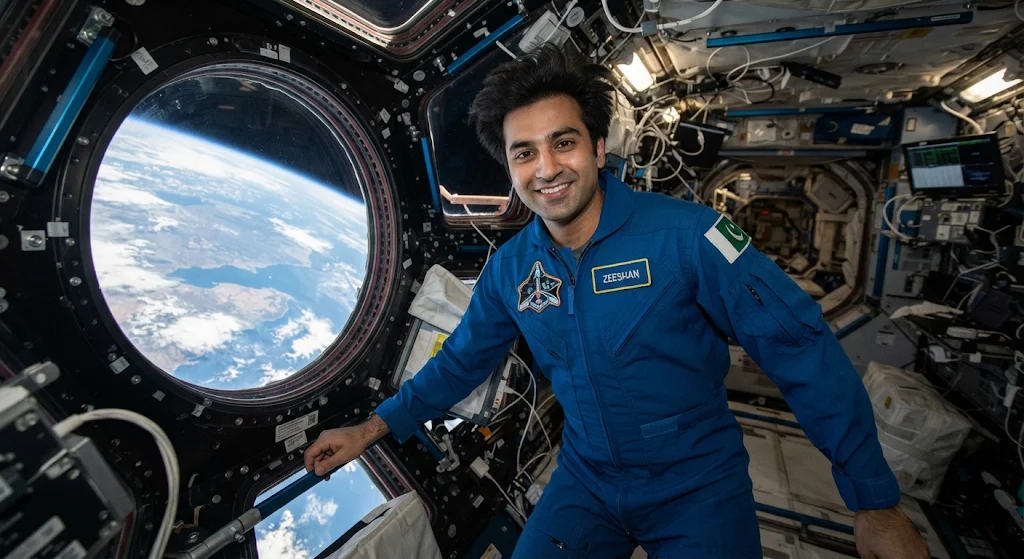
He emphasized that he was carrying out his assigned duties and scientific experiments with dedication in accordance with the mission plan and the expectations of the Pakistani public, noting that words of support from home strengthened his resolve and morale while working alongside his Chinese counterparts.
Training, Mission Work, and a New Career Frontier
For Zeeshan Ali, reaching the Tiangong station represents the culmination of rigorous preparation and selection for the Shenzhou-24 spaceflight, marking a decisive leap in his career from military aviation into human spaceflight. His training in China required mastering complex orbital operations, microgravity protocols, spacecraft systems, and collaborative research procedures alongside seasoned Chinese astronauts.
READ NEXT: China’s Shenzhou-24 carries Pakistan’s first astronaut into space
In orbit, his work centers on executing scheduled scientific experiments and mission responsibilities aboard Tiangong. Both Zeeshan Ali and Prime Minister Shehbaz Sharif highlighted the research dimension of the flight—noting that joint experiments conducted with Chinese colleagues are intended to contribute to broader scientific knowledge and peaceful applications in space for the benefit of humanity.
For Pakistan’s space sector, his flight serves as a high-profile milestone that leadership framed as opening new doors in space research and science, technology, engineering, and mathematics outreach.
Geostrategic and Geopolitical Implications of Pakistan China Space Cooperation
From a geopolitical standpoint, placing a Pakistani astronaut aboard Tiangong highlights how bilateral ties between Islamabad and Beijing have expanded from traditional diplomatic, economic, and security cooperation into high-technology and orbital domains.
Field Marshal Asim Munir captured this trajectory by stating that Pakistan–China friendship—long described as higher than the Himalayas, deeper than the oceans, and sweeter than honey—had now reached the expanses of the universe, while Zeeshan Ali pledged to play his part in elevating bilateral ties further.
Strategically, human spaceflight cooperation deepens technical interoperability and long-term institutional linkages between Pakistan’s space establishment and China’s manned space program at a time when orbital capabilities increasingly shape global prestige, scientific leadership, and strategic influence.
In a regional environment where space programs carry significant symbolic and technological weight, Pakistan’s participation in a Chinese-led crewed mission underscores Beijing’s role as a primary partner in Islamabad’s technological modernization.
At the same time, Prime Minister Shehbaz Sharif stressed that Pakistan views space exploration as a vehicle for peaceful purposes, global scientific enrichment, and national progress—balancing strategic alignment with a message of international scientific contribution as the nation awaits Zeeshan Ali’s safe return to Earth.