



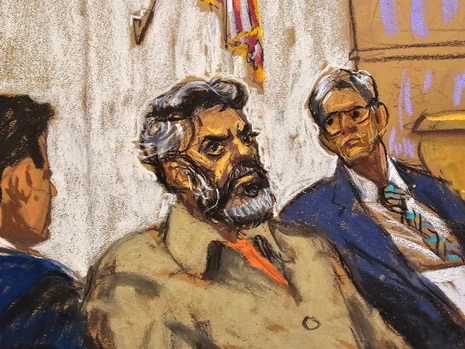
- Asif Merchant: A U.S. federal court convicted Pakistani businessman Asif Raza Merchant in a murder-for-hire plot targeting President Donald Trump.
- Prosecutors say the plot was linked to Iranian retaliation following the killing of IRGC commander Qasem Soleimani.
- The FBI disrupted the plan through an undercover sting operation in June 2024.
- Merchant allegedly paid $5,000 to individuals he believed were contract killers, who were actually FBI agents.
- U.S. prosecutors argue the case reflects a broader pattern of Iran-backed operations targeting American officials.
The federal trial of Asif Raza Merchant, a 47-year-old Pakistani businessman accused of attempting to orchestrate the assassination of President Donald Trump, has concluded with a sweeping conviction that underscores the evolving threat of foreign-backed political violence on U.S. soil. The case, tried in Brooklyn, revealed a chilling blend of coercion, geopolitical retaliation, and opportunistic criminality—an intersection that prosecutors say nearly produced a national tragedy.
A Plot Born in the Shadow of the Iran Conflict
According to federal prosecutors, Merchant arrived in the United States in 2024 with a singular mission: to hire hitmen to kill a U.S. political figure, with President Trump as the likely target. The plot, they argued, was conceived as part of an Iranian retaliation campaign linked to the killing of Qasem Soleimani, the powerful IRGC commander whose death in 2020 reshaped the region’s security landscape.
Iran Employing Foreigners: Pakistani Accused of Plot Against Trump Raises Global Security Concerns
Merchant’s own testimony confirmed that he believed he was acting under the direction—and threat—of Iran’s Islamic Revolutionary Guard Corps (IRGC). He told jurors that Iranian operatives pressured him into participating, threatening his family if he refused. “I had to do this,” he testified, describing a coercive relationship that prosecutors acknowledged but argued did not absolve him of responsibility.
The FBI Sting That Stopped the Plot Cold
The case against Merchant was built on extensive undercover work. In June 2024, he met with individuals he believed were hired killers—who were, in fact, undercover FBI agents. During one meeting, he sketched out an attack plan on a hotel napkin, describing how a shooter could strike at a political rally and escape amid a staged protest. He also paid the agents $5,000 as an initial installment for the murder-for-hire scheme.
Merchant was arrested on July 12, 2024, just one day before the attempted assassination of President Trump in Butler, Pennsylvania. In a striking detail revealed at trial, Merchant told an FBI agent that the Butler shooting—carried out by Thomas Crooks—was “the same thing he was sent here to do,” and that he believed Iran was responsible for that attack as well. Investigators have not corroborated that claim, but it underscored the defendant’s perception of his role in a broader campaign.
A Trial Marked by Extraordinary Testimony
The week-long trial featured dramatic testimony from Merchant himself, who admitted to taking steps toward the assassination plot but insisted he never intended for it to succeed. He claimed he hoped to be caught, believing that U.S. authorities would intervene before any harm occurred.
Russia Iran U.S Targeting: Moscow’s Covert Role in Escalating Middle East Conflict
Prosecutors countered that this narrative was self-serving and contradicted by his actions, including his online posts depicting President Trump’s death—imagery federal agents described as part of his broader effort to demonstrate loyalty to Iranian handlers.
Jurors deliberated for only a few hours before returning a guilty verdict on charges of terrorism, murder-for-hire, and conspiracy. He now faces a potential life sentence.
Iran’s Shadow and America’s Vulnerability
The Merchant case arrives at a moment of heightened tension between the United States and Iran, with ongoing conflict in the Middle East and repeated warnings from U.S. intelligence agencies about Iranian attempts to target American officials. Prosecutors emphasized that the plot was not an isolated incident but part of a pattern of Iran-backed operations aimed at retaliation and destabilization.
The Justice Department’s broader investigation has documented multiple attempts by Iranian operatives to recruit intermediaries—often foreign nationals—to carry out attacks on American soil. Merchant, they argued, was one such intermediary: vulnerable, indebted, and susceptible to coercion, yet still fully responsible for the choices he made.
A Case That Raises Difficult Questions
Merchant’s conviction closes one chapter but opens several others. His testimony about coercion raises complex questions about how foreign intelligence services exploit diaspora communities. His claims about the Butler shooting, while unverified, highlight the potential for disinformation and psychological manipulation in transnational plots.
More broadly, the case forces a reckoning with the reality that foreign-backed assassination attempts against U.S. leaders are no longer theoretical. They are active threats, unfolding in real time, and increasingly reliant on intermediaries who blur the line between victim and perpetrator.