



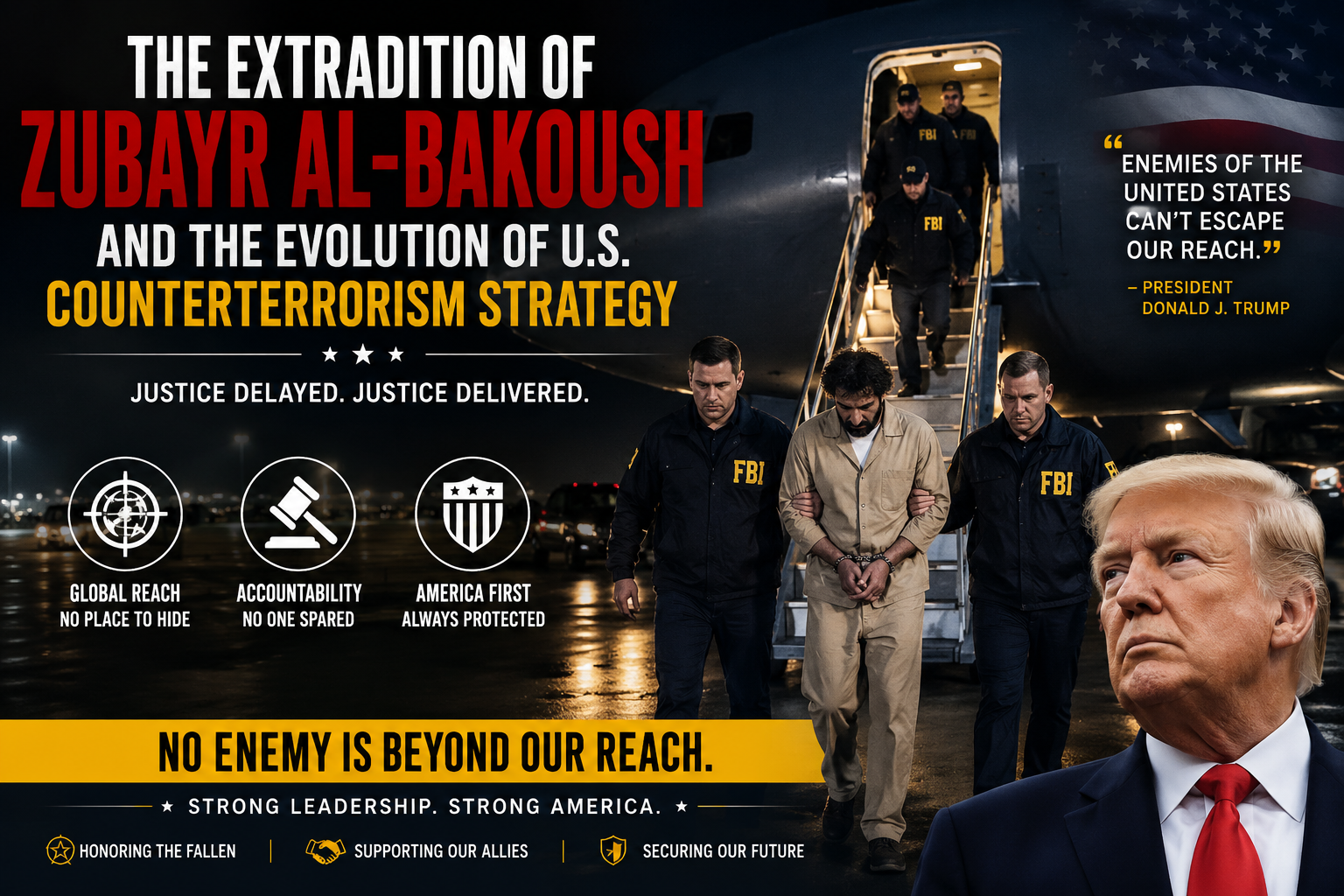
- Benghazi mastermind extradited to the U.S. in a high-security operation watched by millions
- President Donald Trump’s direct oversight reinforces a doctrine of zero escape for U.S. enemies
- Viral moment boosts national sentiment and strengthens Trump’s standing ahead of midterms
It began as a flicker on screens—grainy footage at first, then sharpened by repetition as it spread across social media feeds, cable broadcasts, and smartphones across the United States.
A military aircraft sat under the harsh white lights of Joint Base Andrews. Its engines had gone silent, but the symbolism was deafening.
Then the door opened.
What followed was a scene that would come to define a moment in American power. Federal agents—disciplined, deliberate—escorted a man down the narrow steps. Hands restrained. Movements controlled. No chaos, no theatrics—just precision.
Within hours, millions of Americans had watched the clip.
For many, it was not just an arrest. It was a statement.
The man was Zubayr Al-Bakoush, accused of playing a role in the 2012 Benghazi attack that killed four Americans, including Ambassador J. Christopher Stevens. But in that moment, his identity almost became secondary to what his arrival represented: the visible, undeniable reach of the United States.
And, more pointedly, the posture of a president who has built his political identity on one central idea—that America does not spare its enemies.
There were no speeches, no press conferences in that instant. The imagery did the work.
For supporters of President Donald Trump, the message was unmistakable: this is what accountability looks like. A decade after Benghazi, the United States had not forgotten—and under Trump, it had not relented.
READ NEXT: Raúl Castro Indictment Shakes Cuba as U.S. Signals Possible ‘Maduro-Style’ Action Under Trump
The viral spread of the video transformed a counterterrorism operation into a national spectacle. It resonated not just because of what happened, but because of what it suggested—that time and distance no longer shield those who attack American interests.
What Happened in Benghazi in 2012?
On the evening of September 11, 2012, an armed group of over 20 heavily armed militants affiliated with the extremist group Ansar al-Sharia breached the perimeter of the U.S. Special Mission in Benghazi, Libya. Armed with assault rifles, rocket-propelled grenades, and explosive devices, the attackers set fire to several buildings within the compound, including Villa C, the main residence.
The assault resulted in the deaths of four Americans:
- J. Christopher Stevens, U.S. Ambassador to Libya (died of smoke inhalation)
- Sean Smith, Foreign Service Information Management Officer (died of smoke inhalation)
- Tyrone S. Woods, CIA Global Response Staff security contractor (killed during a mortar attack at the nearby CIA Annex)
- Glen A. Doherty, CIA Global Response Staff security contractor (killed during the mortar attack at the Annex)
The tragedy triggered intense Congressional investigations, security reviews across the Department of State, and years of political debate over national security, government transparency, and military readiness.
Who is Benghazi mastermind Zubayr Al-Bakoush?
According to an eight-count federal indictment unsealed in the U.S. District Court for the District of Columbia, Zubayr Al-Bakoush was an armed member of Ansar al-Sharia.
Indictment and Specific Charges
Federal prosecutors allege that Al-Bakoush:
- Participated directly in assembling outside the main gate and breaching the diplomatic compound.
- Conducted surveillance on diplomatic personnel and attempted to break into diplomatic vehicles.
- Helped facilitate arson attacks on buildings within the mission, leading to the deaths of Ambassador Stevens and Sean Smith.
- Provided material support to a foreign terrorist organization resulting in death.
The eight charges include murder of an internationally protected person, murder of U.S. nationals outside the U.S., attempted murder, arson, and conspiracy to provide material support to terrorists.
READ MORE: Suspect in deadly 2012 Benghazi attack in custody, officials say
How Was He Arrested and Transferred to the U.S.?
The apprehension of Al-Bakoush involved a joint, multi-agency effort:
- Operation & Custody Transfer: Coordinated by the FBI’s New York Field Office alongside the Department of Defense, the CIA, and the Department of State, Al-Bakoush was apprehended abroad and transferred into U.S. federal custody.
- Arrival: Al-Bakoush arrived via military transport at Joint Base Andrews in Maryland.
- Legal Proceedings: Attorney General Pam Bondi, FBI Director Kash Patel, and U.S. Attorney Jeanine Pirro announced his extradition, confirming that Al-Bakoush will face trial in Washington, D.C. federal court.
While supporters point to the operation as proof of President Trump’s strong posture against hostile foreign actors, the arrest of Benghazi participants follows a long-standing U.S. policy across multiple presidential administrations to pursue terrorism suspects abroad and try them in federal court:
- Ahmed Abu Khattala (2014): Captured in Libya during a joint U.S. Special Forces and FBI operation under President Barack Obama. Khattala was brought to Washington, D.C., convicted in federal court on terrorism and arson charges, and sentenced to over two decades in prison.
- Mustafa al-Imam (2017): Captured in Libya by U.S. Special Forces during President Trump’s first term. He was extradited to the U.S. and subsequently convicted for his role in the assault.
- Zubayr Al-Bakoush (2026): Represents the third major co-conspirator formally brought to U.S. soil to face trial for the Benghazi attack.
The Trump administration has emphasized a foreign policy built on deterrence and swift retaliation against threats to American citizens. High-profile extraterritorial actions—ranging from counterterrorism apprehensions to international law enforcement operations such as charges against Venezuelan figures like Nicolás Maduro—are cited by administration officials as evidence that the U.S. will pursue enemies regardless of time or distance.
Domestic Political Optics
Demonstrating concrete accountability for the Benghazi attack remains a powerful political message. Re-engaging on Benghazi allows the administration to reinforce its narrative of national strength, law enforcement resolve, and commitment to military and diplomatic personnel prior to upcoming political cycles.
Judicial Integrity vs. Evidentiary Challenges
Federal prosecutors face the challenge of proving decades-old actions in a court of law. Bringing suspects to U.S. federal court highlights a preference for civilian judicial proceedings over military tribunals, requiring prosecutors to present eyewitness testimony, digital intelligence, and physical evidence that meets the standard of proof beyond a reasonable doubt.
The extradition of Zubayr Al-Bakoush underscores a bipartisan continuity in U.S. national security policy: individuals who target American diplomats and service members will eventually face judicial accountability. For the family members of the four fallen Americans in Benghazi, as well as the broader foreign service and intelligence communities, the ongoing prosecution serves as a reminder that the U.S. government maintains a long memory when pursuing justice on foreign soil.