



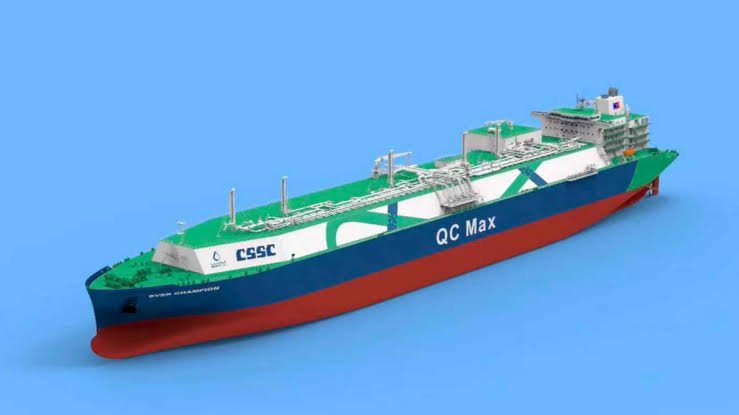
- China Shipbuilding Industry And the QC-Max LNG carrier offers a massive 57 percent increase in capacity over standard 174,000-cubic-meter ships, drastically expanding transit volumes.
- Hudong-Zhonghua’s upgraded membrane containment system restricts the daily cargo boil-off rate to a historic low of just 0.087 percent.
- Backed by a dense industrial cluster of 486,000 entities, China captured 69 percent of all new global shipbuilding orders by deadweight tonnes in 2025.
- Powered by advanced dual-fuel propulsion, the mega-ship meets stringent IMO Tier III emission protocols while remaining compatible with major global ports.
China ushers in a new era of maritime engineering as construction begins on a record-breaking 271,000-cubic-meter LNG carrier, solidifying its dominant position within the elite global shipbuilding sector.
Construction has officially commenced on an ultra-large liquefied natural gas (LNG) carrier boasting an unprecedented capacity of 271,000 cubic meters. This monumental project, undertaken by Hudong-Zhonghua Shipbuilding (Group) Co., Ltd., a subsidiary of the China State Shipbuilding Corporation (CSSC), marks a definitive milestone in China’s rise as a high-end shipbuilding superpower and a pivotal player in global energy logistics.
Project Update: Delivery Scheduled for 2028
The groundbreaking vessel, designated as part of the elite “QC-Max” class, is scheduled for official delivery in 2028. Developed specifically to support a large-scale Qatari LNG expansion project, the vessel reflects the massive commercial momentum shifting toward Chinese shipyards. Hudong-Zhonghua has secured orders for 36 vessels under this specific program, an impressive 24 of which are the ultra-large 271,000-cubic-meter models.
Trump Xi Summit Beijing Signals Diplomatic Reset Amid Global Tensions
Currently, the shipyard holds nearly 60 pending orders for LNG vessels—representing the largest backlog globally by cargo volume—with production schedules stretching reliably into 2030.
Technical Detail: The Engineering of a Mega-Ship
Measuring a staggering 344 meters in length, the QC-Max class vessel redefines the engineering constraints of traditional energy transit. LNG carriers are widely considered the “crown jewel” of the shipbuilding industry due to their extreme technical complexity, hazardous cargo, and demanding supply chain requirements.
| Feature | Conventional LNG Carrier | Hudong-Zhonghua QC-Max |
| Cargo Capacity | 174,000 cubic meters | 271,000 cubic meters |
| Boil-Off Rate (Daily) | Varies | 0.087% |
| Length | Varies | 344 meters |
The core innovation of the QC-Max lies in its upgraded membrane containment system, meticulously designed to maximize overall cargo capacity while elevating structural safety and environmental efficiency. By expanding the cargo envelope, the vessel offers a massive 57 percent increase in capacity compared to the standard 174,000-cubic-meter ships that currently dominate the global market.
China starts construction of world’s biggest hydropower dam in Tibet
To prevent natural cargo loss during long ocean transits, the ship maintains a daily boil-off rate of just 0.087 percent. This drastically minimizes fuel and product evaporation over time. Propulsion is driven by a highly efficient dual-fuel system that satisfies the International Maritime Organization’s (IMO) stringent Tier III emission standards. Despite its unprecedented footprint, the ship’s advanced dimensions ensure it can safely dock at most major LNG terminals worldwide.
Strategic Significance & Industry Background
The commencement of the QC-Max underscores a profound structural shift in global maritime manufacturing. Historically dominated by European and South Korean builders, China’s global market share in LNG carrier construction has now surpassed 30 percent, propelled by aggressive domestic technological breakthroughs and surging industrial capacity.
This single vessel is a product of a larger, highly integrated industrial cluster within China consisting of more than 486,000 active entities. Driven by this expansive network, China’s maritime sector captured an overwhelming majority of the global market. By the close of 2025, China accounted for 56.1 percent of all global ship completions, 69 percent of newly booked orders, and 66.8 percent of the total global order book measured by deadweight tonnes.
The manufacturing of the QC-Max represents more than just a successful contract; it signals that China has firmly secured its position among the elite tier of seafaring nations capable of constructing a full, unrestricted spectrum of advanced maritime vessels. As production scales toward the 2028 deadline, the shipyard is successfully transitioning from high-volume assembly to high-value-added, technologically superior manufacturing.