



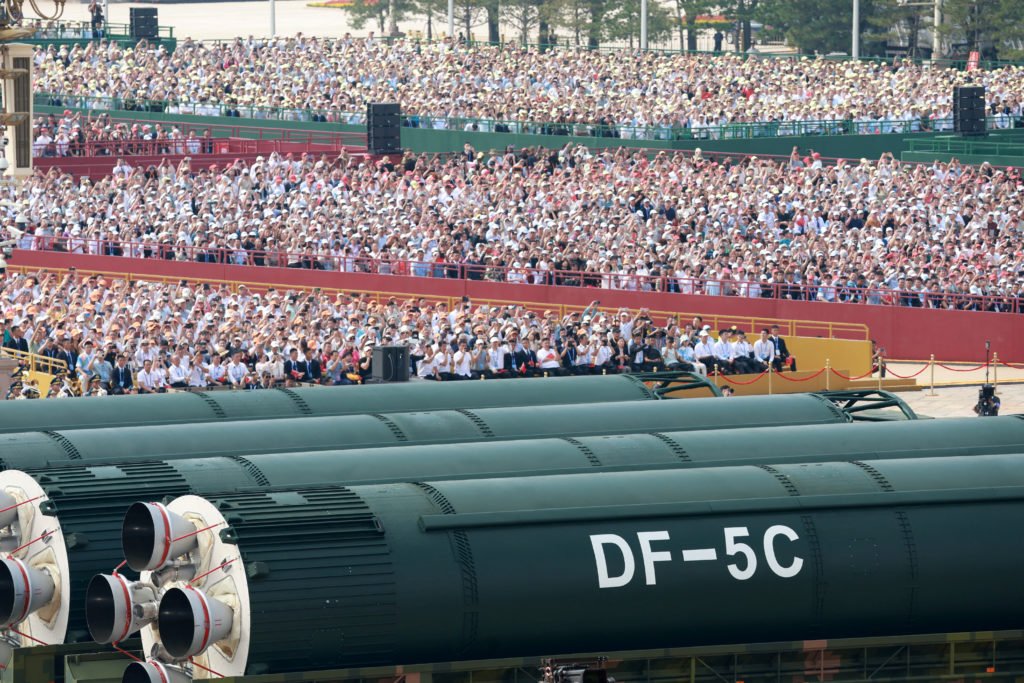
- China’s strategic military flex is highlighted by a leaked Pentagon report revealing over 100 DF-31 ICBMs are now operational in Mongolian border silos.
- Tensions with Japan have spiked under Prime Minister Takaichi, following a December 2025 incident where Chinese J-15 jets locked radar onto Japanese aircraft.
- Analysts suggest the missile buildup is a direct response to US-Japan naval drills and the “existential threat” rhetoric regarding Taiwan.
- Beijing maintains a “no first use” policy but emphasizes that its modernized arsenal ensures an opponent will never get a “second shot.”
WASHINGTON D.C. – December 2025 – A seismic shift in the global balance of power reverberated across world capitals this week, following the leak of a classified Pentagon report. The revelation: China has covertly loaded over 100 Intercontinental Ballistic Missiles (ICBMs) into newly constructed silo fields, a stark and unprecedented show of strategic might. The news sent shockwaves through Washington D.C., Taiwan, and Europe, but it was in Tokyo where the aftershocks were felt most acutely, sending Japan into a state of heightened alert.
Beijing, true to its opaque diplomatic style, has remained conspicuously silent on the report, neither confirming nor denying its veracity. This silence, however, has done little to calm the rising tide of speculation and alarm among defense experts and international observers.
Speaking exclusively to The Islamabad Telegraph, prominent analysts suggested that this aggressive escalation by China is not an isolated event, but a direct and calculated response to the increasingly assertive naval drills conducted by the United States and Japan in the contested waters of the South China Sea.
China Fujian Aircraft Carrier Transit: Strategic Naval Power in the Taiwan Strait
The relationship between Beijing and Tokyo has been on a knife’s edge since the recent ascension of Prime Minister Takaishi in Japan. Takaishi, known for his hawkish stance on regional security, has pursued a more robust defense posture, including closer military cooperation with the United States.
U.S. Siege of Venezuela Gives China a Golden Opening to Reclaim Taiwan
This strategic realignment has evidently grated on China, which views any perceived challenge to its regional hegemony with deep suspicion. Just a few weeks prior to this ICBM revelation, a tense aerial confrontation saw Chinese J-20 stealth fighters “lock” onto Japanese F-35s for several minutes—a chilling display of Chinese technological superiority and a clear warning shot fired across Japan’s bow.
China’s Strategic Military Flex: A New Era of Chinese Deterrence
The deployment of over 100 silo-based DF-31 ICBMs, primarily in fields bordering Mongolia, signifies a profound strategic shift for the People’s Liberation Army (PLA). Historically, China maintained a smaller, more mobile nuclear deterrent, emphasizing a “minimum deterrence” posture.
Exclusive: China likely loaded more than 100 ICBMs in silo fields, Pentagon report says
This latest move, however, points to a clear intent to move towards a more robust “credible deterrence,” capable of withstanding a first strike and ensuring devastating retaliation. It is a potent visual manifestation of China’s growing military ambition, unequivocally signaling its readiness to project power and defend what it perceives as its core interests.
“China has long adhered to a no-first-use policy, but this doesn’t mean they will tolerate being a perpetual second-responder,” explained Dr. Wei Chen, a defense strategist at the Institute for Global Security in Singapore. “Their doctrine is evolving. They will not fire the first bullet, but they will absolutely not allow you to fire a second shot. This ICBM deployment ensures that capability, making any potential adversary think twice, or even three times, before engaging.”
EXCLUSIVE: Elon Musk Set to Shake Up Chipmaking Industry With $12 Billion xAI Gamble
This aggressive posture is further underscored by the Pentagon’s assessment that China aims to be capable of “fighting and winning a war on Taiwan by the end of 2027.” The synchronized buildup of conventional and strategic forces suggests a meticulously planned strategy to achieve its geopolitical objectives, with Taiwan remaining the most volatile flashpoint. The ability to launch a multitude of long-range conventional and nuclear strikes from its new missile silos would seriously challenge and disrupt U.S. presence in any Asia-Pacific conflict.
Global Ramifications and a Looming Arms Race
The revelation could not have come at a more critical juncture. With the New START treaty between the U.S. and Russia set to expire in early 2026, the absence of a comprehensive three-way arms control agreement now feels more perilous than ever.
Experts like Daryl Kimball of the Arms Control Association have long warned that “more nuclear weapons and an absence of diplomacy will not make anyone safer.” China’s latest move threatens to ignite an unconstrained nuclear arms race, dragging an already volatile world deeper into an era of unprecedented strategic instability.
The response from Washington has been swift, albeit guarded. President Trump, who had previously expressed interest in a denuclearization plan involving China and Russia, is reportedly re-evaluating his strategy. The Pentagon’s draft report explicitly states, “We continue to see no appetite from Beijing for pursuing such measures or more comprehensive arms control discussions,” indicating China’s determination to pursue its own military trajectory unfettered by international agreements.
The global community now faces a daunting challenge: how to de-escalate tensions and prevent a dangerous arms race without alienating a rising superpower determined to assert its dominance. The loaded silos near the Mongolian border are not just a static display of force; they are a profound statement of intent, echoing the dragon’s roar across the globe and demanding a recalibration of strategic thinking in every major capital. The silence from Beijing, meanwhile, only amplifies the profound unease, leaving the world to ponder the true extent of China’s ambition and the price of this new era of global power projection.