



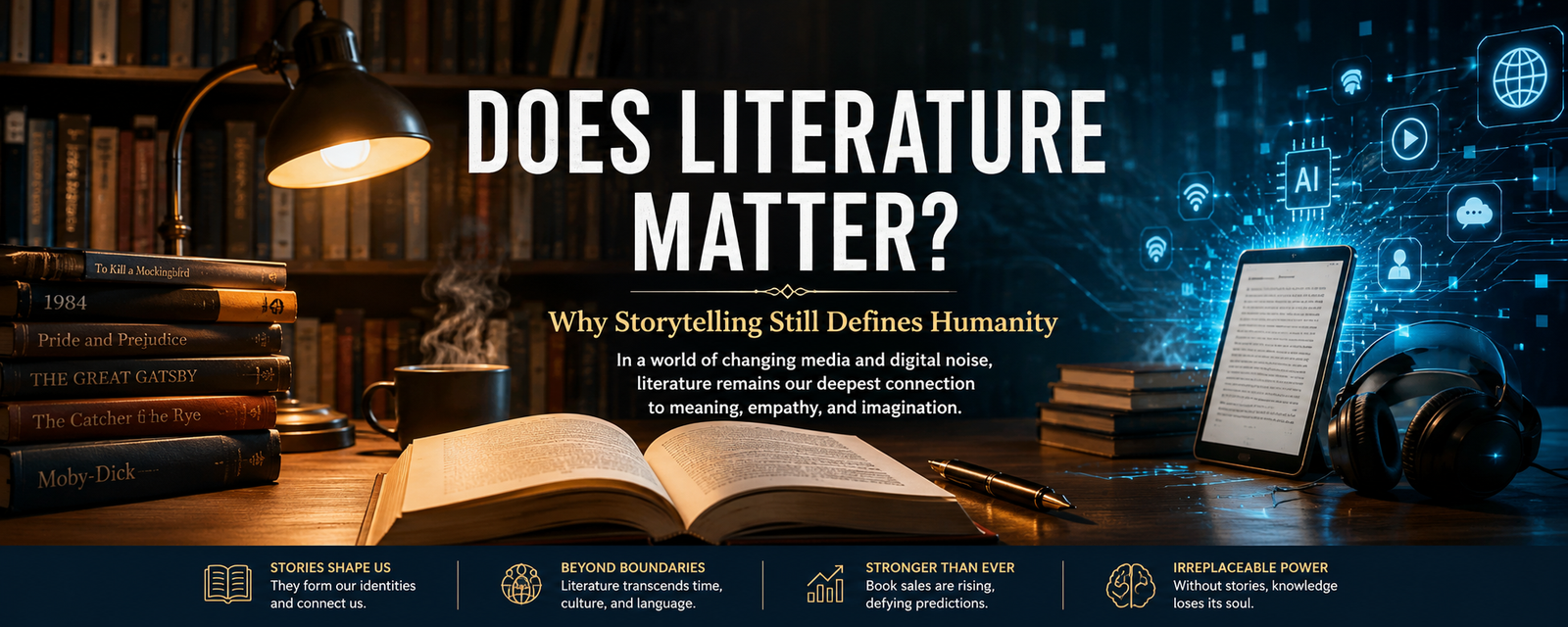
- Does Literature Matter in a world dominated by digital media and artificial intelligence
- Global book sales continue to rise, defying predictions of literature’s decline
- Storytelling remains a fundamental human instinct shaping identity and society
- Without literature, knowledge would lose meaning, depth, and emotional connection
Every few years, someone predicts the death of literature. The rise of digital media, shrinking attention spans, artificial intelligence, and the growing dominance of visual culture are often cited as reasons for its impending decline. Yet literature persists, not merely because books continue to sell in large numbers, but because storytelling remains one of the most fundamental human impulses.
One of the fundamental constituents of literature is the story, which, without exaggeration, is consumed by human beings every day of their lives. Our lives themselves are stories in raw or refined forms, filled with twists and turns that we narrate to others and to ourselves.
We tell stories when recounting a childhood memory, explaining a political event, describing a personal disappointment, or imagining a better future. Even our identities are constructed through narratives. We understand who we are by arranging experiences into stories that give coherence and meaning to our lives.
This primary element of story is so appealing, and therefore so powerful, that people of all ages—from a two-year-old child to a centenarian—are moved by it. Tell a story to a child and leave it unfinished, and the inevitable response is: “What happened next?” The desire to know what follows, to seek completion and meaning, appears almost instinctive. It is one of the pivotal reasons why literature has survived for centuries and why it will continue to survive.
READ MORE:US Iran Talks Bürgenstock Gain Momentum as Pakistan Mediates Breakthrough Deal
All this is possible because, unlike certain other metanarratives, the appeal of literature is not confined to a particular audience. It transcends temporal, spatial, regional, linguistic, racial, and other divisive boundaries, addressing humanity at large.
One of the fundamental constituents of literature is the story, which, without exaggeration, is consumed by human beings every day of their lives. Our lives themselves are stories in raw or refined forms, filled with twists and turns that we narrate to others and to ourselves.
Certainly, commercial interests, political economies, and groups with vested agendas often seek to harness literature and its narrative power for their own purposes by shaping, reshaping, or manoeuvring its scope and impact. Yet literature, in its broadest sense, continues to speak to the human condition, and it is this quality that makes it universal rather than merely topical.
The sagas of postcolonialism, the politics of postmodernism, the intrigues of colonialism, and the challenges of ecofiction may possess specific historical and intellectual significance, but these do not define what literature fundamentally is. Rather, they illustrate some of the many functions literature performs. Beneath these varied manifestations lies a more elemental constituent: the story.
JD Vance, Iranian officials begin peace talks in Switzerland
Evidence suggests that literature is far from losing its readership. According to data from Circana BookScan and Publishers Weekly, the industry leaders in book-sales tracking, annual book sales across literary genres increased from 767 million in 2023 to 785 million in 2025. These figures indicate that the consumption of books remains robust and that fears of a collapse in demand may be overstated.
This encouraging trend, however, is not sufficient grounds for literature’s continued survival. More important than market performance is literature’s intrinsic power. Literature shapes narratives, offers ideological shifts, reinforces certain systems of belief or becomes iconoclastic in challenging them, provides vantage points from which to view the world, and allows readers to inhabit lives they may never experience themselves. Through these capacities, literature expands the horizons of human understanding.
To appreciate literature’s significance, imagine a world without it. Suppose literature were quashed, erased, evaporated, and altogether eliminated from human existence. What would remain? Graphs and charts. Statistics and data. Information without narrative.
Such a world would immediately lose its novels, short stories, poems, plays, biographies, autobiographies, films, paintings, music, and even sculpture. In the next wave of loss, history, anthropology, and religious texts would also be profoundly diminished, for all of them rely, in varying degrees, upon narrative as a means of transmitting knowledge and experience.
The question, then, is not whether literature matters. The more pertinent question is whether humanity can imagine itself without stories. The answer is self-evident. Literature is not merely an ornament of civilization; it is one of its foundations. As long as human beings continue to think, seek meaning, remember the past, understand the present, imagine the future, and tell one another who they are, literature will endure.