



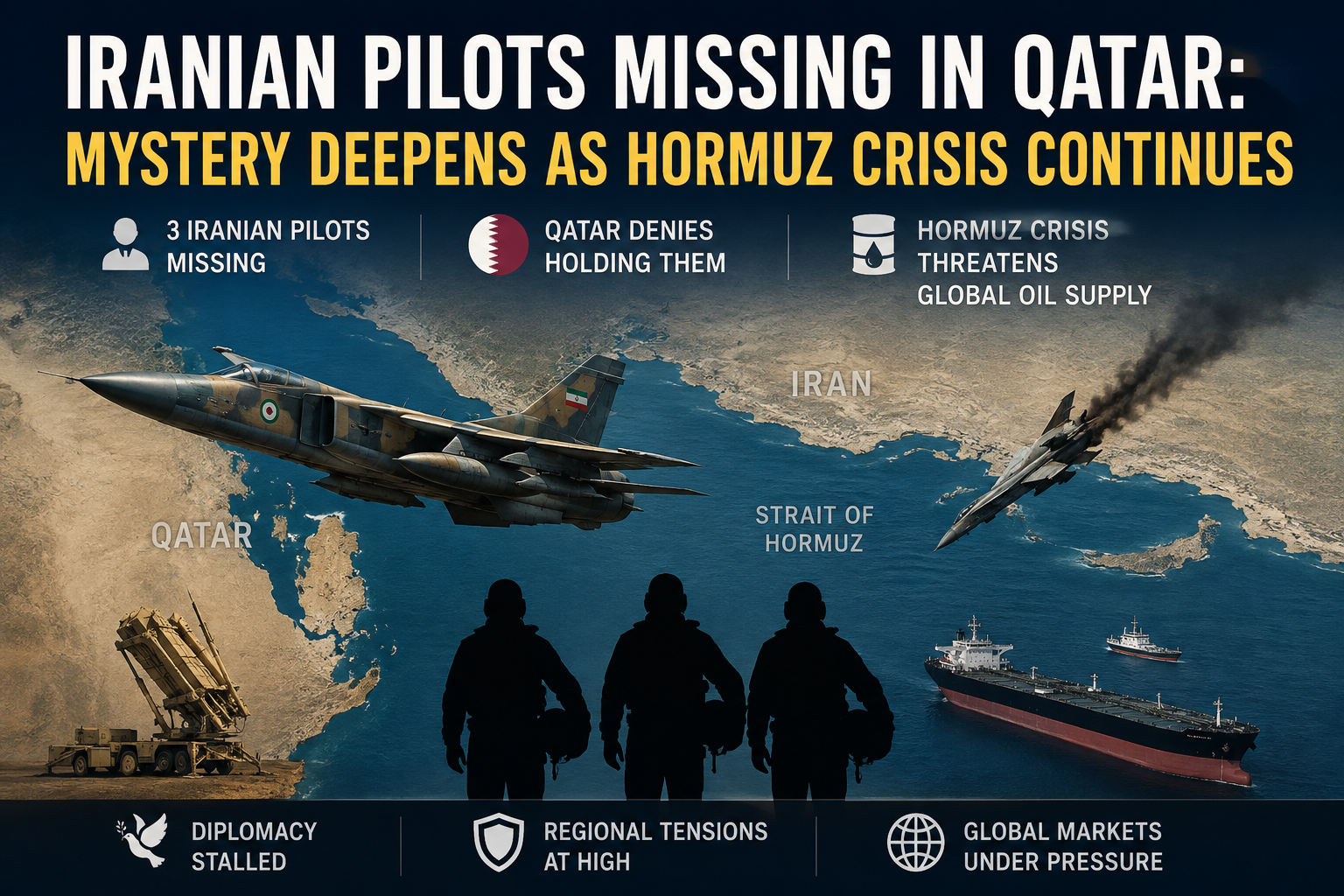
- Iranian pilots: Tehran says three missing Iranian airmen are being held by Qatar, while Doha categorically denies detaining them.
- Strait of Hormuz: The pilots’ mystery has emerged amid stalled U.S.-Iran diplomacy over reopening the vital maritime chokepoint.
- Regional war: The wider conflict has disrupted Gulf security, energy markets and shipping while drawing the Houthis and Red Sea into the crisis.
Nearly six months after the United States and Israel launched their war against Iran, the fate of three Iranian pilots has emerged as one of the conflict’s most intriguing mysteries. Their aircraft were shot down near Qatar in the opening days of the war. Tehran says the Iranian pilots survived and were captured by Qatar. Doha categorically denies holding them.
Iran’s military missing-persons committee has asked the International Committee of the Red Cross to investigate the fate of the Iranian pilots. Tehran says its efforts to establish what happened have been blocked. Qatar says it conducted search-and-rescue operations, recovered the remains of one crew member and found no evidence that the others survived.
A War That Spread Across the Gulf
The mystery began during the opening phase of the war, after Israel launched a major attack against Iran on February 28, followed by U.S. strikes. Washington and Jerusalem said the operation targeted Iran’s nuclear and missile capabilities. Tehran called it aggression and retaliated with missiles and drones.
The conflict quickly expanded beyond Iran and Israel. Qatar, Kuwait, Saudi Arabia and the United Arab Emirates became exposed because of their geography, airspace, energy infrastructure and American military assets.
READ NEXT: China’s Falcon Strike Signals a New Era of Military Partnership With Thailand
It was during those chaotic opening days that two Iranian Sukhoi Su-24 aircraft were shot down after Qatar said they threatened its airspace.
The Mystery of the Missing Airmen
The shoot-down created an unresolved contradiction. One crew member was confirmed dead, while three personnel aboard the two aircraft disappeared from public view.
Iran says the three Iranian pilots survived and were taken prisoner. Qatar says they were never detained.
Qatari Foreign Ministry spokesman Majed Al Ansari said search-and-rescue teams were sent after the aircraft were destroyed and recovered the remains of one pilot. Doha says Iranian officials were invited to review the search effort but did not respond.
The Iranian pilots could have died in the crashes or after ejecting, with their remains never recovered. They could also have survived and been detained, as Tehran alleges. Until independent evidence emerges, the fate of the Iranian pilots remains unresolved.
Why Qatar Matters
The dispute is particularly sensitive because Qatar is one of the key intermediaries between Iran and the United States.
The latest diplomatic efforts have focused on reopening the Strait of Hormuz, through which a major share of the world’s oil and liquefied natural gas normally passes. Traffic has fallen dramatically since the war, putting pressure on energy markets and international shipping.
Washington wants an effectively open maritime corridor. Tehran wants security guarantees, sanctions relief and recognition of its strategic interests.
Against this backdrop, the controversy over the Iranian pilots could become another obstacle to confidence-building. If Tehran and Doha cannot agree on the fate of three military personnel, establishing a broader understanding over Hormuz becomes harder.
Iran’s Aging Air Force
The fate of the Iranian pilots also highlights the condition of Iran’s conventional air force.
Years of sanctions, shortages of spare parts and limited access to Western technology have left Iran operating a mixed fleet that includes aircraft dating from before the 1979 revolution. The Su-24 is itself a Cold War-era aircraft.
READ MORE: Iran Says Pilots Missing After a Brazen Bombing Run Are Prisoners in Qatar
Iran increasingly depended on ballistic missiles and drones rather than attempting to establish sustained air superiority against American and Israeli forces equipped with advanced fighters, surveillance systems, electronic warfare and integrated air defenses.
The disappearance of the Iranian pilots represents the human cost of an air war shaped by a major technological imbalance.
From Military Conflict to Economic War
Iran’s retaliation transformed the economic geography of the conflict.
Qatar’s Ras Laffan energy complex was attacked. Saudi energy facilities came under threat. The UAE faced repeated attacks, while Kuwait was targeted by Iranian missiles and drones. Gulf states that had tried to avoid direct involvement suddenly found themselves exposed to the consequences of war.
The confrontation then moved toward maritime trade.
Iran’s efforts to restrict traffic through Hormuz, combined with American pressure on Iranian ports, created a crisis around one of the world’s most important energy chokepoints. The impact has reached far beyond the Middle East, affecting tanker movements, insurance, energy costs, inflation and industrial planning.
The Houthis and the Red Sea
The war has also expanded through Yemen.
The Iran-aligned Houthis have threatened commercial shipping in the Red Sea and around the Bab el-Mandeb, raising the possibility that two major maritime chokepoints could remain vulnerable simultaneously.
For global shipping, that is a dangerous combination. If Hormuz remains restricted while the Red Sea becomes more hazardous, vessels may face longer routes, higher insurance premiums and increased freight costs.
A War Without a Political Settlement
The central question is now whether military confrontation can be converted into a durable political settlement.
Washington insists that Hormuz must reopen. Tehran seeks guarantees, sanctions relief and compensation while maintaining its claim to protect its security interests.
The United States continues to maintain substantial military forces in the region, while naval assets operate around the Gulf and Arabian Sea. Iran, meanwhile, continues to portray Hormuz as a sovereign security issue.
That is why the mystery surrounding the Iranian pilots matters beyond their individual fate.
A Diplomatic Test
An independent investigation into the missing Iranian pilots could help reduce one layer of mistrust between Tehran and Doha.
If Qatar’s account is confirmed, clarification could remove an important source of tension. If Iran’s allegation is proven, the discovery that the Iranian pilots survived and were detained would trigger a major diplomatic and legal dispute.
The International Committee of the Red Cross could provide a channel for establishing facts about the Iranian pilots.
The unresolved Iranian pilots case could become a confidence test, while the fate of Iranian pilots remains central to Tehran’s demands.
The fate of the Iranian pilots is now connected to the struggle over Hormuz, U.S.-Iran relations, Gulf security, the Houthi threat and the global energy economy.
Six months into the conflict, the Middle East remains caught between escalation and diplomacy. Until the fate of the Iranian pilots is established, their disappearance will remain one of the clearest symbols of a war in which military power, diplomacy and economic pressure have become inseparable.