


The geopolitical landscape of the Asia-Pacific in 2026 is no longer defined by the mere possibility of friction, but by a sophisticated, high-stakes “geometry of deterrence.”
At the heart of this calculation lies the Lockheed Martin F-35 Lightning II, a platform that has evolved from a controversial procurement project into the connective tissue of a regional security architecture. As the U.S. and its allies—Japan, Australia, Singapore, and South Korea—aim for a combined fleet of 300 jets by 2035, the question arises: Is Washington preparing for war, or is it building a “kill web” so dense that conflict becomes unthinkable for Beijing?
The Quantitative Leap: Japan’s Re-Armament
Japan’s trajectory is particularly striking. Historically bound by a pacifist constitution, Tokyo is now on track to become the world’s second-largest operator of the F-35. This is not merely a purchase; it is a profound strategic realignment. By operating both the F-35A (conventional) and the F-35B (short takeoff/vertical landing), Japan is effectively turning its Izumo-class destroyers into de facto aircraft carriers. This capability directly challenges China’s “Anti-Access/Area Denial” (A2/AD) strategy in the South China Sea, providing a mobile, stealthy counter-punch that can operate from austere sites across the Japanese archipelago.
China’s Response: The “Mighty Dragon” and Mass Production
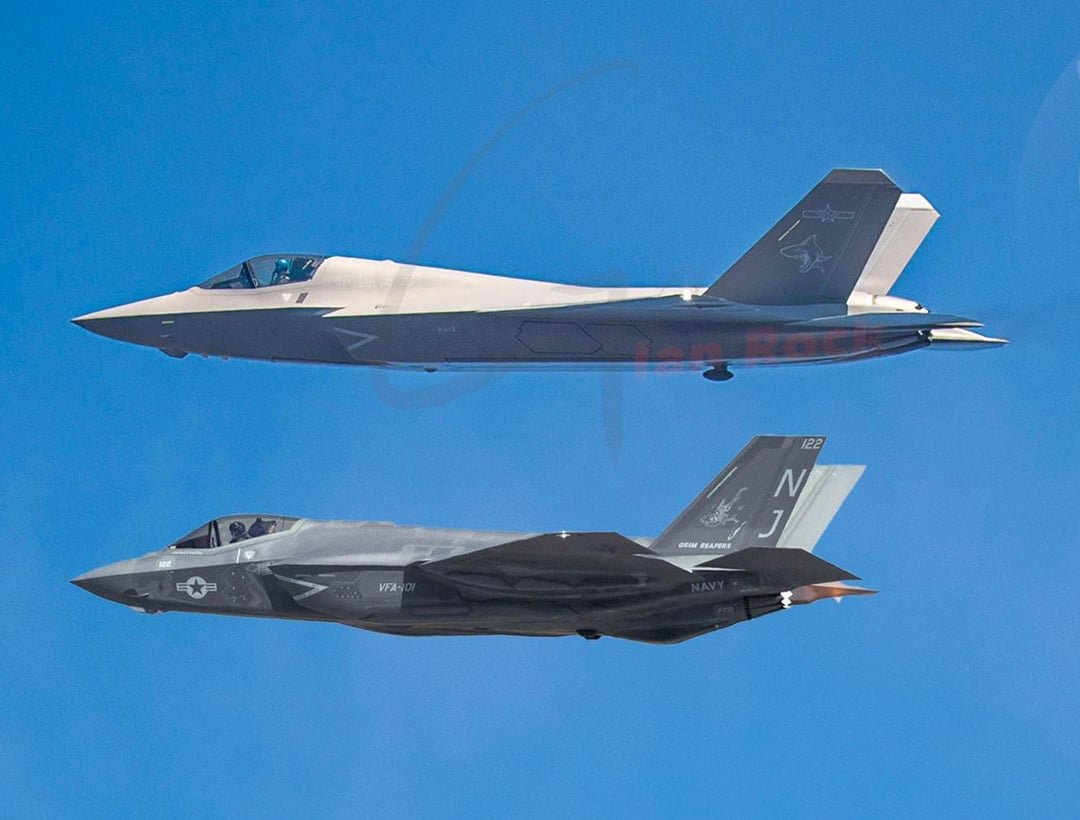
Beijing has not remained static. The People’s Liberation Army Air Force (PLAAF) has accelerated the production of its own fifth-generation crown jewel, the J-20 “Mighty Dragon.” By 2026, Chinese production facilities are churning out an estimated 120 J-20s annually—a rate that rivals the total output of the F-35 program. Unlike the F-35, which is distributed globally, every J-20 is concentrated within China’s borders, specifically within the Eastern and Southern Theater Commands facing Taiwan and the South China Sea.
The U.S. strategy is not about matching China ship-for-ship or jet-for-jet. Instead, it relies on what analysts call “interoperability.” When a Japanese F-35B identifies a target, that data is instantly shared with a U.S. Navy destroyer or an Australian E-7 Wedgetail. This seamless data-sharing creates a “distributed lethality” that complicates Chinese planning. The U.S. is not necessarily preparing for a pre-emptive strike, but it is ensuring that any Chinese move on Taiwan would face a unified, technologically superior response that transcends national borders.
Diplomacy Through Strength
While the 2026 National Defense Strategy (NDS) under the current U.S. administration emphasizes “strength, not confrontation,” the reality on the ground is one of intense preparation. By providing fifth-generation assets to allies, the U.S. is shifting the burden of regional security. It creates a scenario where China must account not just for American intervention, but for a regional “wolfpack” of stealth-enabled nations. This is the new equilibrium: a peace maintained not by the absence of weapons, but by the overwhelming complexity of the weapons deployed.
The Engine of Superpower Rivalry: WS-15 vs. F135
The strategic value of a fifth-generation fighter is often attributed to its stealth coating or its radar, but the true arbiter of its survivability is the engine. As the U.S. distributes F-35s across the Pacific, China has moved to solve its “Achilles’ heel”—the engine. By early 2026, reports confirm that the WS-15 “Emei” has transitioned from testing to serial production, fundamentally altering the kinetic profile of the J-20.
Technical Clash: Power vs. Sophistication
The comparison between the Chinese WS-15 and the American Pratt & Whitney F135 is a study in divergent engineering philosophies. The F-35 relies on a single, massive engine that acts as a power plant for a flying supercomputer. In contrast, the J-20’s twin-engine WS-15 setup is designed for raw speed and sustained high-altitude performance.
The “Cooling” Crisis vs. “Kinetic” Leap
The F135 is currently facing a “power and cooling” bottleneck. The F-35’s advanced Block 4 upgrades require triple the cooling capacity the original engine was designed for. While the U.S. focuses on the Engine Core Upgrade (ECU) to solve this, China has used the WS-15 to leapfrog into the “Supercruise” club. With the WS-15, the J-20 can fly at supersonic speeds without using gas-guzzling afterburners—a capability previously reserved for the F-22 Raptor.
Analyst Note: “The WS-15 isn’t just about speed; it’s about electrical output. More power means the J-20 can eventually carry high-energy weapons and more powerful electronic warfare (EW) suites, narrowing the gap with the F-35’s software advantage.”
Industrial Sovereignty
Perhaps the most significant aspect of the WS-15’s 2026 rollout is China’s industrial sovereignty. By moving away from Russian-made AL-31 engines, Beijing has secured its own supply chain. This allows for the “pulse-line” mass production of the J-20, which is now estimated to exceed 300 units in service.
As the U.S. supplies record numbers of F-35s to Japan and South Korea, they are meeting a Chinese force that is no longer struggling with “engine heart disease” but is instead powered by an indigenous heart designed specifically for the vast distances of the Pacific.
Combat Radius and the Tyranny of Distance: South China Sea Contingency
The “Combat Radius”—the maximum distance an aircraft can travel, engage in combat, and return safely—is the most critical metric for a South China Sea conflict. Here, the geography of the “First Island Chain” creates a massive disadvantage for land-based power unless it is backed by a robust logistics network.
The Stealth Tanker Gap: F-35 vs. J-20
The F-35A has an unrefueled combat radius of approximately 594 nautical miles (1,093 km). While formidable, this range is insufficient to reach the heart of the South China Sea from major bases in Okinawa or Guam without aerial refueling. This makes U.S. and Allied F-35s dependent on “tanker tracks”—predictable paths for refueling aircraft like the KC-46.
In contrast, the J-20 “Mighty Dragon” was designed specifically for the Pacific’s vastness. Its combat radius is estimated at over 700 nautical miles (1,300 km) [01:27]. With the new WS-15 engines, this range is expected to increase due to more efficient “supercruising” (high-speed flight without afterburners).
The Kill Web Strategy
Analysts suggest the U.S. isn’t trying to out-range China. Instead, it is deploying the F-35B (short takeoff/vertical landing) to “austere sites”—small, hidden runways on remote islands [03:51]. This “Island Hopping 2.0” strategy shrinks the distance the jets must fly, effectively neutralizing the J-20’s natural range advantage by moving the “front line” closer to the target.
| Mission Profile | F-35 (Allied Network) | J-20 (PLA Strategy) |
| Launch Point | Dispersed Islands / Carriers | Mainland Bases / Artificial Islands |
| Refueling Need | High (Dependent on Tankers) | Low (Large Internal Fuel Tanks) |
| Tactical Role | Multi-role Stealth [03:51] | Long-range Interception [04:21] |
The J-20’s mission is to be a “sniper,” flying long distances to take out U.S. tankers and radar planes. The F-35’s mission is to be a “network node,” sharing data to ensure that even if one jet is out of range, the entire fleet remains lethal. In 2026, the South China Sea is a battle of China’s reach versus the Allies’ connectivity.