



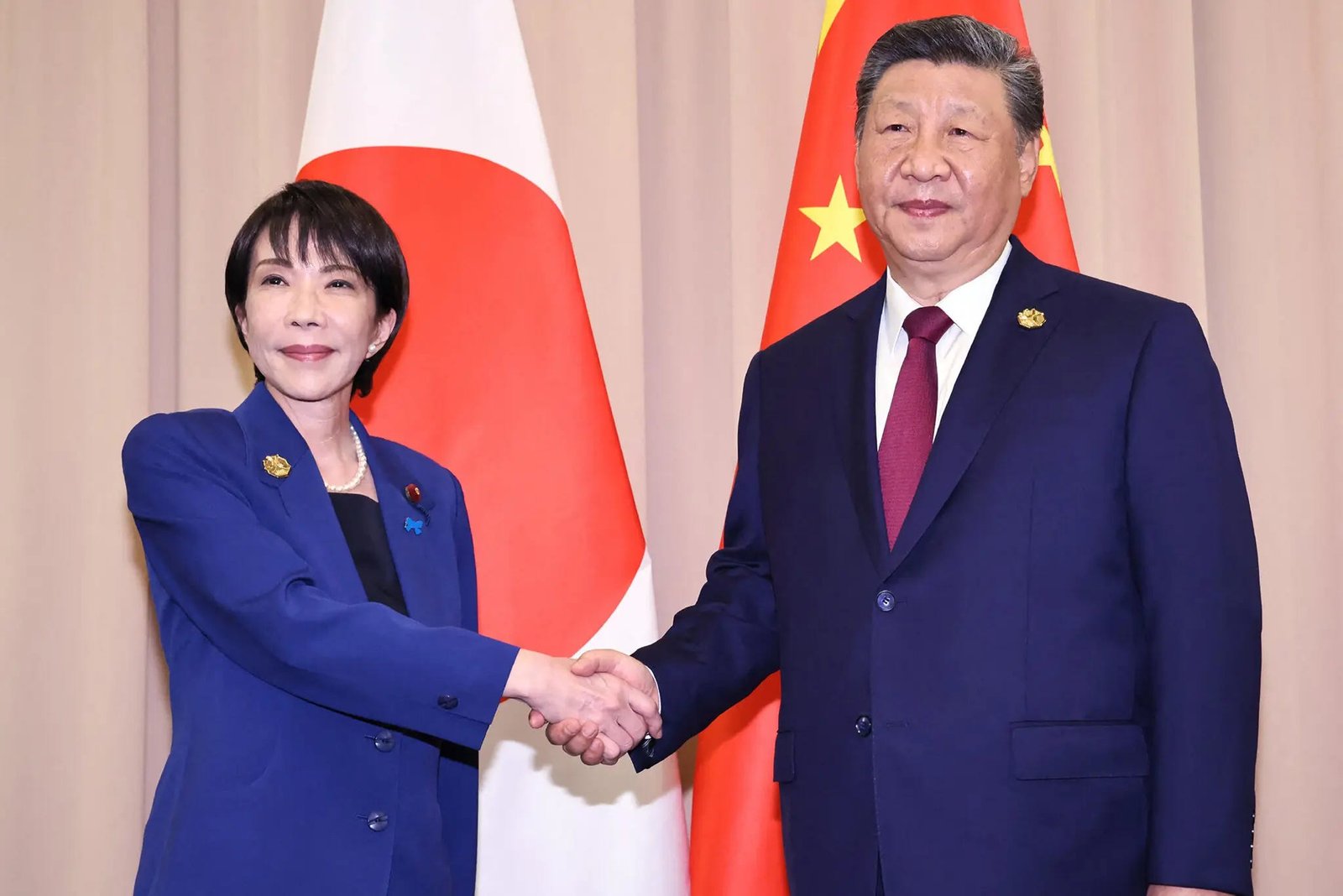
- Japan-China Taiwan tensions spike after Takaichi’s defence remarks.
- Beijing warns Tokyo of “crushing defeat” and issues travel advisories.
- UN, Washington, Paris, and London assess escalating regional risks.
- Economic, military, and diplomatic fallout threatens Asia-Pacific stability.
For the first time in a decade, the relationship between Asia’s two largest powers—Japan and China—is sliding into a dangerous spiral. The trigger this time is Taiwan, but the fuse is long, complicated, and deeply tied to shifting power structures in the Indo-Pacific. Over the past week, the diplomatic row has intensified sharply: Beijing has summoned Japan’s ambassador, issued a travel warning to its own citizens, threatened Tokyo with a “crushing defeat,” and dispatched coast guard vessels near disputed islands.
Tokyo, meanwhile, is scrambling to contain the storm, quietly sending senior diplomats to Beijing to clarify its position while publicly defending its sovereign right to debate national security.
From New York to London, Washington to Paris, high-level policymakers are watching this crisis with quiet alarm. Conversations within major diplomatic missions reflect a simple reality: If Beijing and Tokyo collide over Taiwan—even rhetorically—the implications could spill far beyond East Asia.
Japan China Taiwan Tensions: Alarming Consequences of Takaichi’s Provocative Remarks
Below is an in-depth OpEd following The Islamabad Telegraph’s four-part structure—30% news, 30% analysis, 20% background, and 20% future projection.
JAPAN-CHINA TAIWAN TENSIONS
Japan found itself navigating a sudden diplomatic firestorm after Prime Minister Sanae Takaichi suggested that a Chinese attack on Taiwan could trigger Japanese collective self-defense—a military response. Although Japanese leaders have historically avoided such explicit statements, the new prime minister spoke openly to lawmakers, saying any threat to Taiwan that endangers Japan’s security could justify action under existing laws.
China immediately erupted.
Beijing summoned Japan’s ambassador—its first such move in more than two years—and issued multiple statements condemning Takaichi’s remarks as “dangerous” and “provocative.” A Chinese consul general even posted a threatening message online, saying “the dirty neck that sticks itself in must be cut off,” a post later deleted but not before sparking outrage in Tokyo.
READ MORE: Japan seeks to calm escalating spat with China over Taiwan
Japan lodged formal protests and demanded explanations from Beijing. Simultaneously, Chinese state-linked media launched coordinated attacks, calling Takaichi’s remarks “deliberate provocations.”
Beijing then issued a travel advisory urging Chinese citizens to avoid Japan, citing rising “risks.” The effect on markets was immediate: tourism-related stocks in Tokyo tumbled, with giant retailers and airlines suffering significant losses. Analysts say a prolonged dispute could cost Japan more than half of its annual GDP growth, given China’s significance as a visitor and trade partner.
Compounding the crisis, Chinese coast guard vessels sailed into waters around the Senkaku/Diaoyu Islands, prompting Japanese patrols to push them out. These islands remain one of the most sensitive fault lines in East Asia.
ALSO READ: China, Japan, and the Peril of Manufactured Provocations
Japan has now dispatched the head of its Asia Bureau, Masaaki Kanai, to Beijing to de-escalate the situation, insisting that Takaichi’s remarks do not represent a shift in policy. The prime minister is also likely to meet China’s Premier Li Qiang on the sidelines of the G20 summit in South Africa.
Meanwhile, Taiwan’s President Lai Ching-te accused China of launching a “multifaceted attack” on Japan and urged the international community to keep a close watch.
And indeed, they are watching.
Diplomatic sources in Washington, New York (UN), London, Paris, and several ASEAN capitals confirm ongoing assessments of worst-case scenarios, especially if miscalculations continue.
BEHIND THE ESCALATION
At its core, this crisis is about red lines—Japan crossing one, and China enforcing another.
Japan’s Calculus
Takaichi’s comments represent a significant—even if unofficial—shift. For decades, Japan practiced strategic ambiguity regarding Taiwan. It supported peace, enhanced its defensive capabilities, and maintained a security alliance with the U.S., but avoided explicitly stating how it would respond to a Taiwan contingency.
This ambiguity minimized confrontation with Beijing and preserved economic cooperation.
But Tokyo’s strategic environment has changed:
- China’s military presence near Taiwan has increased dramatically.
- Japan’s defense white papers now openly list China as a “security threat.”
- The U.S. is pressuring allies to commit more robustly to Taiwan’s defense.
Takaichi sees Taiwan not just as a regional issue but as Japan’s first line of defense. If Taiwan falls, Japan’s western islands—including Yonaguni, just 110 km away—become frontline territory.
China’s Calculus
Beijing, on the other hand, cannot tolerate even symbolic shifts on Taiwan.
From the Chinese perspective:
-
Taiwan is a core sovereignty issue.
-
Japan’s military role in the 20th century still carries deep psychological and political weight.
-
Any hint of Japanese involvement in Taiwan’s defense is an emotional and political red line.
Beijing’s threats are therefore deterrent messaging, designed to shame Tokyo back into silence.
Yet China’s response risks overplaying its hand. The travel advisory and social media threats may push Japan to harden its stance, especially under a conservative LDP administration.
The U.S. Factor
Behind the scenes, Washington sees this moment as a litmus test for Japan’s readiness to support a U.S.-led regional defense architecture.
U.S. officials privately welcome Japan’s clarity.
China interprets that alignment as containment.
This dynamic is driving the crisis toward greater complexity.
HOW WE GOT HERE
Japan-China relations have been defined for decades by a careful balance:
- Economic interdependence: China is Japan’s largest trading partner.
- Historical distrust: Wartime memories and nationalist narratives still shape both societies.
- Territorial friction: The Senkaku/Diaoyu islands are an ever-present trigger.
- U.S.-Japan alliance: The bedrock of Japan’s security—viewed by China as a threat.
Past Japanese leaders, even hawkish ones like Shinzo Abe, maintained caution on Taiwan, aware that explicit commitments could ignite a geopolitical firestorm.
Meanwhile, China’s rise has fundamentally altered East Asia’s equilibrium. Its naval expansion, military drills, and assertive diplomacy around Taiwan have reshaped Japanese strategic thinking.
Domestic politics also play a role. Takaichi, long known for her nationalist inclinations, represents an LDP wing more comfortable asserting Japanese military power.
Beijing knows this—and is reacting strongly to prevent a new political doctrine from taking root in Tokyo.
WHAT COMES NEXT?
The world is watching this crisis closely because the consequences extend far beyond rhetoric. The next few weeks could take one of three paths:
- 1. De-escalation Through Diplomacy (Most Likely)
Kanai’s visit to Beijing indicates Japan wants to cool tensions.
If Takaichi uses the G20 summit to soften her stance, Beijing may also recalibrate.
China does not want a full-scale downturn with Japan—especially amid its own economic challenges.
- 2. Prolonged Diplomatic Freeze (Highly Possible)
If Beijing keeps the travel advisory in place, blocks Japanese businesses, or increases patrols around the Senkaku islands, bilateral ties could deteriorate sharply.
This scenario would hurt Japan’s economy disproportionately.
- 3. Strategic Hardening and Militarization (Worst Case)
If both sides escalate:
- Japan could accelerate defense spending and missile deployment.
- China could expand naval deployments near Taiwan and the Senkaku islands.
- The U.S. may deepen joint military planning with Tokyo.
- ASEAN states could be forced to take sides.
- This scenario risks miscalculation—accidental clashes or nationalist overreactions.
Global Stakes
UN officials in New York, diplomats in Washington, Paris, London, and Brussels, and intelligence analysts across the world are already treating the current flare-up as a potential precursor to an Indo-Pacific realignment.
A conflict involving Japan and China—even a limited one—would disrupt:
- Global supply chains
- Semiconductor production
- Energy shipping lanes
- Regional stability
- International markets
The shockwaves would be felt worldwide.
The Japan-China-Taiwan triangle has always been a geopolitical tightrope, but Sanae Takaichi’s comments have shaken that fragile balance. Beijing’s harsh reaction, coupled with Japan’s growing strategic confidence, marks a turning point in East Asian diplomacy.
As the world watches, Tokyo and Beijing now face a delicate choice: retreat to diplomacy or march toward confrontation.
History will judge how they choose to navigate this moment.