


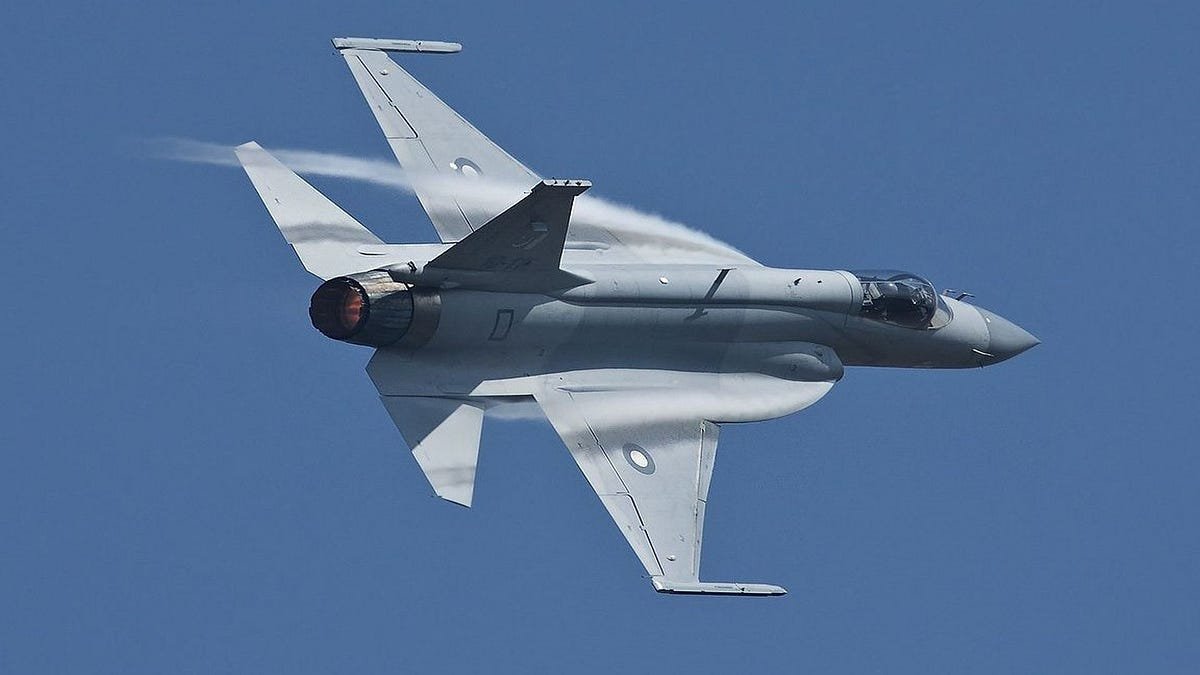
- The JF-17 Thunder Block-III proved its lethality by engaging and neutralizing advanced fourth-generation threats.
- Nations including Iraq, Bangladesh, and Saudi Arabia are now pursuing formal procurement talks for the platform.
- Pakistan’s indigenous defense industry has reached a point of technological sovereignty through the Thunder program.
- The aircraft offers a high-performance, cost-effective alternative to expensive Western defense acquisitions.
The brief but decisive conflict between Pakistan and India last May did more than silence artillery along the Line of Control—it permanently altered the geopolitical architecture of South Asia. For the first time in decades, Pakistan demonstrated more than mere deterrence; it showcased absolute operational dominance. Led by a highly synchronized General Headquarters, Pakistan’s armed forces delivered a calibrated, high-impact response that effectively dismantled long-standing myths regarding Indian military superiority.
Central to this shift was the Pakistan Air Force (PAF) and its fleet of JF-17 Thunder multirole fighters. For years, Indian defense analysts and Western skeptics dismissed the aircraft as an “economy jet.” However, within 72 hours of the conflict’s escalation, the JF-17 silenced its critics. In a landmark Beyond Visual Range (BVR) engagement, a JF-17 Block-III locked, fired, and successfully downed an Indian Rafale—New Delhi’s $200 million flagship acquisition. This single event shifted the psychological and technological landscape of the region overnight.
From Deterrence to Precision Power Projection
The May conflict was characterized by surgical precision rather than the massed infantry formations of the past. Pakistan relied on a sophisticated blend of intelligence-driven strikes, advanced electronic warfare, and coordinated air dominance. While India attempted to seize the initiative through cross-border incursions and standoff missile harassment, the PAF responded by establishing commanding superiority across the battlespace.
What stunned international observers was the level of restraint and control exhibited by Islamabad. Pakistan’s leadership waited out initial provocations, measured the escalation ladder, and then struck critical military targets—including radars, staging sites, and logistical depots—without widening the conflict or endangering civilian populations. Unlike the symbolic skirmishes of 2019, the events of 2025 served as a live demonstration of high-tier electronic warfare and precision capabilities that many assumed were beyond Pakistan’s reach.
Strategic Validation in Washington
The outcome resonated deeply in Washington. U.S. President Donald Trump, who has historically scrutinized Pakistan’s regional role, shifted his tone significantly following the conflict. According to senior U.S. officials, President Trump privately lauded the “disciplined professional force” displayed by the Pakistan Army and Air Force. In public remarks, the U.S. President unexpectedly praised Pakistan’s “stabilizing role” in the region. This shift has moved Pakistan’s defense diplomacy from a position of seeking recognition to one of managing high-level requests for security cooperation and strategic access.
The JF-17 Thunder: A Global Export Magnet
The battlefield success of the JF-17 Thunder has transformed the aircraft into Pakistan’s primary diplomatic calling card. Two decades ago, few imagined this indigenous project would anchor the nation’s export economy. Today, it is an international sensation.
Iraq: In early January, Air Chief Marshal Zaheer Ahmed Baber Sidhu received a state welcome in Baghdad. Iraq’s Air Force Commander, Lt Gen Mohanad Ghalib Mohammed Radi Al-Asadi, expressed intense interest in a JF-17 procurement deal, citing the aircraft’s proven combat record against Tier-1 threats.
Bangladesh: Shortly after, a high-level defense delegation from Dhaka, led by Air Chief Marshal Hasan Mahmood Khan, visited Islamabad. Discussions focused on the JF-17’s integration, maintenance, and radar upgrades. Bangladesh’s interest signals a move toward regional hardware that offers battlefield proof over high-cost marketing.
Saudi Arabia and the Gulf: Riyadh is increasingly viewing the JF-17 as a cost-effective, high-performance complement to its Western fleets. Several Gulf states are now exploring procurement models that bundle the airframe with Pakistani-led training and avionics integration.
A Strategic Inflection Point
Pakistan’s victory shattered the assumption that massive defense spending automatically equates to military superiority. India’s reliance on expensive imports like the S-400 and Rafale proved brittle when faced with Pakistan’s disciplined doctrine and indigenous technological sovereignty.
The conflict validated three core realities: Pakistan has achieved credible technological independence; indigenous hardware can compete with the world’s most expensive platforms; and the South Asian balance of power has permanently narrowed. Pakistan is no longer a spectator in global aerospace; it is a Tier-1 participant. The JF-17 Thunder is the physical proof of this new era—a weapon built, tested, and now exported on Pakistani terms.