



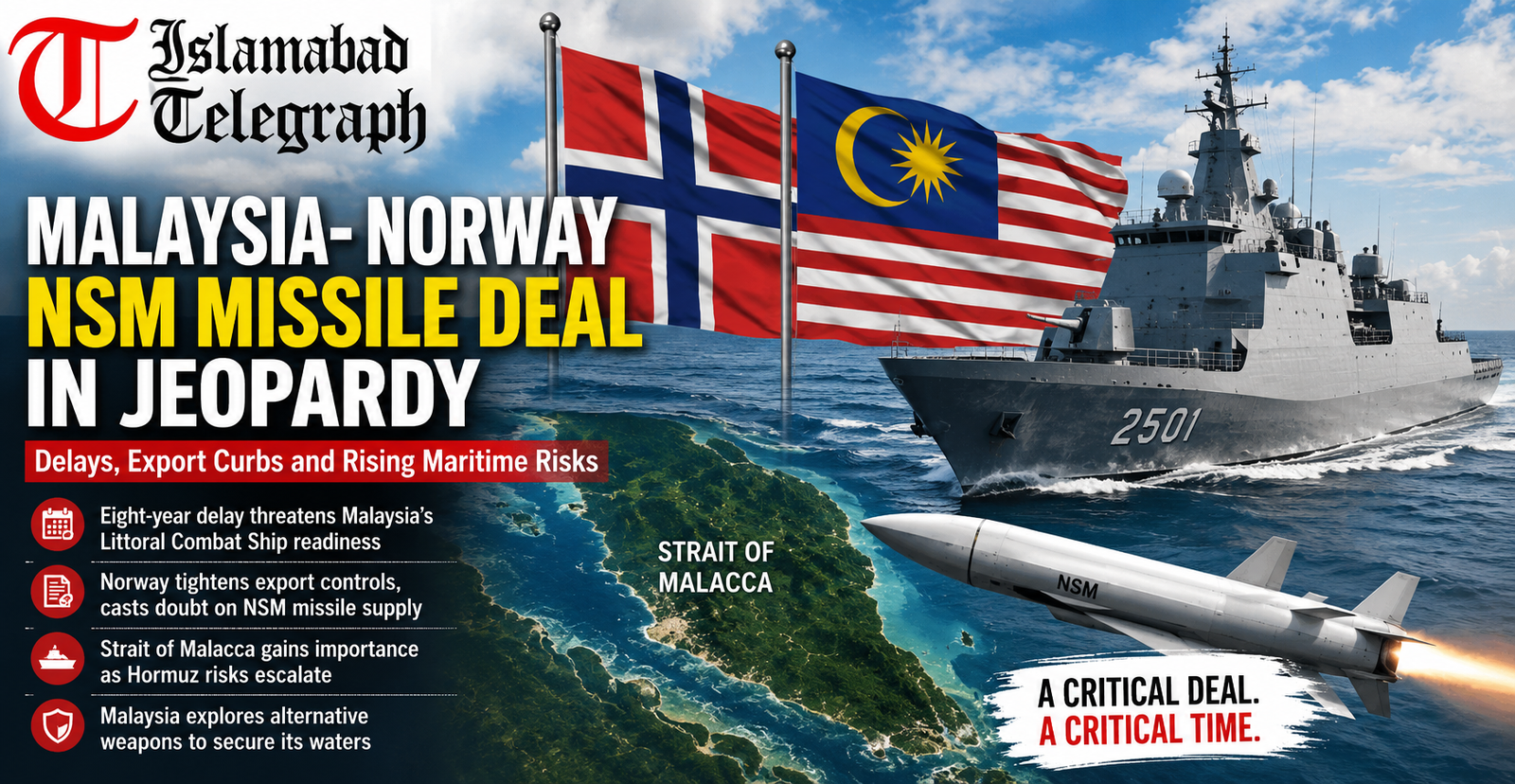
- Malaysia NSM missile deal faces uncertainty after Norway tightens export controls on sensitive defense technologies
- Eight-year delay threatens Malaysia’s naval modernization and Littoral Combat Ship readiness
- Strait of Malacca gains strategic importance amid rising risks in Strait of Hormuz
- Kuala Lumpur may explore alternative missile systems to safeguard critical sea lanes
Kuala Lumpur — A long-delayed defense agreement between Malaysia and Norway has entered a new phase of uncertainty, raising concerns over regional maritime security at a time when global shipping routes are under increasing strain. Malaysia is now seeking “further clarifications” from Norwegian authorities after reports suggested that the supply of Naval Strike Missiles (NSM) may be stalled — or even cancelled — nearly eight years after the deal was first signed.
The agreement, concluded in 2018 between Malaysia and Norwegian defense firm Kongsberg Gruppen, was intended to equip six Royal Malaysian Navy Littoral Combat Ships (LCS) with advanced anti-ship missile systems. However, recent statements from Oslo indicate that export licenses tied to certain sensitive technologies have been revoked, casting doubt over the future of the deal.
Malaysia’s Defense Minister Mohamed Khaled Nordin confirmed that the government is engaging Norway through diplomatic channels to determine the fate of the procurement. “Malaysia will seek further clarifications and find the best solution in the interest of the country,” he said, stopping short of outlining contingency plans or confirming whether Kuala Lumpur would pursue refunds or alternative suppliers.
The Malaysia Sovereign Wealth Fund Targets Rare Earth Growth to Stabilize Ringgit
The Norwegian Ministry of Foreign Affairs, meanwhile, acknowledged that stricter export control policies were behind the disruption. While reaffirming its commitment to bilateral ties, Oslo did not provide a clear timeline or assurance that the missile systems would eventually be delivered.
Illegal labor in Malaysia sparks international outcry as luxury retail hubs are linked to undocumented workforce scandals
The uncertainty surrounding the NSM deal could not come at a more critical time. Malaysia’s LCS program — already plagued by years of delays and cost overruns — is entering a crucial operational phase. The lead vessel, Maharaja Lela, has recently begun sea trials, but without a confirmed primary anti-ship missile system, its combat readiness remains incomplete.
Rare Earth Metals Deal: Malaysia and France Target Global Market with $200M Investment
The Naval Strike Missile, widely regarded as one of the most advanced sea-skimming weapons in its class, offers a range exceeding 300 kilometers and is designed to evade modern air defense systems. Its absence would leave a significant capability gap in Malaysia’s naval deterrence strategy.
Beyond the immediate defense implications, the stalled deal reflects broader geopolitical shifts reshaping global trade and maritime security. Escalating tensions in the Middle East — particularly threats of disruption in the Strait of Hormuz — have forced global shipping operators to reconsider traditional routes. As a result, alternative corridors such as the Strait of Malacca are gaining renewed strategic importance.
Malaysia Gold price today: Gold rises, according to FXStreet data
For Malaysia, which sits astride one of the world’s busiest maritime chokepoints, this shift has elevated the urgency of strengthening naval defenses. The Strait of Malacca handles a substantial portion of global energy and trade flows, and any increase in traffic heightens both economic opportunity and security risks, including piracy, territorial disputes, and potential military confrontations.
Analysts say that delays in acquiring advanced weaponry like the NSM could undermine Malaysia’s ability to safeguard its waters at a time when regional competition is intensifying. Southeast Asia has become a focal point for naval modernization, with countries investing heavily in anti-access and area-denial capabilities to secure critical sea lanes.
Malaysia Brokers Border Peace Talks as Trump Pressure Forces Thailand, Cambodia to Back Down
The faltering Norway deal also underscores the growing complexity of defense procurement in an era of tightening export controls and shifting alliances. Western nations, increasingly cautious about the transfer of sensitive military technologies, are imposing stricter regulations that can disrupt long-standing agreements.
For Kuala Lumpur, the situation presents a difficult balancing act. On one hand, maintaining strong diplomatic and defense ties with Norway remains a priority. On the other, the Malaysian government must ensure that its naval modernization plans are not derailed by prolonged uncertainty.
There are indications that Malaysia may begin exploring alternative missile systems if the NSM deal collapses entirely. Potential options could include suppliers from Asia or Europe, though any transition would likely involve additional costs, integration challenges, and further delays.
As diplomatic engagements continue, the “million-dollar question” — whether Norway will ultimately deliver the NSM systems — remains unanswered. What is clear, however, is that the stakes have risen significantly. In a world where maritime chokepoints are becoming flashpoints, Malaysia’s ability to secure its waters is no longer just a national priority, but a matter of regional and global consequence.