


- Pakistan China Peace Initiative Iran War gains momentum with a five-point roadmap for ceasefire and negotiations
- China signals readiness to guarantee any future US-Iran agreement at Pakistan’s insistence
- Iran expresses willingness to end war, demands binding guarantees for deal compliance
- Islamabad emerges as chief facilitator, coordinating diplomacy across Beijing, Tehran, and Gulf states
In a significant diplomatic breakthrough that could reshape the trajectory of the escalating Middle East conflict, Pakistan’s sustained peace efforts appear to be yielding results as Beijing and Islamabad jointly unveiled a five-point roadmap aimed at ending the ongoing U.S.-Israeli war on Iran.
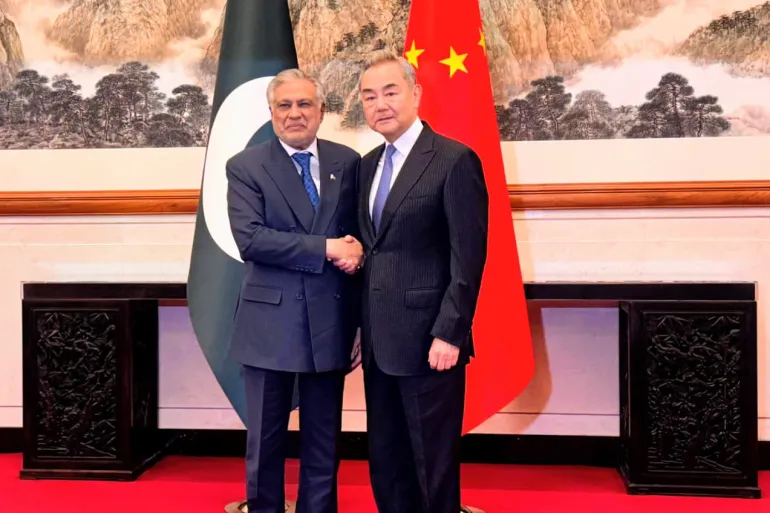
The initiative, announced following high-level talks in Beijing between Pakistan’s Deputy Prime Minister and Foreign Minister Ishaq Dar and China’s top diplomat Wang Yi, calls for an immediate ceasefire, urgent peace negotiations, and comprehensive guarantees to ensure long-term stability in the Gulf.
The joint declaration underscores a rare convergence of strategic interests between Pakistan and China, positioning both nations as central actors in what is increasingly being seen as a decisive diplomatic intervention to halt a widening regional war.
At the core of the five-point initiative is an unequivocal demand for the immediate cessation of hostilities. Both countries warned that continued military escalation risks engulfing the broader Middle East, threatening global energy routes and destabilizing fragile regional economies. The proposal further calls for the swift initiation of peace talks, emphasizing that “dialogue and diplomacy” remain the only viable path forward.
Pakistan Iran War Mediation: Islamabad Positions Itself as the Center of Regional De-Escalation Strategy
Crucially, the plan also stresses the protection of civilians and non-military infrastructure, urging all parties to adhere strictly to international humanitarian law. It highlights the need to safeguard critical facilities, including energy installations and nuclear infrastructure, amid growing fears of catastrophic spillover effects.
Another key pillar of the initiative focuses on securing global shipping lanes, particularly the strategically vital Strait of Hormuz, through which a significant portion of the world’s oil supply passes. Ensuring the safe passage of commercial vessels, the statement noted, is essential to preventing a global economic shock.
Pakistan and China propose five-part peace plan for Middle East
The final component calls for strengthening multilateralism under the framework of the United Nations, advocating for a comprehensive peace agreement grounded in international law and the UN Charter.
The diplomatic push gained further momentum after Iran signaled a conditional willingness to end the war. In a notable shift, Iranian President Ebrahim Raisi stated that Tehran is prepared to enter into a peace agreement, but only if it receives ironclad guarantees that any deal signed with the United States would not be violated “at any cost.”
This demand has emerged as the central sticking point in negotiations, reflecting deep-seated mistrust following previous breakdowns in U.S.-Iran agreements.
However, in what senior officials describe as a “game-changing development,” The Islamabad Telegraph has learned that China is now prepared to provide those very guarantees to Iran—an offer made at Pakistan’s insistence during backchannel diplomacy.
According to sources familiar with the discussions, Islamabad played a pivotal role in persuading Beijing to step in as a guarantor, leveraging its close strategic ties with both Tehran and Beijing. The move is being widely interpreted as a major diplomatic victory for Pakistan, which has steadily positioned itself as the chief facilitator of peace talks in the crisis.
China’s willingness to underwrite a potential agreement not only addresses Iran’s core concern but also significantly enhances the credibility of any future deal, potentially unlocking stalled negotiations between Tehran and Washington.
Diplomatic observers say this development could mark a turning point. With a credible guarantor in place, the likelihood of direct or indirect talks between the United States and Iran has increased substantially.
Pakistan’s role in orchestrating this breakthrough has drawn praise from multiple quarters. Chinese officials have publicly acknowledged Islamabad’s “constructive and consistent” efforts, while Iranian representatives have welcomed Pakistan’s proactive diplomacy aimed at de-escalation.
The initiative builds on a flurry of recent diplomatic activity led by Islamabad, including a high-level meeting involving Saudi Arabia, Türkiye, and Egypt, as well as ongoing indirect exchanges between Washington and Tehran facilitated through structured communication channels.
As tensions continue to simmer, the joint Pakistan-China proposal now stands as the most comprehensive and actionable peace framework on the table. Whether it succeeds will depend on the willingness of all parties to move from battlefield calculations to negotiating tables.
But for now, one thing is clear: Pakistan’s relentless diplomatic push, backed by China’s strategic weight, has injected fresh momentum into a conflict that seemed perilously close to spiraling out of control.