


- Pakistan Iran War Mediation takes center stage as Islamabad hosts Saudi Arabia, Türkiye, and Egypt for crisis talks
- Regional powers push for diplomacy, ceasefire, and possible US-Iran negotiations in Islamabad
- Strategic proposals discussed to reopen the Strait of Hormuz and stabilize global energy markets
- Pakistan emerges as a critical diplomatic bridge between Tehran, Washington, and Gulf capitals
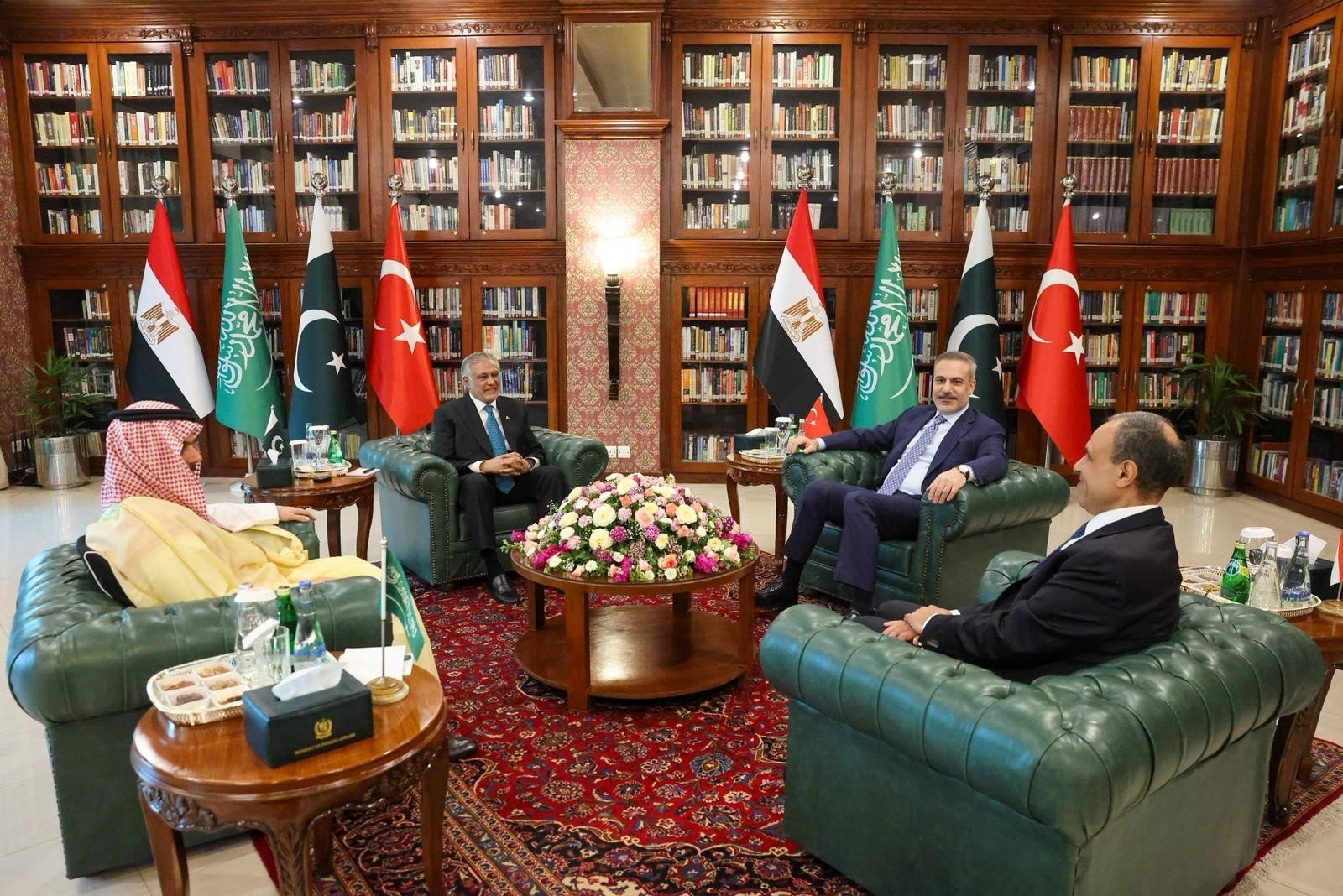
In the hushed, chandelier-lit halls of Islamabad’s Foreign Office, far from the thunder of missiles over the Gulf, a different kind of battle unfolded this week—one waged in cautious language, strategic restraint, and quiet urgency. For two days, Pakistan brought together some of the Muslim world’s most consequential powers—Saudi Arabia, Türkiye, and Egypt—to attempt what increasingly seems improbable: halting a rapidly expanding United States-Israeli war on Iran.
At the center of this diplomatic convergence was Pakistan’s Deputy Prime Minister and Foreign Minister, Ishaq Dar, who chaired the talks with a mix of calibrated optimism and geopolitical realism. What emerged from the Islamabad dialogue was not a breakthrough—but something potentially more consequential: the architecture of a regional mediation framework, anchored in Islamabad, that could shape the next phase of this war.
Trump And Hegseth’s War Doctrine: The Bold Shift Redefining U.S. Military Leadership
Dar’s public remarks were measured, but insiders describe the discussions as unusually candid. “We are not dealing with a conventional conflict,” one senior Pakistani official familiar with the proceedings said. “This is a multi-theatre confrontation with global economic implications. The room understood that urgency.”
Islamabad as the New Diplomatic Nerve Center
Pakistan’s offer to host “meaningful talks” between Washington and Tehran was not improvised. It is the culmination of weeks of backchannel diplomacy, during which Islamabad has quietly positioned itself as a rare interlocutor trusted—if cautiously—by both sides.
Pakistan says it’s ready to host US-Iran talks after regional powers meet
Prime Minister Shehbaz Sharif had already laid the groundwork. In a lengthy call with Iranian President Masoud Pezeshkian, Sharif signaled Islamabad’s readiness to mediate at a moment when conventional diplomatic channels had nearly collapsed. Tehran’s response was telling: public endorsement of Pakistan’s role and explicit gratitude for its mediation efforts.
Iran US Peace Talks: Strategic Ambiguity Defines Tehran’s Calculated Shift Toward Negotiations
Simultaneously, Pakistan’s military leadership has been engaged in parallel conversations. Field Marshal Asim Munir—whose institutional influence remains decisive—has reportedly maintained regular contact with senior U.S. officials, including Vice President JD Vance. This dual-track engagement—civilian diplomacy and military communication—has given Islamabad unusual leverage in a fragmented diplomatic landscape.
The Hormuz Question: Economics Driving Diplomacy
While public statements emphasized ceasefire and dialogue, much of the substantive discussion focused on a single chokepoint: the Strait of Hormuz.
Before the war, nearly 20 percent of global oil and liquefied natural gas shipments transited this narrow waterway. Today, that flow has been effectively choked, sending shockwaves through global markets and triggering fears of a prolonged energy crisis.
According to multiple sources familiar with the talks, Islamabad became the venue for a series of ambitious—and controversial—proposals aimed at reopening Hormuz. Among them:
- A multinational management consortium, potentially involving Saudi Arabia, Türkiye, and Egypt, to oversee maritime traffic and ensure neutrality.
- A Suez-style fee mechanism, floated by Cairo, that would institutionalize transit payments while providing financial incentives for compliance.
- Confidence-building measures, including phased reopening of shipping lanes under international monitoring.
Pakistan’s position, however, has been cautious. While supportive of mechanisms to restore maritime flow, Islamabad has resisted direct participation in any consortium, wary of entanglement in what could become a militarized economic arrangement.
Still, Dar confirmed a tangible outcome: Iran’s agreement to allow additional Pakistani-flagged vessels safe passage through Hormuz—a limited but symbolically important concession.
A Coalition of Middle Powers
The Islamabad meeting underscores a broader shift in global diplomacy: the rise of middle-power coalitions attempting to manage crises once dominated by great powers.
Saudi Arabia, Türkiye, and Egypt each arrived with distinct priorities. Riyadh seeks stability in energy markets and insulation from direct confrontation. Ankara, balancing its NATO ties with regional ambitions, has pushed strongly for an immediate ceasefire. Cairo, facing economic vulnerabilities, is acutely sensitive to disruptions in global trade routes.
What unites them is a shared recognition that escalation serves no one.
“The ministers advocated dialogue and diplomacy as the only viable pathway,” Dar said, echoing a consensus that appears increasingly disconnected from realities on the battlefield—but no less urgent.
The Limits of Mediation
Yet for all the diplomatic choreography, the central question remains unresolved: will Washington and Tehran come to the table?
There are tentative indications. Germany’s foreign minister has suggested that a direct meeting could take place in Pakistan “very soon,” though no official confirmation has followed. Analysts caution that both sides may view talks less as a path to peace than as a tactical pause.
“There is a risk that diplomacy becomes a tool for managing escalation rather than ending it,” said one regional analyst briefed on the Islamabad discussions. “The United States may be buying time. Iran may be seeking relief. Their end goals are not aligned.”
Meanwhile, the battlefield continues to evolve. The entry of Yemen’s Houthi forces into the conflict, coupled with the deployment of additional U.S. troops to the region, has expanded both the geographic scope and the strategic stakes of the war.
Pakistan’s Strategic Calculation
For Pakistan, the mediation effort is not merely altruistic. It reflects a calculated attempt to assert diplomatic relevance at a moment of global realignment.
Islamabad’s unique positioning—bordering Iran, maintaining close ties with Gulf monarchies, and retaining functional channels with Washington—gives it a credibility few others possess. China’s reported support for the initiative further strengthens its diplomatic hand, aligning the effort with broader shifts toward multipolar crisis management.
But the risks are equally significant. Failure could expose Pakistan to diplomatic pressure from multiple directions. Success, however partial, could redefine its role in regional geopolitics.
The Road Ahead
As the Islamabad talks concluded their first phase, no major announcements were made. There was no ceasefire, no handshake between adversaries, no immediate de-escalation.
What emerged instead was a fragile, evolving process—one that places Islamabad at its center.
“All eyes will be on Pakistan,” one diplomat observed as delegations departed the capital. “Not because it can end the war alone—but because, right now, it may be the only place where ending it is still being seriously discussed.”
In a region increasingly defined by escalation, that may be significance enough.