



-
Trump Hegseth military leadership: A decisive break from traditional, consensus-driven U.S. military strategy
- Emphasis on clarity, speed, and mission-first execution over bureaucracy
- Civilian leadership reasserted over Pentagon institutional control
- A new doctrine prioritizing victory over prolonged conflict management
For more than a century, American presidents have inherited a familiar script when it comes to military leadership. The language was polished, the posture predictable, and the decisionmaking filtered through layers of institutional caution. Wars were managed, not won.
Strategies were drafted to satisfy committees, not to impose outcomes. And the public was conditioned to expect a commander in chief who spoke like a custodian of the status quo rather than an architect of disruption.
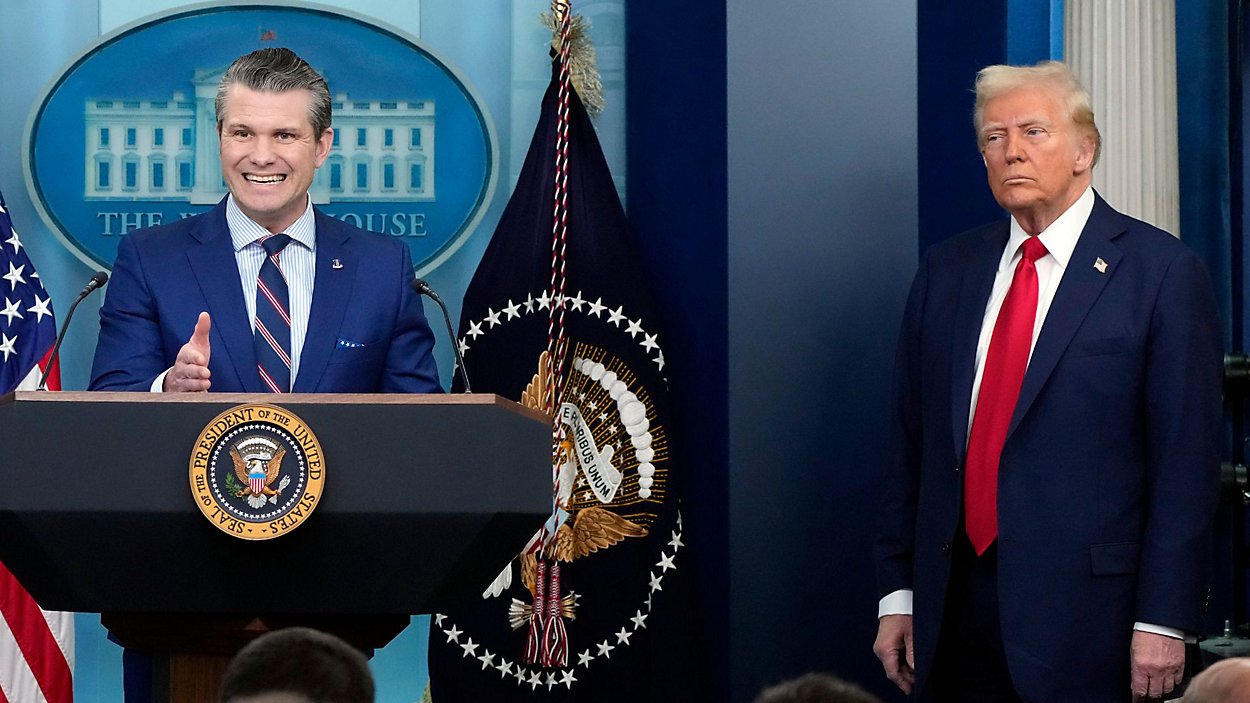
Donald Trump and Pete Hegseth shattered that mold. Whether one agrees with their approach or not, the break from presidential tradition is unmistakable. Their style of military leadership—direct, unvarnished, and unapologetically resultsdriven—stands in sharp contrast to the managerial presidencies of the past. And it is precisely that contrast that has reshaped the national conversation about what wartime leadership should look like.
Tomhawk Missile Usage: Record Tomahawk Missile Usage Raises Strategic Alarms Across Pentagon
Trump’s approach to military decisionmaking has always been rooted in a blunt premise: clarity beats ambiguity, and decisive action beats bureaucratic drift. Past administrations often framed military engagement in the language of “international consensus,” “strategic patience,” or “multilateral coordination.” Trump rejected that vocabulary outright.
His leadership style is built on the belief that the United States should speak with one voice, act with one hand, and pursue objectives without apology. That posture—whether in dealing with adversaries, allies, or the sprawling defense bureaucracy—marks a departure from the diplomatic caution that defined previous eras.
Trump reacts as Hegseth says US will keep pressure on Iran ‘as long and as hard as necessary’
Pete Hegseth, now a central figure in shaping the administration’s military philosophy, amplifies that shift. His worldview is forged not in thinktank conference rooms but in the lived experience of combat. He speaks in the language of soldiers, not strategists. And he approaches military leadership with a conviction that America’s fighting forces should be unleashed to win, not constrained to manage. That ethos resonates with a segment of the military community that has long felt sidelined by Washington’s riskaverse culture.
Iran War Humanitarian Crisis Deepens as Global Food and Medicine Supply Chains Collapse
Together, Trump and Hegseth represent a leadership model that rejects the idea that war should be sanitized for public consumption. They do not hide the stakes, soften the rhetoric, or dilute the objectives. Their communication style—direct, sometimes confrontational, always unfiltered—signals to both allies and adversaries that the United States is no longer operating under the old assumptions. Past presidents often relied on diplomatic ambiguity as a strategic tool. Trump and Hegseth treat ambiguity as a liability.
This shift is not merely stylistic; it is structural. Previous administrations tended to defer heavily to the institutional military establishment, allowing generals, intelligence officials, and interagency committees to shape the contours of U.S. engagement.
Trump, by contrast, has repeatedly asserted that civilian leadership—not bureaucratic inertia—must drive military outcomes. Hegseth reinforces that philosophy by challenging the entrenched culture within the Pentagon, arguing that America’s warfighters deserve leadership that prioritizes mission success over institutional preservation.
Critics argue that this approach is too aggressive, too disruptive, or too dismissive of diplomatic nuance. Supporters counter that the old model—slow, cautious, and consensusdriven—produced decades of inconclusive conflicts and strategic drift. Regardless of where one stands, the contrast is undeniable: Trump and Hegseth have reintroduced the idea that military leadership should be bold, decisive, and unafraid of confrontation.
What makes their partnership particularly distinct is the fusion of Trump’s strategic instincts with Hegseth’s battlefield credibility. Trump brings the outsider’s willingness to challenge sacred cows; Hegseth brings the soldier’s insistence that wars must be fought with clarity of purpose. Together, they have created a leadership dynamic that rejects the incrementalism of past presidencies in favor of a more assertive, missionfirst doctrine.
This is not the language of the postCold War managerial class. It is not the tone of presidents who sought to balance military action with diplomatic hedging. It is something different—something that breaks from the long arc of presidential tradition. And whether history ultimately judges this shift as necessary correction or radical departure, it is clear that Trump and Hegseth have redefined what it means to lead militarily in the modern era.
Their approach is not a continuation of the past. It is a deliberate rejection of it. And in that rejection, they have forced the country to confront a question that previous administrations avoided: Should America’s military leadership be shaped by the caution of institutions or the conviction of individuals?
Trump and Hegseth have made their answer unmistakably clear.