



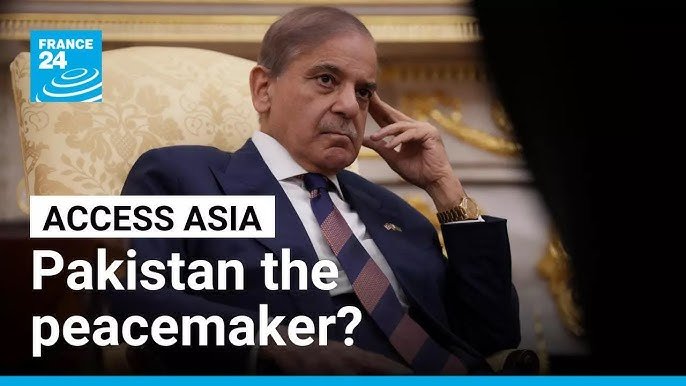
- Pakistan US Iran Talks mark a major diplomatic breakthrough as Islamabad hosts high-level negotiations
- Pakistan’s leadership played a decisive role in securing a fragile ceasefire between Washington and Tehran
- GCC countries demand inclusion of their security concerns before any final agreement is reached
- The Iran war triggered global economic shocks comparable to early COVID-19 disruptions
In a moment that may well be remembered as a turning point in modern diplomacy, Pakistan’s Prime Minister Shehbaz Sharif and Chief of Army Staff Asim Munir have emerged as unlikely architects of global stability—leaders who, through calculated diplomacy and quiet persistence, helped steer the world away from the brink of a catastrophic war between the United States and Iran.
At a time when global markets trembled, oil routes were threatened, and the specter of a wider regional conflagration loomed large, Islamabad positioned itself not merely as a concerned observer, but as a decisive mediator.
The significance of Pakistan hosting high-stakes talks between the United States and Iran in Islamabad on Saturday cannot be overstated. With delegations led by senior officials—including U.S. Vice President J. D. Vance—arriving in the Pakistani capital, the event marks one of the most consequential diplomatic gatherings in the country since its role in facilitating the historic U.S.-China rapprochement of 1971. That moment reshaped the Cold War balance; today, Pakistan seeks to reshape the fragile equilibrium of the Middle East.
The Hour of Diplomacy — Pakistan’s Historic Hand in Turning War into a Ceasefire
Pakistan’s emergence as a chief negotiator did not happen overnight. Behind the scenes, both Shehbaz Sharif and Field Marshal Asim Munir maintained separate and highly sensitive backchannels, relaying messages between U.S. President Donald Trump and Iranian President Masoud Pezeshkian.
These parallel diplomatic tracks were complemented by outreach to key global and regional stakeholders, including China, Saudi Arabia, Turkey, and Egypt. The result was a fragile two-week ceasefire—an achievement that many analysts believe prevented a war that could have spiraled into a global economic disaster.
Asim Munir Iran War Diplomacy: How Pakistan’s Field Marshal Convinced Trump to Delay Strike on Iran
The economic stakes were staggering. During the peak of hostilities, disruptions in the Strait of Hormuz—through which nearly 20 percent of global oil supplies pass—triggered sharp spikes in energy prices. Early estimates suggest that the conflict shaved off hundreds of billions of dollars from the global economy within weeks, with oil prices surging by over 30 percent at one point.
Comparisons were quickly drawn with the economic devastation caused by the COVID-19 pandemic, which cost the global economy an estimated $10–12 trillion. While the Iran-U.S. conflict did not reach that scale, the trajectory was alarmingly similar: supply chain disruptions, financial market volatility, and widespread uncertainty threatening global growth.
How the Iran war could change the US relationship with Gulf states
It is within this context that Pakistan’s diplomatic intervention gains even greater significance. By hosting talks in Islamabad, Pakistan is not only offering a neutral venue but also asserting itself as a credible and trusted intermediary. This transformation—from a country once labeled as “fragile” to a proactive peace broker—reflects a broader recalibration of Pakistan’s foreign policy. Strengthened ties with China, deepening strategic cooperation with Saudi Arabia, and pragmatic engagement with Iran have collectively enhanced Islamabad’s diplomatic leverage.
Yet, even as Pakistan’s prominence grows, a critical challenge remains: ensuring that any U.S.-Iran agreement addresses the legitimate concerns of the Gulf Cooperation Council (GCC) states. For countries like Saudi Arabia, the United Arab Emirates, and Bahrain, the conflict with Iran has not been theoretical—it has been immediate and deeply personal, marked by missile and drone attacks, threats to energy infrastructure, and regional instability.
One of the foremost concerns for GCC states is the security of the Strait of Hormuz. As a vital artery of global energy supply, any disruption to maritime traffic poses a direct threat not only to Gulf economies but to global energy markets. Gulf states insist that any ceasefire must include ironclad guarantees for freedom of navigation. Without such assurances, the credibility of any agreement would be severely undermined.
Trump Final Strike on Iran Looms as U.S. Forces Mobilize and Tehran Prepares for Decisive War
Equally pressing is the demand for a cessation of attacks on Gulf territories. Over the course of the conflict, missile and drone strikes targeting infrastructure in Saudi Arabia, the UAE, and Bahrain have heightened fears of a broader regional war. For GCC states, a ceasefire that does not explicitly address these threats is, at best, incomplete and, at worst, unsustainable.
Another critical issue is Iran’s support for regional militias in Yemen, Iraq, and Lebanon. GCC countries argue that these groups have acted as proxies, destabilizing governments and prolonging conflicts across the Middle East. Any lasting peace, they contend, must include mechanisms to curb such support and integrate regional security frameworks.
Diplomatic frustrations have also emerged at the international level. Recent developments at the United Nations Security Council—where efforts to pass resolutions addressing Gulf security were blocked—have reinforced perceptions among GCC states that their concerns are being sidelined. This has only strengthened the argument that regional stakeholders must be directly involved in any peace process.
Pakistan, given its unique position, is perhaps the only country capable of bridging this gap. Its strong ties with both Gulf states and Iran, coupled with its growing rapport with global powers, place it in an ideal position to advocate for a more inclusive agreement. Analysts argue that Islamabad must use its leverage to ensure that GCC concerns are not merely acknowledged but fully integrated into the negotiation framework.
The vision for lasting peace in the region hinges on this inclusivity. Gulf states, particularly the UAE, have long emphasized coexistence, hosting large Iranian communities and maintaining economic ties despite political tensions. For them, peace is not just about ending hostilities but about creating a sustainable framework for regional stability.
As the world turns its attention to Islamabad this weekend, the stakes could not be higher. Pakistan’s diplomatic gamble has already yielded significant dividends, elevating its status on the global stage. But the true test lies ahead: transforming a fragile ceasefire into a durable peace. If successful, Pakistan will not only have prevented a devastating war but also redefined its role in the international system—as a bridge between rivals, a voice for regional stability, and, perhaps, a genuine architect of peace in a fractured world.