



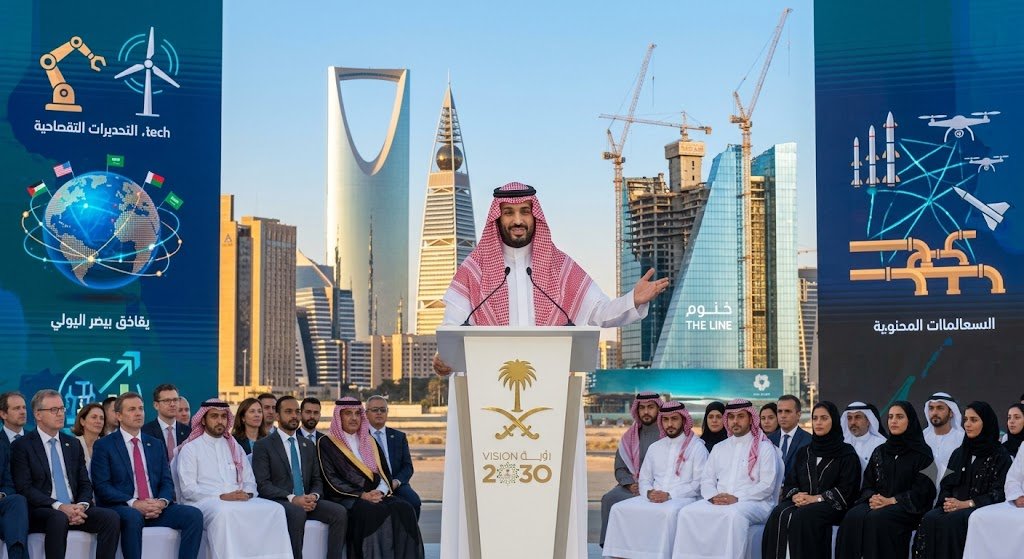
- Saudi Arabia Transformation under Mohammed bin Salman is accelerating economic and geopolitical dominance
- Vision 2030 is attracting global tech, defense and infrastructure investments
- Houthi attacks highlight regional risks but fail to derail Saudi momentum
- U.S.-Saudi strategic partnership remains central to regional stability
Riyadh — The Saudi Arabia Transformation under Mohammed bin Salman is rapidly reshaping the geopolitical and economic balance of the Middle East, positioning the Kingdom as an emerging global power with ambitions that extend far beyond its traditional role as an oil exporter.
Nearly a decade into his leadership, Crown Prince Mohammed bin Salman has driven a sweeping recalibration of Saudi Arabia’s national strategy. The Saudi Arabia Transformation under Mohammed bin Salman is no longer confined to domestic reforms; it has evolved into a multidimensional approach encompassing economic diversification, military modernization and global diplomacy.
Under Vision 2030, the Kingdom has aggressively pursued foreign investment, drawing major global corporations across technology, satellite communications and defense sectors. This influx has reinforced the Saudi Arabia Transformation under Mohammed bin Salman, enabling sustained economic expansion and reducing reliance on hydrocarbons.
Strait of Hormuz Closure Impact on Singapore: Trade, Energy and the Fragility of a Global Hub
Large-scale infrastructure initiatives and giga-projects have become defining features of this transformation. These developments are not only modernizing the Kingdom but also advancing the broader Saudi Arabia Transformation under Mohammed bin Salman by positioning the country as a hub for innovation, logistics and global commerce.
Regionally, the pace of change has been significant. Analysts note that the Saudi Arabia Transformation under Mohammed bin Salman is beginning to outpace competing Gulf economies, including the United Arab Emirates, particularly in scale, capital deployment and long-term strategic planning.
At the geopolitical level, the Saudi Arabia Transformation under Mohammed bin Salman is reinforced by a multi-vector foreign policy. Riyadh maintains strong strategic alignment with the United States while simultaneously deepening ties with China and coordinating with Russia on energy markets. Engagement with Türkiye, Pakistan, Egypt and Qatar further reflects the expanding scope of the Saudi Arabia Transformation under Mohammed bin Salman.
This diplomatic breadth has positioned Saudi Arabia as both a partner and a power broker. The Saudi Arabia Transformation under Mohammed bin Salman has therefore elevated the Kingdom’s influence across competing global blocs, strengthening its leverage in an increasingly fragmented international system.
However, the transformation is unfolding amid persistent security challenges. Yemen’s Iran-backed Houthi movement has escalated attacks, including drone and missile strikes targeting Saudi territory. These actions are widely seen as attempts to disrupt the Saudi Arabia Transformation under Mohammed bin Salman and undermine investor confidence.
The Threat to Saudi Arabia’s Main Oil-Export Route Is Growing
The strategic stakes are particularly high given current disruptions in the Strait of Hormuz. In response, the Kingdom has relied on alternative export routes, most notably the East-West Pipeline, which transports crude oil to the Red Sea port of Yanbu. This infrastructure has become a cornerstone of the Saudi Arabia Transformation under Mohammed bin Salman, ensuring continuity in energy exports despite regional instability.
From Yanbu, shipments pass through the Bab al-Mandeb strait, a critical maritime chokepoint. The stability of this corridor is essential not only for Saudi Arabia but also for global energy markets. Any disruption could test the resilience of the Saudi Arabia Transformation under Mohammed bin Salman at a time of heightened geopolitical tension.
Despite these risks, Saudi Arabia has maintained substantial export volumes, helping stabilize global oil supply. This resilience underscores the structural strength of the Saudi Arabia Transformation under Mohammed bin Salman, which is designed to withstand external shocks.
The United States continues to play a pivotal role in supporting Saudi Arabia’s security. Washington has approved significant arms sales and maintains close coordination with Riyadh on regional defense. This partnership reinforces the Saudi Arabia Transformation under Mohammed bin Salman, particularly in safeguarding critical infrastructure and trade routes.
At the same time, U.S. policymakers appear cautious about deeper military involvement in Yemen, reflecting broader strategic priorities. Even so, the alignment between Washington and Riyadh remains a central pillar of the Saudi Arabia Transformation under Mohammed bin Salman.
The breakdown of the 2022 truce with the Houthis introduces new uncertainty. Yet, despite the escalation, there is little evidence that these pressures can fundamentally derail the Saudi Arabia Transformation under Mohammed bin Salman. Instead, they are likely to accelerate efforts to strengthen defense capabilities and diversify economic assets.
Supporters argue that the Saudi Arabia Transformation under Mohammed bin Salman represents one of the most ambitious modernization programs in the contemporary world. They contend that its structural foundations—economic diversification, global partnerships and strategic infrastructure—make it inherently resilient.
Critics caution that unresolved regional conflicts could continue to impose risks. However, even these challenges have not slowed the momentum of the Saudi Arabia Transformation under Mohammed bin Salman, which continues to advance across multiple fronts.
What is increasingly clear is that Saudi Arabia is no longer operating at the periphery of global affairs. The Saudi Arabia Transformation under Mohammed bin Salman has positioned the Kingdom as a central actor shaping outcomes in energy markets, geopolitical alignments and emerging technologies.
The question posed by rising tensions—whether external threats can halt this transformation—appears to have a consistent answer among many policymakers and analysts. The Saudi Arabia Transformation under Mohammed bin Salman may face tests, but it is unlikely to be reversed.
In strategic terms, Saudi Arabia’s trajectory reflects not just adaptation, but ambition. The Saudi Arabia Transformation under Mohammed bin Salman is redefining the Kingdom’s role in the international system—one that is increasingly assertive, resilient and globally consequential.