



- Syria post-Assad revival marks the end of decades of dictatorship and foreign domination
- Mohammed bin Salman’s regional vision positions Syria as an Arab economic and security anchor
- Trump’s repeal of Caesar Act sanctions unlocks billions in Saudi and Gulf investment
- Analysts warn of security risks but say Syria’s new leadership has unprecedented backing
One year after the fall of Bashar al-Assad, Syria stands at a historic inflection point that few would have imagined possible after more than five decades of dynastic dictatorship, war, sanctions, and state collapse.
The images from Damascus this December—crowds filling Umayyad Square, families waving the pre-Baath Syrian flag, and a new president addressing a public no longer paralyzed by fear—symbolized more than the end of a ruler. They marked the collapse of an entire order that had reduced one of the Arab world’s most vibrant societies into a battlefield for foreign powers and extremist militias.
Trump Sharaa Alliance: Former Rebel Ahmed al-Sharaa Becomes Washington’s Key Partner in Syria
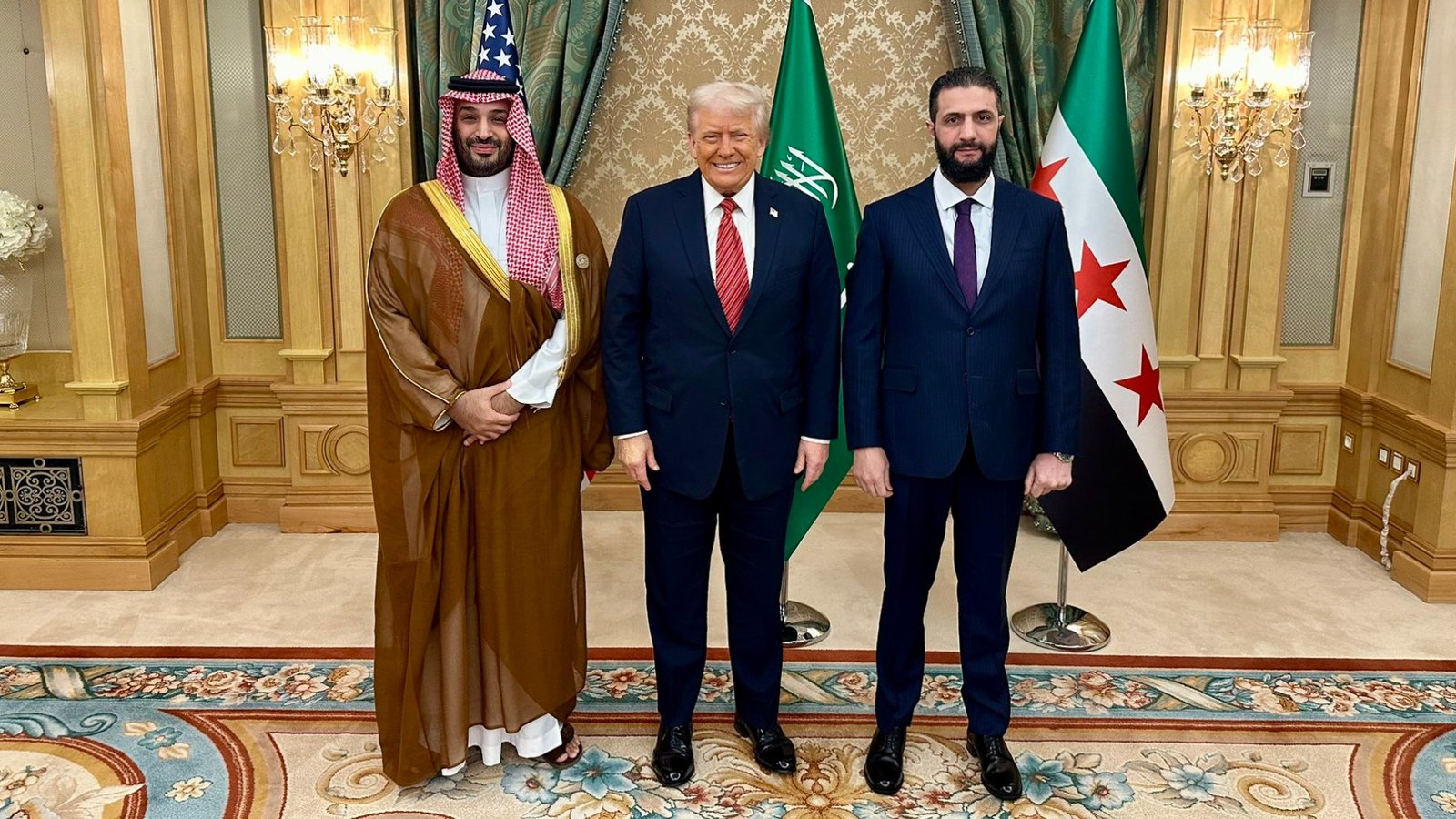
At the center of this transformation are three figures whose alignment has reshaped Syria’s trajectory: Saudi Crown Prince Mohammed bin Salman, U.S. President Donald Trump, and Syria’s unlikely new leader, Ahmed al-Sharaa. Together, they represent a convergence of Arab capital, American power, and Syrian pragmatism—an axis that analysts increasingly argue has given Syria its first genuine chance at recovery since 2011.
Ending a half-century of tyranny
For Syrians, the fall of Assad ended not just a civil war but a system of rule built on surveillance, torture, sectarian manipulation, and economic suffocation. Under Hafez and later Bashar al-Assad, Syria’s once-impressive infrastructure, middle class, and cultural life deteriorated steadily, culminating in the devastation unleashed after 2011. Cities like Aleppo and Homs were reduced to rubble, millions were displaced, and the country became a corridor for Iranian militias, Hezbollah weapons, and transnational jihadist networks.
READ MORE: Dispatch from Riyadh: Why Syria is central to the Middle East’s future
Mohammed bin Salman has long viewed this outcome as both a humanitarian tragedy and a strategic disaster. From Riyadh’s perspective, Assad’s Syria was not a sovereign Arab state but an Iranian forward operating base stretching from Tehran to the Mediterranean. Removing that structure—without allowing Syria to collapse into permanent chaos—was essential to any durable Middle Eastern order.
ALSO READ: Israel–Syria Rift Tests Washington’s New Middle East Strategy
Trump’s return to the White House provided the decisive external catalyst. Unlike previous U.S. administrations that oscillated between disengagement and moralistic paralysis, Trump framed Syria through a hard-headed strategic lens: weaken Iran, eliminate ISIS, stop endless wars, and allow regional powers to take ownership of stabilization. The repeal of Caesar Act sanctions through the NDAA was not charity; it was a calculated bet that economic oxygen, not isolation, was the only way to prevent Syria from relapsing into extremism.
The Sharaa factor: pragmatism over ideology
Ahmed al-Sharaa’s rise is, without question, improbable. His past—rooted in jihadist insurgency, imprisonment, and reinvention—has rightly drawn scrutiny. Yet foreign policy is not built on moral purity but on outcomes. Analysts in Riyadh and Washington argue that al-Sharaa’s transformation mirrors the broader evolution of the region itself: from ideological rigidity to survival-driven pragmatism.
What distinguishes al-Sharaa from Syria’s previous rulers is not rhetoric alone, but incentives. Unlike Assad, whose power rested on repression and foreign patrons, al-Sharaa’s legitimacy depends on reconstruction, stability, and international reintegration. His outreach to minorities, commitment to a constitutional process, and willingness to cooperate with Arab states reflect an understanding that Syria cannot be governed as a sectarian fortress.
Saudi officials privately acknowledge the risks, but emphasize the absence of alternatives. A fragmented Syria would invite ISIS resurgence, Iranian re-entry, and endless Israeli-Iranian confrontation. A sanctioned Syria would remain fertile ground for militancy. Supporting al-Sharaa, they argue, is not an endorsement of his past, but an investment in Syria’s future.
Syria Post-Assad Revival: Why Riyadh is all-in
Mohammed bin Salman’s engagement with Syria is inseparable from his broader Vision 2030 worldview. The crown prince seeks an integrated Arab economic and security corridor—from the Gulf through the Levant—that can compete, attract investment, and stabilize populations. Syria is the geographic and symbolic keystone of that vision.
Saudi investments exceeding six billion dollars this year are not acts of sentimentality. They are targeted toward electricity generation, housing, hospitals, transport corridors, and energy infrastructure—the foundations of state recovery. Clearing Syria’s World Bank arrears was a strategic move to unlock multilateral financing and institutional oversight, reducing the risk of corruption and collapse.
There is also a cultural dimension. Syria is deeply embedded in Arab identity, and many Saudi families trace their lineage to Damascus, Homs, and Aleppo. For Riyadh, Syria’s rehabilitation is a form of historical restoration—bringing a wounded heart of Arab civilization back into the fold.
Trump’s wager and Israel’s unease
Trump’s backing of al-Sharaa has unsettled Israel, which views any former jihadist at its northern border with suspicion. Israeli strikes inside Syria underscore legitimate security concerns, particularly regarding armed factions and hostile rhetoric. Yet Washington’s assessment diverges: engagement, not perpetual bombardment, is seen as the best way to neutralize threats over time.
Trump’s calculation is rooted in leverage. By tying sanctions relief and reconstruction to security cooperation, the U.S. retains influence over Damascus’ behavior. A functioning Syrian state aligned with Arab interests is, in this view, less dangerous than a vacuum ruled by militias.
Challenges ahead—but a clear direction
None of this minimizes Syria’s challenges. The country remains scarred, impoverished, and fragile. ISIS cells persist, sectarian wounds remain raw, and governance capacity is thin. The recent attack killing U.S. personnel was a stark reminder that spoilers are active and determined.
Yet foreign policy is about trajectories, not perfection. One year after Assad’s fall, Syria is moving—however unevenly—toward reintegration rather than isolation, reconstruction rather than stagnation, and Arab anchoring rather than Iranian subjugation.
Analysts across the Gulf increasingly agree on one point: without Mohammed bin Salman’s strategic vision and Trump’s decisive political backing, Syria would likely have drifted into another lost decade. With them, and with a Syrian leader who understands that survival now depends on delivery rather than dogma, the country has a chance—perhaps its last—to reclaim the stability and dignity it once knew.
Syria, long a symbol of Middle Eastern failure, is now a test case for a new regional order. Whether it succeeds will shape not just Damascus, but the future balance of the Arab world itself.