



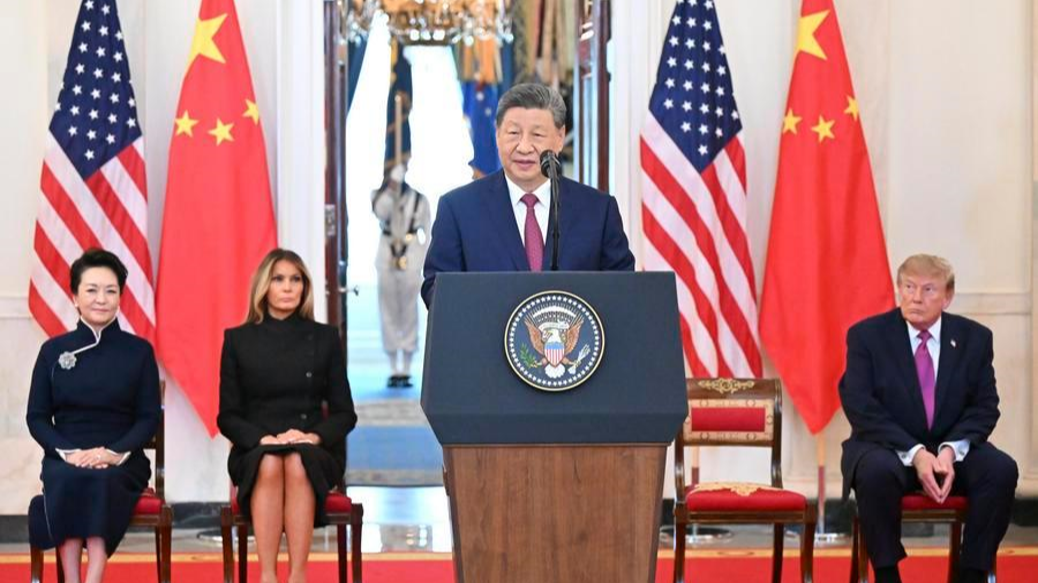
- Xi Jinping In The U.S: as President Donald Trump breaks protocol to personally greet Chinese President Xi Jinping and host an extraordinary White House state dinner.
- World leaders and Silicon Valley titans gather in Washington to navigate bilateral trade, AI regulation, and geopolitical tensions.
- High-profile attendees including Nvidia’s Jensen Huang and Tesla CEO Elon Musk underscore the central role of technology in global superpower relations.
- Both leaders emphasize constructive strategic stability to avoid conflict and build a framework for future economic cooperation.
WASHINGTON — In an unprecedented display of diplomatic spectacle and economic realpolitik, US President Donald Trump rolled out the ultimate red carpet for Chinese President Xi Jinping and his wife, Peng Liyuan, marking a dramatic shift in how Washington manages its most formidable strategic rival.
Breaking Protocol on the Tarmac
Setting an extraordinary tone long before the White House grand hall was unsealed, President Trump made the rare move of personally traveling to Joint Base Andrews in Maryland to welcome President Xi upon his arrival on American soil. By custom, sitting American presidents wait for foreign dignitaries at the White House rather than greeting them on the tarmac—a gesture previously reserved for figures of spiritual or historical magnitude, such as visiting Popes.
READ NEXT: Xi-Trump Summit: The High-Stakes Encounter Reshaping War, Trade, and the Global Order
Accompanied by First Lady Melania Trump, a full military honor guard, and an impressive B-1 bomber flyover, Trump personally greeted Xi and Peng as they descended the stairs of Air China 747. The personal greeting sent an unmistakable signal across global capitals: despite years of sharp rhetoric, aggressive tariff maneuvers, and hawkish trade policies, Trump is eager to construct a fresh personal baseline with Beijing.
A Star-Studded Gathering of Silicon Valley Royalty
The evening peaked inside the East Room of the White House, where Trump hosted a star-studded state dinner that brought together American political power and Silicon Valley elite. The guest list featured the primary architects of the global tech revolution—most notably Nvidia CEO Jensen Huang, Tesla and SpaceX CEO Elon Musk, OpenAI CEO Sam Altman, Meta CEO Mark Zuckerberg, and former Apple CEO Tim Cook.
+-------------------------------------------------------------------+
|                  NOTABLE STATE DINNER GUESTS                      |
+-------------------------------------------------------------------+
| • Jensen Huang   | CEO, Nvidia                                    |
| • Elon Musk      | CEO, Tesla & SpaceX                           |
| • Sam Altman     | CEO, OpenAI                                    |
| • Mark Zuckerberg| CEO, Meta                                      |
| • Tim Cook       | Former CEO, Apple                              |
| • Sundar Pichai  | CEO, Alphabet / Google                         |
| • John Roberts   | Chief Justice, US Supreme Court                |
+-------------------------------------------------------------------+
During his address, Trump celebrated the historic “foundation of commerce and mutual respect” between the two economies, gesturing to the technology titans positioned at the head tables. Framing the relationship around mutual strength, Trump presented Xi with a custom-designed 3-foot bald eagle sculpture—a symbolic gesture crafted alongside Melania Trump to represent the “free and soaring spirit of America”.
READ MORE: Trump and Xi lavish praise on each other at White House state dinner
Trump also invited guests to preview the ongoing construction of the massive new White House ballroom, noting with his trademark theatrical flair that once completed, it would accommodate over 1,000 guests.
                +---------------------------------+
                |      BALD EAGLE STATUE GIFT     |
                |  Height: ~3 Feet                |
                |  Design: Custom American Artist |
                |  Symbol: Free & Soaring Spirit  |
                +---------------------------------+
Navigating Trade Wars, AI Hegemony, and Geopolitics
Beneath the glittering chandeliers and shared toasts lies an array of deep-seated geopolitical frictions. While Washington and Beijing recently extended a fragile tariff truce until early next year, economic rivalry remains fierce. China continues to post massive trade surpluses, while the United States maintains strict export controls on advanced microchips and artificial intelligence infrastructure to limit Beijing’s technological expansion.
The meeting comes as the two superpowers navigate crucial flashpoints:
-
Artificial Intelligence: Maintaining technological boundaries without triggering full-scale digital decoupling.
-
Bilateral Trade: Managing tariffs and ensuring agricultural market access for American farmers.
-
Global Conflict & Stability: Addressing ongoing tensions in Iran, cross-strait stability regarding Taiwan, and supply chain security.
During his speech, Xi Jinping invoked historic moments of US-China cooperation—referencing George Washington’s collection of Chinese porcelain, World War II alliances, and Richard Nixon’s landmark 1972 visit—to argue that the two superpowers can avoid the “Thucydides trap” (the historical pattern where a rising power and an established power inevitably slide into war). Xi stressed that Trump’s “Make America Great Again” agenda can peacefully coexist alongside China’s goal of national rejuvenation.
Boldly Resetting the US-China Relationship
What the world witnessed at Joint Base Andrews and the White House East Room was not merely ceremonial vanity, but a deliberate, high-stakes effort by Trump and Xi to execute a formal reset of US-China ties. By discarding traditional diplomatic distance in favor of direct, personalized rapport, Donald Trump has signaled that despite deep mistrust and ideological rivalries, pragmatism and economic deal-making will dictate the next era of global superpower relations.