



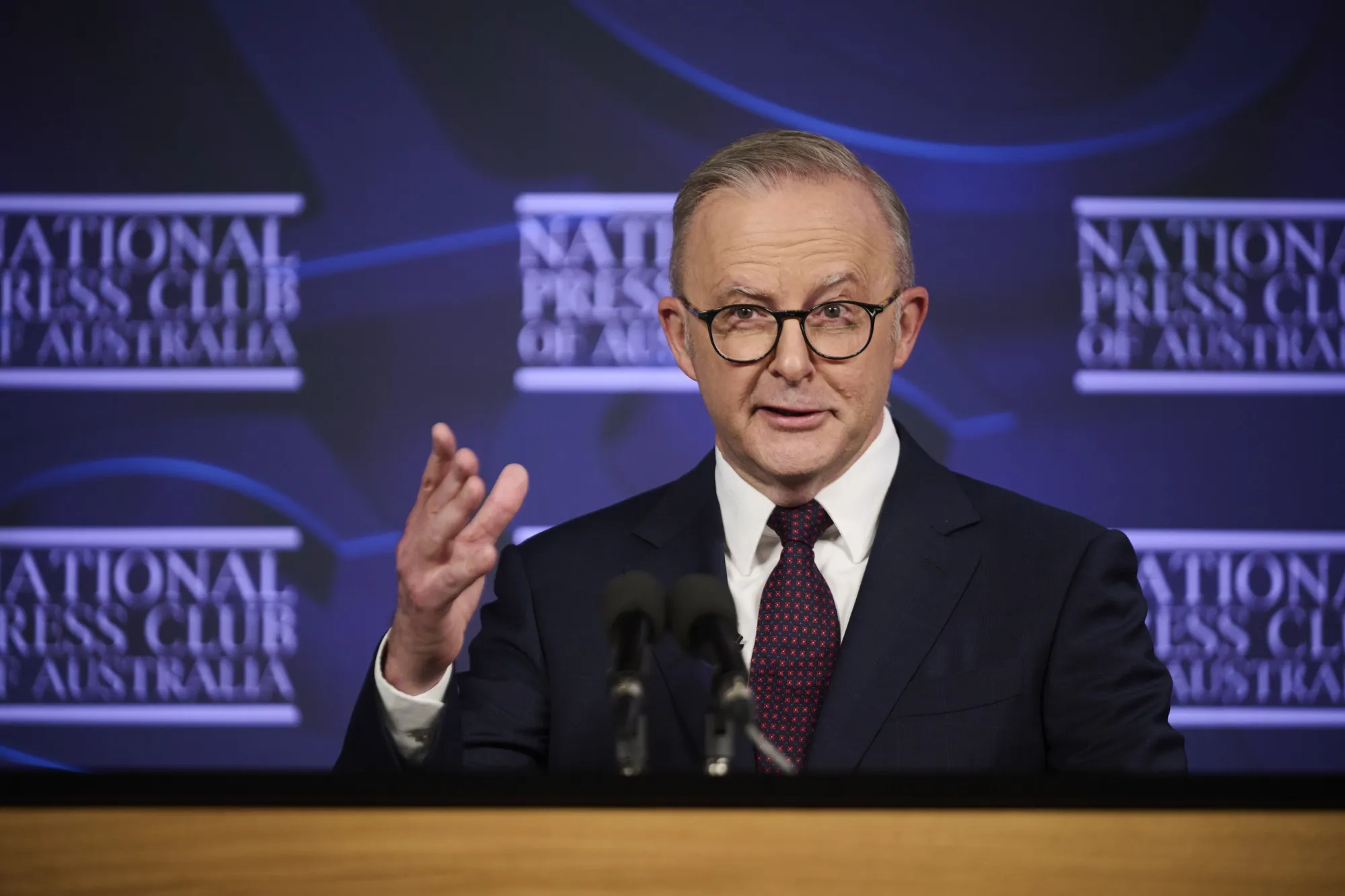
- Australian Prime Minister Anthony Albanese ruled out collective blame after the Brondi attack, stressing the suspects acted individually and not on behalf of any religion or community.
- The prime minister’s televised remarks brought relief to Australia’s Muslim community, amid fears of backlash following the deadly Bondi Beach shooting.
- Sources told The Islamabad Telegraph that the attackers had roots in India, though Australian authorities have not officially disclosed their country of origin.
- The Brondi attack has renewed national debate over gun laws, licensing reforms, and intelligence vetting despite Australia’s historically strict firearm regulations.
Australia is grappling with grief and shock after the deadly Brondi attack—also widely referred to as the Bondi Beach attack—that left 15 people dead during a Hanukkah celebration in Sydney, marking the country’s deadliest mass shooting in nearly three decades. Yet amid national mourning, Prime Minister Anthony Albanese made a forceful and carefully calibrated intervention that has resonated far beyond Australia’s borders and brought visible relief to the country’s Muslim community.
Speaking during a live current affairs program, the Australian Prime Minister made it “loud and clear” that the perpetrators acted individually, not as part of any organized network, religion, sect, or community. His message was unambiguous: collective blame would not be tolerated, and no faith should be stigmatized because of the actions of violent extremists.
Brondi and Brown University Attack Spark Global Debate on Gun Control
“There’s no evidence of collusion. There’s no evidence that these people were part of a cell,” Albanese said, stressing that while the act was driven by an ideology he described as an “extreme perversion of Islam,” it had nothing to do with Islam itself or with Australia’s Muslim population.
That distinction proved critical at a time when communities were on edge, drawing parallels with international incidents such as the Brown University attack, where early speculation fueled online misinformation before investigations concluded. Across Australia, Muslim leaders, civil rights groups, and ordinary citizens described the prime minister’s remarks as a “sigh of relief” that prevented backlash and preserved social cohesion.
READ MORE: Father and Son Used Licensed Firearms in Sydney Terror Attack, Police Say
Authorities have identified the suspects as a 50-year-old father, killed by police at the scene, and his 24-year-old son, who remains in a coma under police custody. The father legally owned six licensed firearms, used in the attack, and was a member of a gun club. The son, Australian-born, had previously been examined by domestic intelligence agencies due to associations with individuals later jailed, but was not found to be radicalized at the time and was not on a watchlist.
ALSO READ: Brondi and Brown University Attack Spark Global Debate on Gun Control
While Albanese declined to disclose the suspects’ country of origin beyond official immigration details, sources told The Islamabad Telegraph that the attackers had roots in India, a claim that is now fueling quiet diplomatic scrutiny but has not been formally confirmed by Australian authorities. The prime minister’s refusal to speculate publicly underscored his effort to prevent ethnic or national profiling as investigations continue.
The Brondi attack has reignited debate over gun control in a country long considered a global model after sweeping reforms following the 1996 Port Arthur massacre. Albanese announced that leaders would revisit firearms licensing, including limits on the number of guns per individual and periodic reviews rather than lifetime permissions. “Licenses should not be in perpetuity,” he said, acknowledging that radicalization can occur over time.
At a National Cabinet meeting, leaders proposed tighter intelligence checks, restrictions on firearm types, and potential limits on licenses to citizens. Despite strict laws, civilian gun ownership has climbed to over four million firearms—25% more than in 1996—raising uncomfortable questions about regulatory gaps.
The attack, described by Albanese as an act of “pure evil,” specifically targeted the Jewish community, deepening fears amid a rise in antisemitic incidents, including synagogue firebombings and attacks on kosher businesses in recent years. Mourners gathered at Bondi Pavilion, laying flowers and lighting candles for the victims, including a 10-year-old girl.
In an era where news cycles often collide with unrelated trending topics—from vikings vs cowboys and packers vs broncos NFL debates to Hollywood commentary by Rob Reiner or updates on a Patrick Mahomes injury—the Australian leader’s words cut through the noise with moral clarity. His approach stood in contrast to reactionary politics seen elsewhere, reinforcing Australia’s commitment to unity over division.
As investigations proceed, the prime minister’s stance has set the tone: justice will be pursued relentlessly, but Australia will not allow terror to fracture its multicultural fabric. In a moment of profound national trauma, that message may prove as consequential as any legislative reform.