



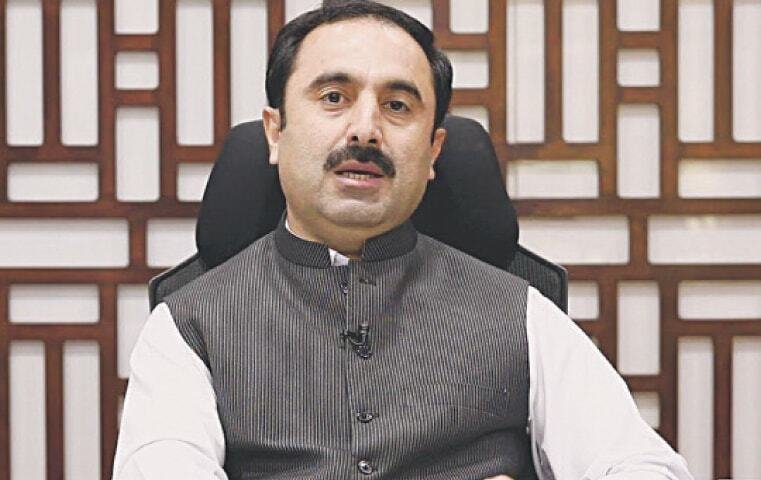
No Flash, No Fame — Just Work, Duty, and the People’s Prayers
In the long, air-conditioned corridors of Khyber Pakhtunkhwa’s Civil Secretariat — where the scent of paper mingles with the faint hum of ceiling fans and where bureaucracy often feels like a distant empire — something unusual has happened. A quiet revolution. Not one of slogans or marches, but of decency, empathy, and old-fashioned service. At its center stands Chief Secretary Shahab Ali Shah, a man whose humility has become folklore and whose footsteps, rather than his words, have left a mark across the province.
He is not the kind of bureaucrat who commands attention with flashing cameras or motorcades. In fact, one might pass him on the street and never know he holds the most powerful administrative office in Khyber Pakhtunkhwa. His clothes are plain, his shoes often dusty, and his conversations soft-spoken. Yet, from the peaks of Swat to the plains of Dera Ismail Khan, people speak of him in tones usually reserved for saints, not civil servants.
“He doesn’t send letters — he arrives,” says a schoolteacher from Charsadda. “You turn around, and there he is — standing in your classroom, looking at the blackboard, smiling gently, asking the children about their dreams.”
It began quietly. Soon after his appointment, instead of summoning deputy commissioners to his office, Shahab Ali Shah began to visit them — not for inspection, but for understanding. He walked through muddy alleys in rural towns, visited community clinics without protocol, and dropped by schools where no one had seen a senior officer in years.
One winter morning in Peshawar, a group of nurses at the Lady Reading Hospital noticed a man in a worn grey coat standing silently near the emergency ward. They assumed he was a relative of a patient until he began asking precise questions about bed capacity, medicine shortages, and attendance logs. When he left, the hospital’s administrative officer realized who he was — the Chief Secretary of the province.
That quiet visit resulted in a complete overhaul of the hospital’s patient management system within a week. “He doesn’t shout or threaten,” said one official. “He makes you feel responsible. That’s far more powerful.”
And then there was the restaurant story — the one that turned him into a kind of urban legend.
A man, exhausted after seven fruitless visits to the Chief Secretary’s office, went to a small eatery for a late dinner. As he stood in line, he glanced back and froze. There, holding a tray and wearing a surgical mask, stood Shahab Ali Shah himself — waiting, like any other customer. The man, trembling with surprise, poured out his frustration.
Shahab listened patiently, nodded, and without drama, took out his phone. “It will be done,” he said simply. Within an hour, the man’s issue — a long-pending land registration — was resolved.
When someone tried to take a photo, Shahab smiled and said, almost apologetically,
“Please don’t make this viral. I’m here to serve, not to be celebrated.”
The next morning, the restaurant workers still couldn’t believe it. “A Chief Secretary who queues for food?” one of them laughed. “He’s either the humblest man alive — or the bravest.”
His days begin early and end long after most offices close. He is known to call district commissioners past midnight, not to scold, but to check if an issue has been resolved. “I’m just asking for progress,” he tells them. But everyone knows that when Shahab calls, it’s because he has already been there — in person.
Once, during a surprise visit to a girls’ high school in Swabi, he found the principal missing. Instead of suspending her on the spot, he asked the students about their classes, their teachers, their challenges. Later that evening, he called the principal himself. “Madam,” he said softly, “I visited your school today. Your students spoke well of you. Let’s make them proud of their school too.”
She broke down in tears. “No officer had ever spoken to me like that,” she told colleagues later. “He didn’t punish me — he made me want to do better.”
That is Shahab Ali Shah’s quiet magic. He doesn’t rule. He inspires.
In an age where bureaucracy often feels like an untouchable fortress — a place of privilege, ego, and paperwork — Shahab has restored something nearly forgotten: the moral beauty of public service. He works without personal publicity, without political posturing. When asked for interviews, he declines. “This is my duty, not my story,” he says. “Write about what’s broken — not about me.”
His humility, however, has not dulled his authority. Officers know that he demands results, not excuses. A missed deadline is not tolerated, nor is indifference. Yet, even his reprimands come with dignity. “We serve people, not procedures,” he once told a group of senior officers. “Every file has a human story behind it. Never forget that.”
Across the province, his influence has become cultural. Markets are cleaner. Parks are better kept. Hospitals are monitored. Teachers are showing up. And perhaps most remarkably, the people — once cynical about government — are beginning to believe again.
A fruit vendor in Kohat put it simply: “He walks like us, eats like us, listens like us. Maybe that’s why the Almighty listens to him.”
There’s a Pashto proverb that says, “Do good and throw it into the river.”
But the people of Khyber Pakhtunkhwa have their own version now:
“Do good — and if you’re Shahab Ali Shah, even the river pauses to salute you.”
In a time when power is often mistaken for privilege, he has proved that the truest power lies in humility — in the ability to touch lives quietly, without cameras, without noise, and without expecting anything in return.
And somewhere tonight, while others sleep, Shahab Ali Shah will still be awake — a dim light glowing in his office — reading reports, making notes, and planning his next unannounced visit.
Because for him, public service is not a position.
It is a prayer.