


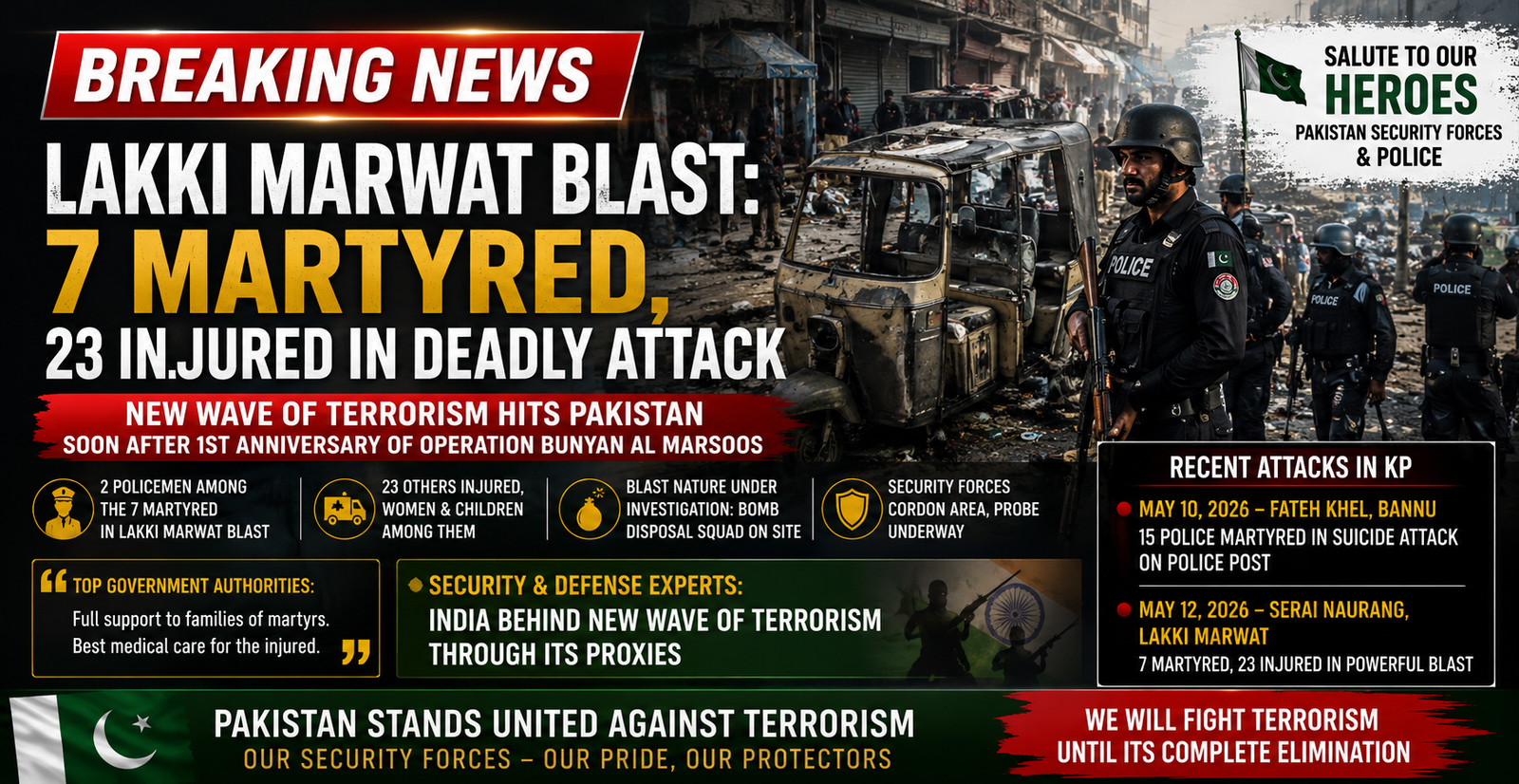
- Lakki Marwat blast martyres 7 people, including two brave policemen, as Pakistan faces renewed terrorism threat.
- 23 injured in explosion targeting busy traffic square in Serai Naurang tehsil, Khyber Pakhtunkhwa.
- Security forces and Bomb Disposal Squad launch investigation into nature of the attack.
- Experts link rising violence to coordinated proxy networks amid regional geopolitical tensions.
Lakki Marwat, Khyber Pakhtunkhwa — A fresh wave of terrorism has shaken Pakistan once again, just days after the nation marked the first anniversary of Operation Bunyan-ul-Marsoos, a landmark counter-terrorism campaign hailed by security institutions as a decisive blow against militant networks.
On Tuesday, at least seven people, including two brave police personnel, were martyred and 23 others injured in a powerful explosion in Serai Naurang tehsil of Lakki Marwat district. According to police, the blast tore through a busy square where traffic police were performing routine duties to regulate movement between Bannu and Dera Ismail Khan.
Lakki Marwat police spokesperson Qudratullah Khan confirmed the casualties, identifying the martyred officers as Adil Jan and Rahatullah. “Bodies have been shifted to the Tehsil Headquarters Hospital, while critically injured individuals, including a teenage girl and a woman, have been referred to Bannu for advanced treatment,” he said.
Pakistan Strikes with Precision: Operation Bunyān al-Mārsūs Redefines South Asian Deterrence
Authorities are still investigating whether the attack was carried out through a suicide bomber or an explosive-laden vehicle. Bomb Disposal Squad experts have cordoned off the area, collecting forensic evidence amid shattered shops and damaged three-wheelers, scenes that underscore the brutality of the attack.
Rescue 1122 spokesperson Shahdab Khan confirmed swift emergency response, stating that ambulances reached the site within minutes. “We urge citizens to stay away from the blast zone as clearance and rescue operations continue,” he said.
Bannu Police Attack on Anniversary of Marke-e-Haq Raises Questions Over Timing and Proxy Warfare
The incident has once again placed Pakistan’s security forces at the frontline of a renewed and evolving terror threat. The timing, coming immediately after the symbolic anniversary of Operation Bunyan al-Marsoos, has raised serious concerns within national security circles.
Pakistan’s security establishment has strongly responded, with senior officials reaffirming that the country’s armed forces and police remain fully committed to eliminating terrorism in all its forms. A senior security official, speaking on condition of anonymity, said, “This is not an isolated incident. We are witnessing a coordinated attempt to destabilize Pakistan after significant gains made during Operation Bunyan al-Marsoos.”
7 killed as blast targets police in NW Pakistan
He added that intelligence inputs suggest increased activity of proxy militant networks operating from across the border, coordinated to exploit internal vulnerabilities. “These groups are not acting alone. There are structured support systems behind them, and investigations are ongoing to trace external linkages,” he noted.
Defense analysts in Islamabad argue that the resurgence of attacks in Khyber Pakhtunkhwa reflects a broader regional proxy strategy. Security expert Mustansar Klasra stated, “Pakistan’s counter-terror gains have clearly unsettled hostile actors. Whenever Pakistan achieves stability through military success, we observe an uptick in asymmetric warfare through non-state proxies.”
US Attack on Iran Ships Pushes War Into Dangerous Phase, Triggers Global Oil Shock
Another analyst, Dr. Sarah Ahmed, emphasized the importance of understanding the geopolitical dimension. “We cannot ignore the regional context. Proxy warfare has long been a tool used in South Asia’s security environment. Pakistan’s forces are now dealing with both internal remnants of militancy and externally facilitated networks,” she said cautiously.
While Pakistan has not officially named any state actor, senior defense circles have repeatedly pointed to external intelligence involvement in sustaining proxy militant groups operating along the western border regions.
Chief Minister Khyber Pakhtunkhwa Sohail Afridi condemned the attack and sought an immediate report from the Inspector General of Police. He expressed deep sorrow over the loss of lives and directed authorities to ensure the best medical treatment for the injured. “The provincial government stands firmly with the families of the martyrs,” his statement said.
This latest attack follows the killing of 15 police personnel in a suicide assault on the Fateh Khel police post in Bannu just days earlier — underscoring a troubling escalation targeting Pakistan’s frontline security forces.
Despite the renewed violence, officials insist that Pakistan’s security apparatus remains resilient. “Our police and armed forces are the backbone of national stability. Every sacrifice strengthens our resolve,” a senior Interior Ministry official said.
As investigations continue, Pakistan faces yet another test in its long battle against terrorism — one that security experts say is now entering a new, more complex phase of hybrid and proxy warfare.