



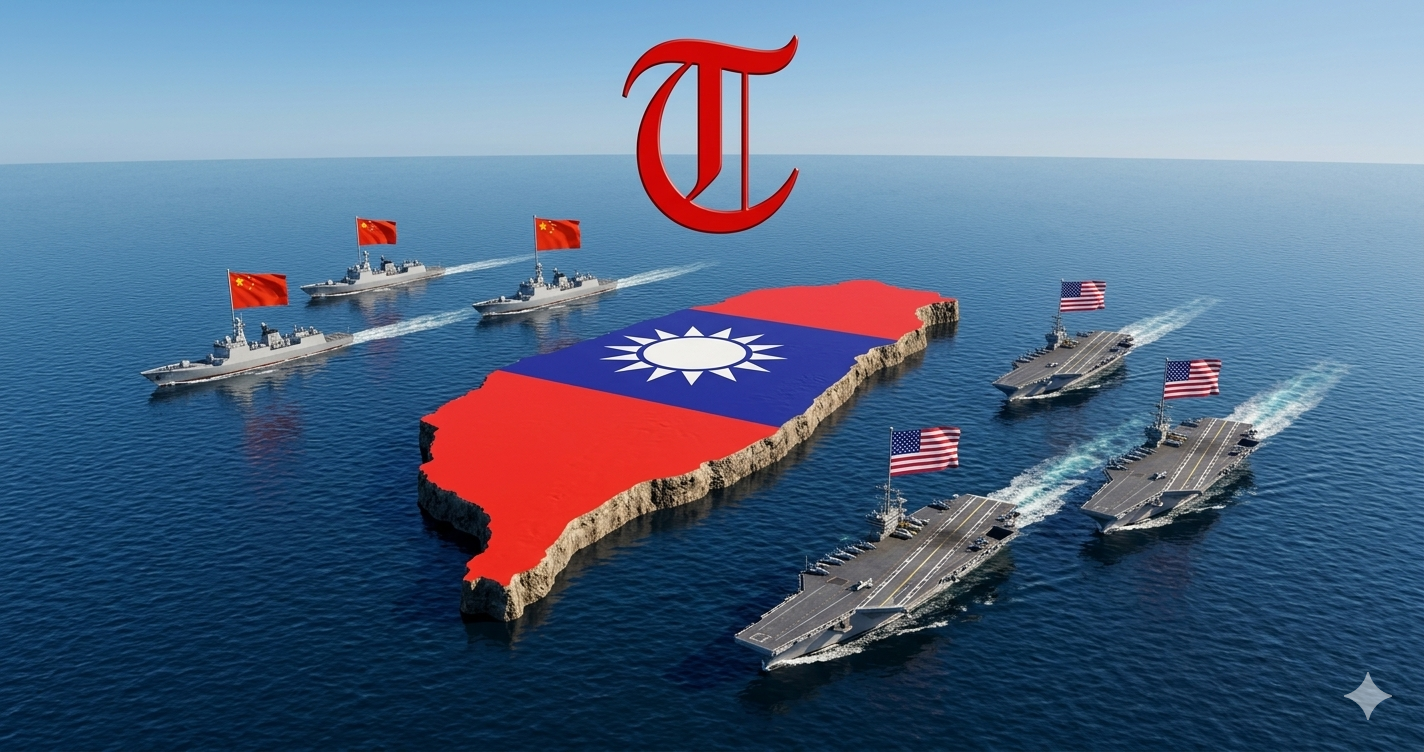
- Taiwan China conflict is shifting from military threats to political strategy
- China-Taiwan trade exceeds $260 billion despite rising tensions
- Taiwan dominates global semiconductor production through TSMC
- United States and Japan backing strengthens Taiwan’s deterrence posture
The Taiwan China conflict is entering a decisive new phase—one defined less by imminent war and more by calculated political maneuvering. While Beijing continues to assert its “One China” policy, widely acknowledged by most countries, Taiwan is pushing back with growing confidence, backed by the United States and Japan. The Taiwan China conflict is therefore evolving beyond traditional military confrontation into a broader geopolitical contest.
Taiwanese President Lai Ching-te has sharpened the Taiwan China conflict through his diplomatic outreach. His surprise visit to Eswatini—one of only 12 nations maintaining formal ties with Taipei—was both symbolic and strategic. Despite reported Chinese pressure on multiple countries to block his travel, Lai declared that Taiwan’s 23 million people have the right to engage globally. Beijing’s harsh response highlights how sensitive the Taiwan China conflict has become at the diplomatic level.
Yet the Taiwan China conflict is no longer defined solely by military threats. Unlike the United States’ direct interventions—from actions linked to Nicolás Maduro to tensions involving Iran—China is adopting a slower, more sophisticated approach. The Taiwan China conflict is increasingly shaped by political influence, economic leverage, and diplomatic isolation rather than immediate force.
A major development in the Taiwan China conflict is the recent engagement between mainland China and Taiwan’s opposition leadership. This landmark outreach signals Beijing’s intent to shape Taiwan’s internal politics. By building ties with opposition figures, China is attempting to influence electoral outcomes and public sentiment, redefining how the Taiwan China conflict may unfold in the coming years.
Economic Power vs Strategic Leverage in the Taiwan China Conflict
Economically, the Taiwan China conflict reflects a stark imbalance. China has a GDP exceeding $17 trillion, while Taiwan’s economy stands at roughly $790 billion. However, the Taiwan China conflict is complicated by Taiwan’s dominance in semiconductor manufacturing.
Sanae Takaichi Wins Two-Thirds Majority: Implications for Japan-China Tensions, South China Sea, and Taiwan Security
TSMC produces more than 50% of the world’s contract chips and nearly 90% of advanced semiconductors. This gives Taiwan critical leverage in the Taiwan China conflict, making it indispensable to global supply chains and advanced technologies.
Taiwan president defiant as begins Eswatini trip; China calls him a ‘rat’
Despite tensions, economic interdependence remains a defining feature of the Taiwan China conflict. Bilateral trade exceeds $260 billion annually, with China accounting for more than a quarter of Taiwan’s exports. This deep economic relationship both stabilizes and complicates the Taiwan China conflict.
Military Balance and Grey-Zone Tactics in the Taiwan China Conflict
Militarily, the Taiwan China conflict favors China. Its armed forces, especially the navy, have expanded rapidly, supported by advanced missile systems and modern air power. Taiwan, however, is adapting within the Taiwan China conflict by investing in asymmetric defense strategies such as mobile missiles, drones, and coastal systems.
Taiwan Geopolitical Crisis Deepens as U.S. Arms Deal Delays Expose Growing Risks of Global Conflict
The Taiwan China conflict is increasingly defined by grey-zone tactics. China’s regular activities—warplanes entering Taiwan’s air defense zone, naval deployments near key islands, and cyber operations—are designed to pressure Taiwan without triggering open war. These tactics are steadily reshaping the Taiwan China conflict.
Taiwan’s position in the Taiwan China conflict is strengthened by external support. The United States remains its main security partner, while Japan considers stability in the Taiwan Strait essential. This support reinforces deterrence in the Taiwan China conflict but also increases the risks of escalation.
Forecast: The Future of the Taiwan China Conflict
The Taiwan China conflict is unlikely to escalate into immediate full-scale war. Instead, Beijing appears focused on a long-term strategy centered on political influence and strategic pressure. The Taiwan China conflict could follow three main paths.
First, the Taiwan China conflict may remain in a prolonged status quo, with rising tensions but no direct confrontation. Second, political changes within Taiwan could shift the trajectory of the Taiwan China conflict toward renewed engagement with China. Third, a miscalculation could escalate the Taiwan China conflict into a broader regional crisis.
For now, China’s approach to the Taiwan China conflict reflects patience and strategic calculation. It is leveraging economic strength, diplomatic reach, and political influence to achieve its objectives. Taiwan, meanwhile, continues to strengthen its identity, alliances, and technological importance within the Taiwan China conflict.
Ultimately, the Taiwan China conflict is no longer just a territorial dispute. It has become a defining test of global power dynamics. How the Taiwan China conflict evolves will shape the future of Asia and influence the broader international order for decades to come.